

Maddy summaryHF 2717 increases funding for school safety programs in Minnesota by raising the minimum safe schools revenue for school districts to $100,000 or $44 per student (starting fiscal year 2026), and establishes "safe schools aid" to reimburse districts for safety costs. It expands this funding to cooperative school units (like shared service groups) starting in 2027, appropriating $4.354 million annually for cooperative units. Funds must be used for specific safety purposes including security personnel, mental health services, facility upgrades, violence prevention programs, and cybersecurity. The bill applies to all Minnesota school districts and cooperative units, with most provisions effective for fiscal year 2026.
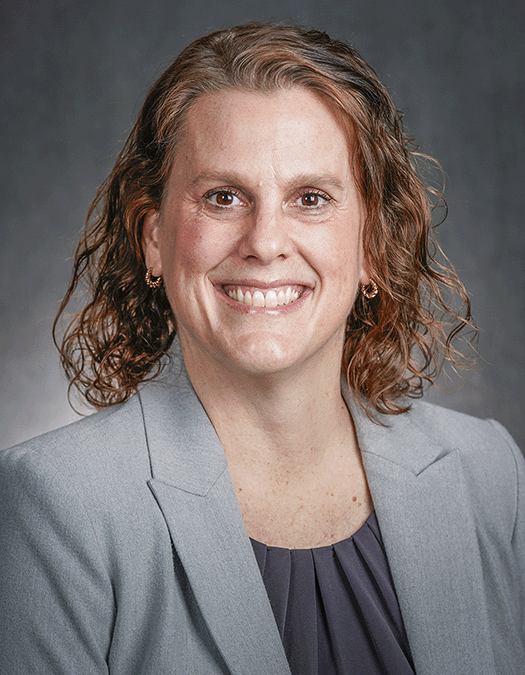
Rep. Kari Rehrauer
Sponsored bills
Maddy summaryHF 1624 establishes a $5 assessment on every mattress and box spring sold in Minnesota, paid by both producers (manufacturers) and retailers. The collected funds will go into a dedicated mattress recycling account, with money annually appropriated to the Pollution Control Agency. This agency will then award grants to local governments to expand and support their mattress recycling programs. The bill directly affects mattress/box spring sellers (through the assessment) and local governments (through grant funding), creating a new state-funded recycling infrastructure.
Maddy summaryHF 2705 modifies Minnesota's sales tax exemption for clothing, limiting the exemption to items priced at $150 or less per item. The bill defines "clothing" broadly to include standard apparel like jackets, shoes, diapers, and swimwear, but explicitly excludes accessories (e.g., handbags, jewelry), sports equipment (e.g., cleats, helmets), and protective gear (e.g., hard hats, safety glasses). It does not exempt items sold separately, such as belt buckles or costume masks, or materials that become part of clothing (e.g., zippers, fabric). The change takes effect for sales after September 30, 2025, directly affecting consumers purchasing clothing above the $150 price point and retailers applying the tax exemption.
Maddy summaryHF 2342 appropriates $1.5 million for each of fiscal years 2026 and 2027 to fund academic assistance programs through the Minnesota Alliance of Boys and Girls Clubs. The grant directly supports youth, particularly those needing the most academic help, by funding homework help, tutoring, the Exact Path personalized learning program (for K-12 math, reading, and language arts), literacy/STEM activities, mentorship, and attendance strategies. The recipient must provide a 25% nonstate funding match, and any unused 2026 funds carry over to 2027. This is a funding bill focused on concrete program support, not procedural changes.
Maddy summaryHF 2387 amends Minnesota Statutes § 124D.118 to establish a program allowing schools to provide free half-pint milk to students who do not participate in the full school lunch program. This directly affects public and nonpublic schools in Minnesota, enabling students to receive milk without needing to take a complete lunch, thereby reducing food waste from uneaten meals. The bill authorizes state reimbursement of 20 cents per milk serving for kindergarten students and up to 50 cents (or USDA rate) for lunch milk, with funding appropriated for fiscal years 2026 and 2027. Schools must follow commissioner-established guidelines to participate, focusing on daily milk access as a nutritional supplement.
Maddy summaryHF 1005 adjusts payment rates for healthcare providers under Minnesota's medical assistance program. It increases reimbursement rates for certain residential services, sets a new statewide rate for behavioral health home services, and adjusts physician professional service rates. These changes directly affect hospitals, clinics, and care providers receiving state medical assistance payments for these specific services. The bill amends existing statutes to implement these rate adjustments while requiring budget neutrality for hospital payments. It does not create new programs but modifies existing payment structures for covered services.
Maddy summaryHF 2773 appropriates $500,000 for fiscal year 2026 and $500,000 for fiscal year 2027 from the general fund to fund Lutheran Social Services' CORE program. The funding supports home-delivered meals for Minnesota veterans outside Hennepin and Ramsey Counties, along with technical assistance and outreach services for participating programs. The bill requires annual reports by September 1 detailing how funds were used and the number of veterans served. This one-time appropriation ensures direct support for veterans' meal access and program coordination, with transparency through mandatory reporting.
Maddy summaryHF 2847 establishes a statewide clean transportation standard requiring fuel providers in Minnesota to meet annual carbon intensity targets for transportation fuels. It creates a credit system where providers exceeding the standard earn credits (for lower emissions), while those falling short face deficits (requiring fees or credit purchases). The Department of Transportation will implement the program, requiring fuel providers to report emissions data using standardized calculations and enforce penalties for noncompliance. This directly affects companies supplying gasoline, diesel, and alternative fuels in Minnesota, mandating annual reductions in carbon intensity across all transportation fuel pathways.
Maddy summaryHF 1083 amends Minnesota law to prohibit domestic abuse advocates (such as counselors or shelter staff) from disclosing certain client information without consent. The bill specifically states that these advocates cannot share information acquired during professional services, except when the client provides written consent, a crime is involved, or the client sues the advocate. This directly affects domestic abuse survivors seeking help and the advocates who support them. The change updates Minnesota Statutes 595.02 to add this restriction, aligning with existing confidentiality rules for other professionals like social workers and counselors.
Maddy summaryHF 2325 requires Minnesota employers to pay non-exempt employees at least 1.5 times their regular hourly rate for work performed on designated holidays. The bill directly affects hourly workers in Minnesota who are scheduled to work on holidays defined under Minnesota Statutes section 645.44, subdivision 5. It amends existing law (Minnesota Statutes 2024, section 177.25) to add a new provision mandating this overtime pay rate specifically for holiday work. This changes the current standard by explicitly requiring higher pay for holiday shifts, rather than allowing employers to use alternative compensation methods. The bill does not change the definition of "holiday" but specifies the required pay rate when work occurs on those days.