

Maddy summaryThis is a symbolic resolution, not a law. Minnesota's legislature formally urges the President to respect and comply with federal court rulings, specifically referencing the Trump administration's refusal to follow a court order regarding an immigration case. The resolution directs Minnesota's Secretary of State to send copies to the President, Congress, and Minnesota's congressional delegation. It has no legal effect but serves as a formal statement supporting judicial independence.
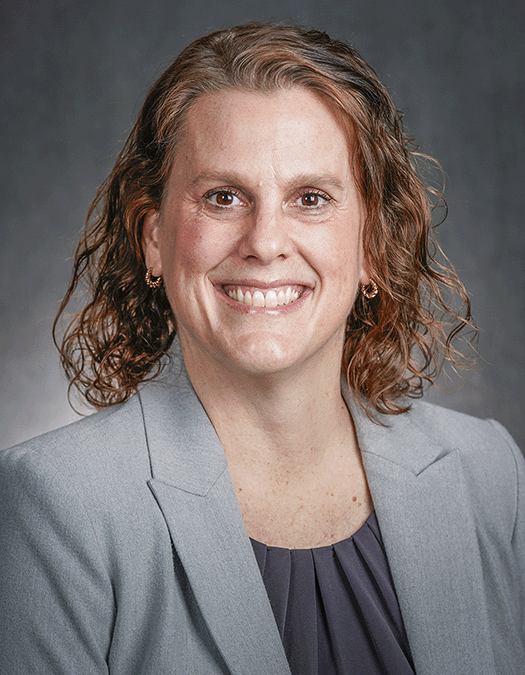
Rep. Kari Rehrauer
Sponsored bills
Maddy summaryHF 2341 allows teachers with 30 years of service to retire at age 60 without a reduced pension, modifying early retirement rules. It increases employer contributions to the Teachers Retirement Association from 13.3% to 13.5% for coordinated members and 17.3% to 17.5% for basic members after June 2025. The bill also raises postretirement adjustments and removes delays for these adjustments for early retirees. These changes directly affect Minnesota teachers and school districts, which will pay higher pension contributions starting July 2025.
Maddy summaryHF 3292 requires Minnesota to study how U.S. tariffs and retaliatory tariffs from other countries impact state households and businesses. The bill appropriates funds to the commissioner of management and budget to examine these economic effects, specifically breaking down impacts by household income level and business sector/size. The study must be completed and reported to legislative committees by February 1, 2026. This bill directly affects all Minnesotans and businesses through the mandated analysis of existing tariff policies.
Maddy summaryHF 1660 requires Minnesota's Commissioner of Children, Youth, and Families to conduct a statewide assessment of out-of-school youth programs for children and teens under 21. The commissioner must gather data on current programs, funding, and populations served, while engaging youth, families, and community providers to identify barriers and gaps. By February 2026, the commissioner must submit a report with findings and recommendations to legislative committees, including proposals to improve access and quality. The bill appropriates a one-time $ amount in fiscal year 2026 specifically for this assessment and reporting process.
Maddy summaryHF 1289 requires social media platforms operating in Minnesota to display a mental health warning label each time a user accesses the platform. The label must warn of potential negative mental health impacts, include resources like the 988 Suicide Lifeline, and remain visible until the user exits or acknowledges the warning. The bill also mandates that platforms show a pop-up timer notification every 30 minutes (customizable up to 60 minutes) tracking daily active usage time, which users must acknowledge before dismissing. These requirements apply to all covered social media platforms and take effect July 1, 2025. The law does not create private lawsuits but allows the attorney general to enforce it.
Maddy summaryThis bill (HF 3262) removes the requirement for teacher candidates to complete the edTPA performance assessment (Section 1) and mandates that student teachers be placed within 30 miles of their preferred location or school site (Section 2). It directly affects teacher candidates, teacher preparation programs, and the Professional Educator Licensing and Standards Board. The bill requires the Board to amend state rules to eliminate the edTPA requirement and to establish the 30-mile placement rule, with exceptions only if both the program and candidate agree to a different placement. These changes represent concrete policy shifts in teacher education requirements.
Maddy summaryHF 382 modifies how Minnesota calculates wage rates for staff in disability waiver programs, directly affecting providers serving people with disabilities and their employees. The bill establishes new percentage-based formulas using median wages for specific job titles (e.g., 15% of home health aide wages + 30% of nursing assistant wages for residential direct care staff) instead of previous calculations. It affects 17 staff categories including residential care, employment support, and positive supports roles. The changes take effect January 1, 2026, or after federal approval, and amend Minnesota Statutes 256B.4914.
Maddy summaryHF 3281 requires Minnesota's Department of Health to hire a public health school health services consultant. The consultant must be a registered nurse with specific Minnesota licensure, three years of school nursing experience, and expertise in school health for children and adolescents. This position will develop policies, support school health professionals through training and resources, and improve coordination between schools, health centers, and agencies. The bill directly affects the Department of Health (which must hire the consultant), school nurses, and school health professionals statewide. It focuses on enhancing health services and educational outcomes for students in schools through structured support and resource development.
Maddy summaryHF 3280 requires the Minnesota Pollution Control Agency to study the costs of producing sustainable aviation fuel (SAF) using captured carbon dioxide from wastewater treatment and green hydrogen. The bill mandates two key studies: one to design infrastructure capturing CO2 emissions at a St. Paul wastewater facility, and another to assess building a facility combining that CO2 with on-site green hydrogen for SAF production. By June 2029, the agency must report on capital/operating costs, projected jobs, and annual SAF output potential relative to Minneapolis-St. Paul International Airport's needs. The bill appropriates $300,000 from the general fund to cover these studies and the required report, effective upon enactment.
Maddy summaryHF 3294 is a non-binding resolution passed by the Minnesota House of Representatives. It urges the President and Congress to fully fund Medicaid and oppose federal funding cuts, directly affecting Minnesota's 1.2 million Medicaid beneficiaries - including children (41% covered), seniors, people with disabilities, and communities of color (covering 80-90% of Black and American Indian births). The resolution has no new funding mechanisms or state policy changes; it solely requests federal action. It does not impose new requirements or alter existing Medicaid programs.