

Maddy summaryHF 3184 repeals Minnesota Statutes section 471.9998, which previously prohibited local governments (like cities and counties) from banning paper, plastic, or reusable bags. This bill removes a state-level barrier, allowing municipalities to implement their own bag ban policies if they choose. The repeal directly affects local governments, which can now pass ordinances restricting bag use, and merchants who may face new local requirements. It does not create new bag bans but enables local decision-making on the issue.
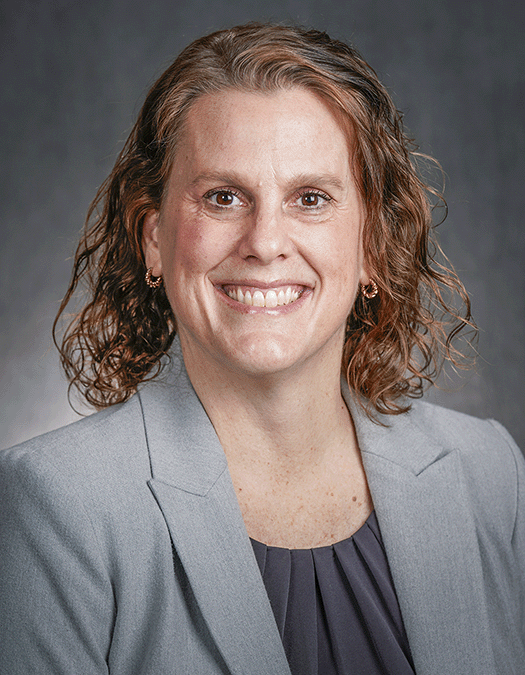
Rep. Kari Rehrauer
Sponsored bills
Maddy summaryHF 2309 amends Minnesota's housing statutes to expand access to rental assistance and housing aid. It removes funding restrictions for workforce housing projects, clarifies eligible uses for housing aid funds, and expands eligibility for rental assistance programs to include more low-income households. The bill modifies rules about who can receive funding (removing certain disqualification criteria for individuals and businesses) and requires program administrators to prioritize households with children and incomes up to 30% of area median income. These changes directly affect low-income renters, housing providers, and local housing programs administering state and federal housing assistance.
Maddy summaryHF 1278 establishes a one-time $30 million reproductive health equity grant fund to support abortion care access in Minnesota. The bill provides funding to abortion providers, government agencies, and nonprofits whose primary work involves abortion care, with grants designed to increase access, cover uncompensated care for low-income patients, secure facility infrastructure, and fund staff training in trauma-informed care. Eligible organizations must apply through the commissioner of health, who will prioritize applications based on local need, health equity impact, and applicant need. The fund becomes effective July 1, 2025, with grants to begin by January 1, 2026, and includes strict privacy protections requiring confidentiality of patient information.
Maddy summaryHF 2289 requires Minnesota hospitals to maintain registered nurse staffing levels consistent with nationally accepted standards, ensuring adequate care for patients. Hospitals must create and implement staffing plans specifying maximum patient-to-nurse ratios for each unit, developed with input from direct-care registered nurses, and report these levels to the state. The bill prohibits retaliation against nurses who raise staffing concerns and imposes civil penalties for noncompliance. It directly affects all licensed Minnesota hospitals, their nursing staff, and patients by mandating safer staffing practices. The law appropriates funding to support implementation of these requirements.
Maddy summaryHF 1653 appropriates $1 million from state bonds to fund electric bus charging stations for school buses statewide. The bill directs the commissioner of commerce to provide grants to eligible school districts or public transit agencies under Minnesota Statutes §216C.374, specifically for installing Level 2 and Level 3 charging infrastructure. Funding comes from bonds sold by the state under established procedures, with grants awarded through the existing electric school bus deployment program. This measure directly affects school transportation systems seeking to transition to electric fleets, effective upon final enactment.
Maddy summaryHF 3231 amends Minnesota's charter school laws to modify authorizer responsibilities and board membership rules. It requires charter school authorizers (like school districts or independent entities) to document annual staff training on chartering and their duties in annual reports, and mandates they complete department-approved training each year. The bill also tightens board membership requirements for charter schools, prohibiting contractors, employees of the school, or individuals with conflicts of interest (like family members employed by the school) from serving on boards. These changes directly affect charter school authorizers and the boards of individual charter schools. The bill focuses on procedural oversight, not funding or curriculum changes.
Maddy summaryHF 3221 establishes a legislative study group to examine Minnesota's high school graduation credit requirements. The group, composed of eight legislators (four House, four Senate) appointed by leadership, must study current requirements, consider flexible pathways for student readiness, teacher licensure, and workforce alignment, and recommend changes by December 2026. The bill appropriates $64,000 for 2026 and $64,000 for 2027 to support the study group's work through the Legislative Coordinating Commission. The group must submit a preliminary report by December 2025 and a final report by December 2026, with the study group expiring after the final report is submitted or December 31, 2026. This bill directly affects how graduation requirements may be reviewed and potentially changed for Minnesota students.
Maddy summaryHF 3017 appropriates $1 million from the general fund for a nonprofit organization, Guns Down Love Up, to acquire property for a retreat center specifically for victims of gun violence. The funds are designated for property acquisition only, not for operating the center, and must be spent within the fiscal year 2026 timeframe. This bill directly affects individuals who have experienced gun violence by providing funding for a dedicated support space. The appropriation is subject to standard state fiscal rules and becomes effective upon final enactment.
Maddy summaryHF 2339 increases Minnesota's income threshold for the child tax credit, allowing more families to qualify for the full benefit before credits begin phasing out. The bill raises the phaseout threshold from $35,000 to $45,490 for married couples filing jointly and from $29,500 to $38,340 for other filers. This change directly affects Minnesota taxpayers with children who file individual income tax returns, as it prevents the credit from decreasing at lower income levels. The bill also requires future annual inflation adjustments to these thresholds starting in 2026.
Maddy summaryHF 2903 appropriates $1 million from Minnesota's general fund for fiscal year 2026 to fund transitional housing projects. The commissioner of human services will distribute grants to eligible organizations to renovate existing facilities into transitional housing, improve current transitional housing sites, construct new sites, or enhance safety and accessibility at existing sites. This one-time funding directly supports housing providers and individuals experiencing homelessness by expanding access to safe, habitable transitional housing. The bill specifies concrete uses for the funds but does not create new eligibility requirements beyond existing statutory provisions.