

Maddy summaryHF 1845 expands Minnesota's definition of "veteran" to include two specific groups: (1) Hmong veterans naturalized under the federal Hmong Veterans' Naturalization Act of 2000, and (2) individuals who served honorably with secret guerrilla units or irregular forces operating from Laos in support of U.S. forces between February 28, 1961, and May 14, 1975. The bill amends Minnesota Statutes section 197.447 to add these categories to the existing definition, ensuring these veterans qualify for state benefits. It also creates an advisory task force of veterans, experts, and community members to help determine eligibility under the new definition. This change directly affects Hmong veterans and Laotian-based veterans who previously may not have met Minnesota's veteran criteria.
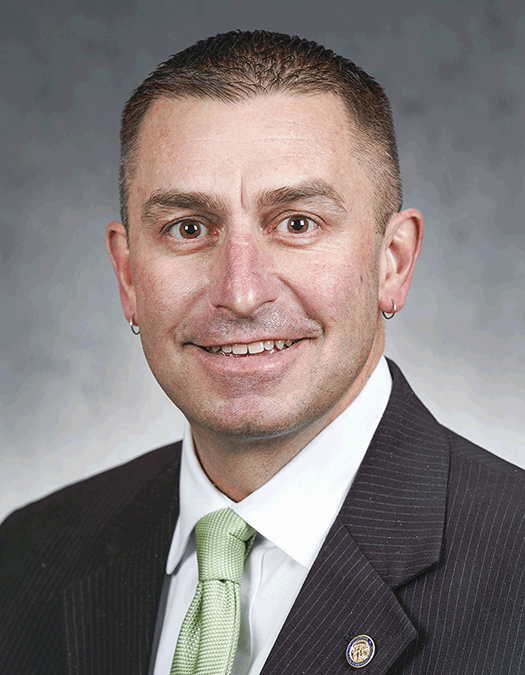
Rep. Josiah Hill
Sponsored bills
Maddy summaryHF 2352 increases funding for Minnesota schools offering approved recovery programs that support students recovering from substance abuse. It raises the maximum annual grant per program from $125,000 to $325,000 to cover costs for recovery staff, student support, and approved transportation. The bill appropriates $1.95 million for fiscal year 2026 and $1.95 million for 2027, with unused 2026 funds carrying over to 2027. These changes apply to programs recognized by the state and take effect starting in 2026.
Maddy summaryHF 2043 appropriates $250,000 from the general fund to the Minnesota Department of Education for a three-year student attendance marketing campaign. The campaign must raise awareness about attendance importance and absenteeism consequences, address barriers to school attendance, and be inclusive for all public school students. The Department must issue a request for proposals, award contracts to organizations with proven outreach capacity, and require post-campaign reports detailing goals, strategies, outcomes, and fund usage. This one-time funding is available only for fiscal year 2026 and expires June 30, 2028.
Maddy summaryHF 1582 modifies Minnesota's Teachers Retirement Association (TRA) benefits for educators. It allows teachers with 30 years of service to retire at age 60 without reduced annuity payments (previously requiring 35 years), adjusts early retirement penalties, and increases postretirement cost-of-living adjustments. The bill also raises employer contribution rates for school districts (from 13.3% to 17.3% for basic members) and increases pension adjustment revenue rates for school districts starting in 2026. These changes directly affect current and future TRA members, school districts funding retirement costs, and the state's retirement system budget.
Maddy summaryHF 2072 provides $10 million in one-time state funding for Minnesota's Community Energy Transition Grant Program, which supports local communities in developing projects for cleaner energy and energy efficiency. The funds, drawn from the general state budget for fiscal year 2026, are available until June 30, 2028, and will be managed by the commissioner of employment and economic development. This appropriation does not change the program's existing rules but ensures financial resources for eligible community initiatives under Minnesota Statutes section 116J.55.
Maddy summaryThis bill appropriates $238,000 for fiscal year 2026 and $238,000 for fiscal year 2027 from the workforce development fund to support the Minnesota Helmets to Hardhats program. The funds will help Building Strong Communities connect National Guard members, military reservists, active duty personnel, and veterans to construction industry apprenticeships and career training through the Department of Labor and Industry. The program must not discriminate based on protected characteristics like race, religion, or gender. It directly affects military-connected individuals seeking careers in building and construction trades.
Maddy summaryHF 1866 modifies how Minnesota school library aid funds can be spent. The bill specifies that these funds must directly cover: salaries for library media specialists, electronic/computer equipment, IT infrastructure, digital resources, and library furniture/supplies. It updates Minnesota Statutes section 124D.992 to clarify these allowable uses, replacing previous language. The changes take effect for fiscal year 2026 and later.
Maddy summaryHF 1762 proposes adding a new constitutional amendment to Minnesota's state constitution. If approved by voters, it would guarantee all persons equal rights under state law and prohibit discrimination based on race, color, national origin, ancestry, disability, or sex - including protections for pregnancy decisions, gender identity, gender expression, and sexual orientation. The amendment would apply to all state actions and agencies, requiring any discriminatory state action to be the "least restrictive means" of achieving a "compelling governmental interest." The proposed amendment must be submitted to voters in the 2026 general election, with implementation starting January 1, 2027, if ratified.
Maddy summaryHF 1757 requires anyone who owns, possesses, or controls a firearm to report a loss or theft to local law enforcement within 48 hours. Failure to report can result in escalating penalties, starting with a minor offense for the first violation and increasing to a gross misdemeanor for repeated failures. The bill also provides immunity from prosecution for storage-related offenses if the report is made on time and mandates that law enforcement agencies report lost or stolen firearms to the state commissioner within seven days. Additionally, the bill appropriates $36,000 for a one-time implementation of a reporting system to support these requirements.
Maddy summaryHF 1828 implements recommendations from the state auditor's fire relief association working group by requiring Minnesota firefighters' relief associations to prepare detailed annual financial statements. These statements must show all income, expenses, assets, and liabilities in a format set by the state auditor and be certified by an independent CPA with at least five years of public accounting experience (not affiliated with the association). The associations must submit these certified statements to the state auditor by June 30 each year, with the requirement effective January 1, 2026. The bill directly affects all firefighters' relief associations operating under Minnesota law.