

Maddy summaryHF 2741 transfers grant programs focused on increasing racial and ethnic diversity in Minnesota's teaching workforce from the Professional Educator Licensing and Standards Board (PELSB) to the Department of Education. It requires the Department of Education to produce annual reports by November 3 (starting in 2025) detailing all state-funded programs aimed at recruiting, preparing, and retaining teachers of color and American Indian teachers, including their effectiveness and policy recommendations. The bill also modifies teacher licensure rules, including new requirements for paraprofessional credentials and training standards. These changes directly affect school districts, teacher training programs, and the PELS Board, which will no longer administer these grant programs. The legislation appropriates funds to support these administrative shifts and reporting obligations.
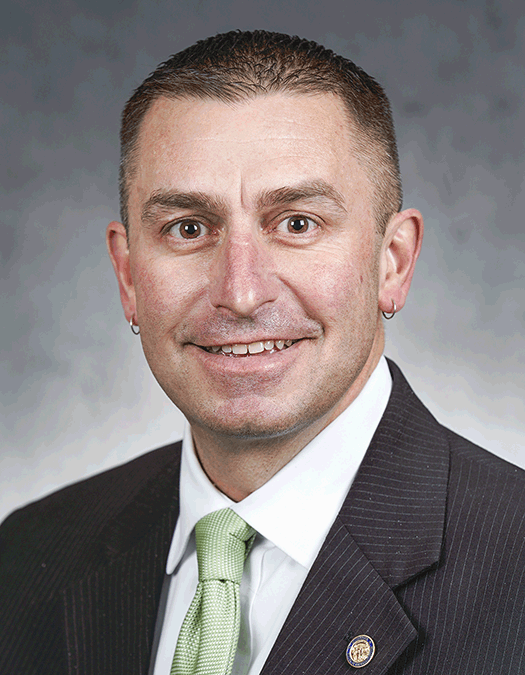
Rep. Josiah Hill
Sponsored bills
Maddy summaryHF 745 modifies how Minnesota school districts calculate compensatory revenue eligibility for low-income students, requiring districts to count children eligible through both direct certification (like SNAP benefits) and education benefits (such as school meal programs) as of October 1 each year. It adjusts spending rules, requiring at least 80% of compensatory revenue to be spent at individual school sites (with a temporary 40% allowance for 2026-2027 if meal program data is incomplete) and mandates reporting for adjustments due to enrollment changes. The bill establishes a Compensatory Revenue Task Force, composed of education officials, school board representatives, and parent advocates, to analyze the funding formula and make recommendations. It appropriates funds for these changes and takes effect for fiscal year 2026.
Maddy summaryHF 1377 appropriates $1.75 million annually (2026-2027) for matching grants, $350,000 annually for equipment grants, and $1 million annually for block grants to Minnesota public television stations. The bill directs the commissioner of administration to allocate these funds based on recommendations from the Minnesota Public Television Association. It directly affects public television stations eligible under Minnesota Statutes, section 129D.13, by providing dedicated state funding for operational support and equipment. The funding is sourced from the general fund and applies specifically to fiscal years 2026 and 2027.
Maddy summaryHF 2502 modifies Minnesota's child tax credit to reduce the "marriage penalty" by raising the income level at which the credit begins to phase out for married couples filing jointly. The bill increases the phaseout threshold from $35,000 to $63,900 for joint filers (while slightly raising the threshold for other filers to $31,950), meaning married couples will retain more of their child credit at lower income levels. This change directly affects married Minnesota taxpayers filing jointly who currently lose credit benefits at lower incomes than single filers. The adjustment takes effect for taxable years beginning after December 31, 2024, and includes automatic inflation adjustments starting in 2025.
Maddy summaryHF 982 creates a new education benefit in Minnesota for dependents of disabled veterans. It provides full tuition, mandatory fees, and book coverage (after subtracting other aid) for dependents of veterans with a 100% permanent disability, and 50% coverage for dependents of veterans with a 70%+ disability rating. The benefit applies to undergraduate programs at Minnesota state colleges, universities, or the University of Minnesota Board of Regents institutions. Eligible students must be enrolled at these institutions, and institutions apply for the benefit on their behalf through the Office of Higher Education.
Maddy summaryHF 2210 allocates $105 million from the general fund to the Minnesota Department of Education for school unemployment aid under existing law (Minnesota Statutes § 124D.995). This one-time funding directly supports school districts and employees eligible for unemployment benefits during school-related layoffs. The bill provides no new policy changes but ensures existing unemployment aid programs receive additional financial resources for the 2026 fiscal year.
Maddy summaryHF 1538 provides state funding from the workforce development fund for teacher apprenticeship programs in Minnesota for fiscal years 2026 and 2027. It requires school districts to develop programs meeting five specific standards: school district involvement, mentorship, approved training, wage increases tied to skill levels, and a pathway to a Tier 3 teaching license. School districts, higher education institutions, and charter schools can partner to create these programs and use the funds to reimburse costs. The bill also mandates a report to legislative committees on how the funds were used and recommendations for improving the program as a pathway to teacher licensure, effective July 1, 2025.
Maddy summaryHF 1361 appropriates $8 million from state bond proceeds to fund improvements at CHS Field in St. Paul. The city of St. Paul will receive the grant to cover predesign, construction, and equipment for upgrades meeting Major League Baseball standards, including a new locker room, enhanced visitor amenities, and environmental remediation of contaminated soil. The state will issue bonds up to $8 million to fund this appropriation, following Minnesota's bond sale procedures. This bill directly affects CHS Field's operations and the city's ability to modernize the stadium.
Maddy summaryHF 491 appropriates $250,000 for fiscal year 2026 and $250,000 for fiscal year 2027 from the general fund to provide grants to Hometown Hero Outdoors, a Stillwater-based nonprofit. The funding supports mental health services and outdoor recreational activities for current and former law enforcement officers, firefighters, and emergency medical services personnel. The bill directs these services to promote positive mental health, longevity, quality of life, and interactions with mental health professionals through organized outdoor programs. It does not create new policy but allocates specific funds to an existing nonprofit for targeted support of first responders.
Maddy summaryHF 492 appropriates $250,000 for fiscal year 2026 and $250,000 for fiscal year 2027 from the general fund to fund mental health services and outdoor recreational activities for currently serving military personnel and veterans in Minnesota. The funds are directed to Hometown Hero Outdoors, a Stillwater-based nonprofit, to support programs promoting mental wellness, community interaction with professionals, and quality of life through outdoor engagement. This bill specifically provides dedicated funding for an existing nonprofit's established services rather than creating new state programs. It directly affects military members and veterans by expanding access to mental health support and outdoor activities through this designated organization. The appropriation is limited to these specific fiscal years and services as outlined in the bill.