

Maddy summaryHF 3741 modifies Minnesota's educational assistance program for veterans' families, providing an annual $750 stipend for eligible children and spouses of veterans. It affects children and spouses of deceased veterans (including those who died in service), prisoners of war, or missing in action personnel who meet residency requirements and maintain satisfactory academic progress at Minnesota public institutions. The bill specifies the stipend cannot be used by individuals who have already earned a bachelor's degree. It updates definitions to clarify eligibility criteria and repeals an outdated provision, ensuring funds are directed to qualifying family members pursuing higher education in Minnesota.

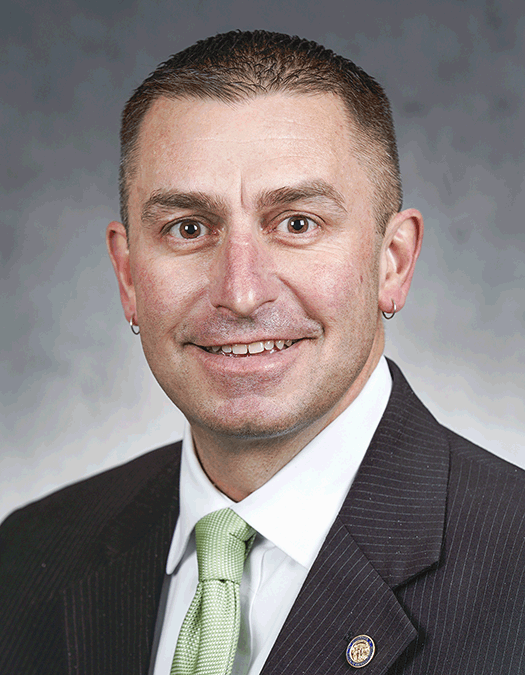
Rep. Josiah Hill
Sponsored bills
Maddy summaryHF 3467 allows Minnesota's Commissioner of Veterans Affairs to redirect agency resources toward specific veterans' initiatives, including addressing food insecurity, homelessness, and suicide prevention. The bill requires the commissioner to submit an annual report by October 15 to the governor and relevant legislative committees, detailing resources used and the critical issues supported in the previous year. This legislation directly affects veterans by enabling targeted support for urgent needs through state agency resources. It creates a formal mechanism for tracking how funds and resources are allocated to veterans' programs. The bill is currently in its initial legislative stage, having been introduced on February 19, 2026.
Maddy summaryThis bill modifies how Minnesota calculates registration taxes for passenger automobiles and hearses, directly affecting vehicle owners and dealers. It establishes a new tax rate of 1.575 percent based on the manufacturer's suggested retail price for vehicles registered on or after November 16, 2020, while maintaining a slightly lower rate for older registrations. The legislation introduces a tiered tax devaluation schedule that reduces the taxable value of a vehicle by a specific percentage each year it remains in use, with the reduction amount varying depending on the vehicle's price range. Additionally, the bill clarifies that the tax calculation excludes the cost of optional accessories and destination charges, except for pre-2020 registrations.
Maddy summaryThis bill repeals a previous requirement that reduced special education funding by $250 million starting in the 2027-2028 school year. The legislation directly affects the state's education finance system and the Department of Education by removing the mandate to cut special education aid appropriations. Under this bill, the commissioner of management and budget will no longer be required to assume the $250 million reduction when preparing state revenue forecasts, and the commissioner of education will not need to adjust the special education cross subsidy aid factor to make up any shortfall. The change takes effect on July 1, 2026, restoring the previous funding structure for special education aid.
Maddy summaryThis bill appropriates $1,925,000 from Minnesota's general fund to support the operations of five public television stations in Greater Minnesota for fiscal year 2026. The funding is distributed as specific grants to Pioneer PBS, Lakeland PBS, KSMQ, PBS North, and Prairie Public television, with amounts ranging from $200,000 to $650,000 for each station. The legislation takes effect the day after it is officially enacted and directs the commissioner of administration to manage the distribution of these funds.
Maddy summaryThis bill modifies how disability benefits are reduced for Minnesota police, firefighter, and paramedic members who started receiving disability payments before July 1, 2023, when they return to work. It changes the calculation method for reducing disability benefits when these members earn income from other employment, ensuring the reduction applies consistently to those who began disability before the specified date. The legislation updates existing rules to clarify how much disability benefits decrease based on reemployment earnings, using a dollar-for-dollar reduction ratio for certain service levels and a tiered approach for others. This change affects only current disability recipients who started their benefits prior to the July 1, 2023 cutoff, while members who began receiving benefits on or after that date remain subject to previously established reduction rules.
Maddy summaryThis bill repeals previous tax exemptions that allowed certain preferred seats and amenities at athletic events to be sold without sales tax. It also provides funding for safe harbor shelter and housing grants to support individuals experiencing homelessness. By removing the exemptions, the legislation ensures that these specific stadium seats and related amenities are now subject to standard sales tax like other retail items. The funding provision aims to allocate state money directly to organizations assisting with shelter and housing needs.
Maddy summaryThis bill modifies the rules for the St. Paul Teachers Retirement Fund Association and adjusts pension funding for Independent School District No. 625. It increases the pension adjustment rate for ISD 625 to 5.95% for fiscal year 2027 and later, while setting a lower rate of 1.25% for other districts starting in 2025. Additionally, the legislation raises employee contribution rates for the basic program to 11.25% in 2026 and 11.5% thereafter, and adjusts employer contribution rates for coordinated members. These changes take effect on July 1, 2026, with specific provisions for pension revenue calculations beginning in fiscal year 2027.
Maddy summaryThis bill prohibits large food retail stores in Minnesota from using surveillance technology to set personalized prices for individual customers. It bans the use of electronic shelving labels and prevents stores from collecting data on shoppers under 17 years old or using protected class information like race or gender to determine pricing. The law applies to grocery stores over 10,000 square feet or larger stores with significant food sales, while excluding financial institutions and insurance companies from its requirements.
Maddy summaryThis bill clarifies laws regarding public waters and public drainage systems in Minnesota to streamline repair processes and reduce regulatory burdens. It allows drainage authorities to proceed with repairs without commissioner approval when existing records are available, while requiring a notification process and a 60-day review period for repairs lacking such records. The legislation also expands the list of activities that do not require a public-waters-work permit, specifically adding repairs to lawfully established drainage systems and culvert replacements that do not impact trout streams. Additionally, it mandates that the state consider designated wetlands as part of existing drainage systems if their management interferes with authorized drainage functions.