

Maddy summaryThis bill establishes a grant program to provide funding for student and staff safety improvements at schools. The Department of Public Safety's School Safety Center will distribute these grants to qualifying public, charter, and nonpublic schools. Each eligible school may receive up to $500,000 for authorized safety projects, provided they demonstrate additional funding sources. The legislation requires that at least half of the grants be awarded to schools located outside the seven-county metropolitan area. Funding is allocated from the state general fund for fiscal year 2027 and remains available until June 30, 2029.
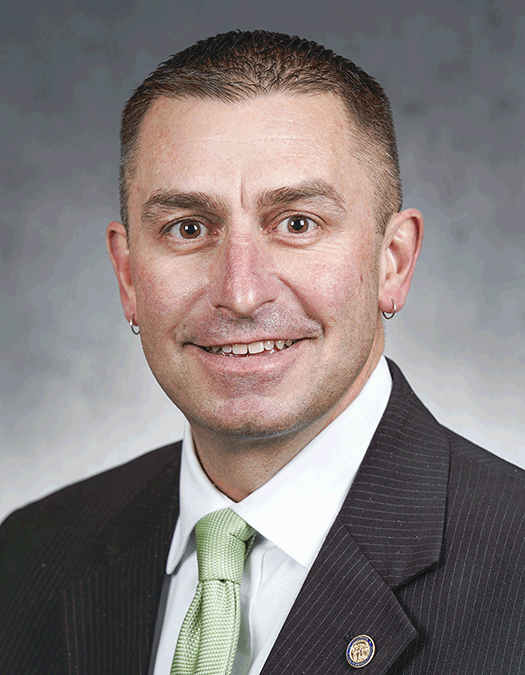
Rep. Josiah Hill
Sponsored bills
Maddy summaryThis resolution formally condemns Hinduphobia and anti-Hindu bigotry while reaffirming Minnesota's commitment to religious freedom and inclusion. It directs state agencies, educational institutions, and law enforcement to enhance their understanding of Hinduphobia and include the Hindu community in diversity initiatives and anti-bias training. The bill also calls on the attorney general and state employees to enforce existing anti-discrimination laws to protect the Hindu community. This is a symbolic resolution that does not create new laws or funding but expresses legislative support for religious tolerance and encourages proactive measures against discrimination.
Maddy summaryThis bill requires regulators in Minnesota to accept specific, recent evidence when checking if a property's subsurface sewage treatment system is working correctly. It mandates that officials use the most reliable data available, such as lab-tested groundwater samples or measurements of soil depth, provided the results are less than two years old. Property owners can now submit these existing records to prove compliance without undergoing new, potentially invasive testing, as long as the agency follows a set priority for which data to trust. Additionally, the law ensures that owners are notified of their rights at least 90 days before any official notice of noncompliance is issued.
Maddy summaryThis bill authorizes the issuance of up to $5.5 million in state bonds to fund road improvements at the intersection of U.S. Highway 61 and Washington County State-Aid Highway 32 in Forest Lake. The allocated money will be used for preliminary and final design, engineering, land acquisition, and construction of a roundabout and related traffic safety enhancements. Once approved, the state will sell these bonds to generate the necessary funds, which must be deposited into a specific highway fund account before being spent on the project. The legislation takes effect immediately upon final passage by the legislature.
Maddy summaryThis bill requires Minnesota school districts and charter schools to adopt evidence-based safety plans that are developed with input from students, parents, teachers, and law enforcement. It establishes a new anonymous threat reporting system and creates a School Safety Center at the Department of Public Safety to provide model plans and consulting services to schools. The legislation also modifies rules regarding when firearms are allowed on school property and provides additional funding for student support personnel.
Maddy summaryThis bill repeals a previous requirement that assumed a $250 million reduction in special education funding for the 2027-2028 biennium and subsequent years. Under the new provisions, the state commissioner of management and budget will no longer be required to forecast this specific funding cut when preparing revenue and expenditure forecasts. The legislation also removes the mandate that the legislature must identify enacted provisions from the Blue Ribbon Commission on Special Education to offset the assumed funding reduction. If savings from those provisions fall short of $250 million, the commissioner of education would no longer be required to reduce the special education cross subsidy aid factor to make up the difference. The changes take effect the day following final enactment of the bill.
Maddy summaryThis bill requires Minnesota state agencies to pay certain interns at least $15 per hour. It applies specifically to interns who qualify for federal Pell Grants based on financial need and are enrolled full-time (nine semester credits or equivalent) in school. The law excludes interns already eligible for unpaid positions under federal labor rules. It defines "state intern" broadly to include those working in executive, legislative, or judicial branch roles. The policy directly affects student interns in state government positions meeting these financial and enrollment criteria.
Maddy summaryHF 3119 establishes minimum pay standards for Minnesota teachers and certain unlicensed school staff starting July 1, 2026. It sets teacher compensation thresholds at $60,000-$100,000 annually (based on education and experience) and a $25 hourly wage floor for unlicensed staff who regularly interact with students. The bill requires annual inflation adjustments using the Consumer Price Index, beginning in 2030, and creates state aid programs to help school districts cover these costs. School districts, charter schools, and other public education entities directly affected must meet these standards or receive state funding to do so.
Maddy summaryThis bill (HF 3556) is a naming resolution that commemorates Melissa Hortman by designating Minnesota's community solar garden program as the "Melissa Hortman Community Solar Garden Program." It does not change any program rules, funding, or operations - it only adds a short title to Minnesota Statutes section 216B.1641. The bill directly honors Melissa Hortman, a former state legislator, through this naming. It is procedural and has no policy impact beyond the name change.
Maddy summaryThis bill modifies how Minnesota school districts and charter schools receive funding for student support staff, such as counselors and nurses. It establishes a minimum funding floor, ensuring districts receive at least $40,000 per year while charter schools receive a minimum of $20,000, with amounts calculated based on the number of students. The legislation also sets specific dollar amounts for the per-student allowance for these positions, starting at $17.08 in 2025 and increasing to $34.32 in 2027 and later years. Additionally, the bill appropriates money from the state's general fund to provide extra aid for these personnel in fiscal year 2027.