

Maddy summaryHF 3008 appropriates $250,000 from Minnesota's arts and cultural heritage fund for fiscal year 2026 and another $250,000 for fiscal year 2027. The funds will be provided as a grant to Hometown Hero Outdoors, a Stillwater-based nonprofit, to support outdoor recreational activities and mental health services. These services are directly intended for currently serving military personnel and veterans in Minnesota. The bill aims to improve mental health outcomes and quality of life through structured outdoor engagement and access to mental health professionals.
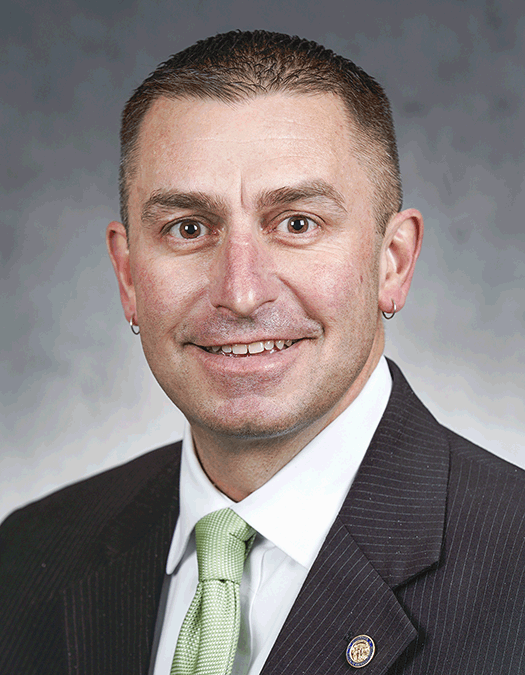
Rep. Josiah Hill
Sponsored bills
Maddy summaryHF 1679 allocates $5 million for fiscal year 2026 and $5 million for fiscal year 2027 from the state's arts and cultural heritage fund to support public television. The funding is specifically designated for the Minnesota Public Television Association (MPTA) to provide production and acquisition grants for public television programming. This bill directly affects MPTA's ability to fund local and national content for Minnesota viewers through existing state law. The funding mechanism provides stable, multi-year support for public broadcasting services.
Maddy summaryHF 3074 creates legal rights for transportation network company (TNC) drivers in Minnesota to form and join labor organizations for collective bargaining. It directly affects "active drivers" who completed at least the median number of rides in the most recent two quarters, as defined by the bill. The law establishes a certification process where drivers can designate an exclusive representative (like a union) through the Bureau of Mediation Services, while prohibiting TNCs from controlling or dominating driver representation groups ("company unions"). Drivers gain the right to negotiate terms and conditions of work, including grievance procedures, with TNCs, and the bill defines "lockout" to prevent TNCs from restricting driver access to the platform during disputes.
Maddy summaryHF 2342 appropriates $1.5 million for each of fiscal years 2026 and 2027 to fund academic assistance programs through the Minnesota Alliance of Boys and Girls Clubs. The grant directly supports youth, particularly those needing the most academic help, by funding homework help, tutoring, the Exact Path personalized learning program (for K-12 math, reading, and language arts), literacy/STEM activities, mentorship, and attendance strategies. The recipient must provide a 25% nonstate funding match, and any unused 2026 funds carry over to 2027. This is a funding bill focused on concrete program support, not procedural changes.
Maddy summaryHF 2773 appropriates $500,000 for fiscal year 2026 and $500,000 for fiscal year 2027 from the general fund to fund Lutheran Social Services' CORE program. The funding supports home-delivered meals for Minnesota veterans outside Hennepin and Ramsey Counties, along with technical assistance and outreach services for participating programs. The bill requires annual reports by September 1 detailing how funds were used and the number of veterans served. This one-time appropriation ensures direct support for veterans' meal access and program coordination, with transparency through mandatory reporting.
Maddy summaryHF 2325 requires Minnesota employers to pay non-exempt employees at least 1.5 times their regular hourly rate for work performed on designated holidays. The bill directly affects hourly workers in Minnesota who are scheduled to work on holidays defined under Minnesota Statutes section 645.44, subdivision 5. It amends existing law (Minnesota Statutes 2024, section 177.25) to add a new provision mandating this overtime pay rate specifically for holiday work. This changes the current standard by explicitly requiring higher pay for holiday shifts, rather than allowing employers to use alternative compensation methods. The bill does not change the definition of "holiday" but specifies the required pay rate when work occurs on those days.
Maddy summaryHF 1936 appropriates $1.25 million for fiscal year 2026 and $1.25 million for fiscal year 2027 from the workforce development fund to the Minnesota Alliance of Boys and Girls Clubs. The funds will support a statewide youth job skills and career development program focused on early access to education, work-based learning, STEM pathways, career exploration, and first job placement through community partnerships. The program must include career guidance and life skills components, and requires a 25% match from nonstate resources. This is a one-time funding appropriation for a specific youth workforce initiative.
Maddy summaryHF 2930 cancels $15 million previously allocated for ALS research and redirects that same amount to fund a new, one-time collaboration between the University of Minnesota Board of Regents and the Mayo Clinic. The $15 million in fiscal year 2026 will support ongoing ALS research aimed at improving patient lives and finding a cure, with funds to be used by the partnership until fully expended or by January 15, 2030. The bill requires the University of Minnesota to submit annual reports starting in 2026 detailing how the funds were used. This replaces prior funding mechanisms established in 2022 and 2024, which are now repealed.
Maddy summaryThis bill appropriates $1 million for 2026 and $1 million for 2027 to expand Junior Achievement North's financial literacy, career readiness, and entrepreneurship programs for Minnesota students. It directly affects elementary and secondary students, with a specific focus on increasing access for underserved students and providing equitable programming across greater Minnesota. The grant requires Junior Achievement North to report annually by February 1 to education committees, detailing program participation, demographics, operations, and partnerships. The funding must align with existing evidence-based grant procedures under Minnesota law.
Maddy summaryHF 107 modifies Minnesota's unemployment insurance rules for workers involved in labor disputes. It specifies that workers participating in or directly affected by a labor dispute can receive benefits until the end of the week the dispute was active, while those not involved are eligible until the dispute began. The bill clarifies that certain situations - like employer safety violations, lockouts, or being fired before a dispute starts - do not make applicants ineligible. This directly affects workers who stop working due to labor conflicts, ensuring they maintain eligibility under defined conditions. The changes amend Minnesota Statutes section 268.085, subdivision 13b.