

Maddy summaryHF 1599 appropriates $3 million from the general fund for preliminary design work on a grade-separated interchange at the intersection of Trunk Highway 36 and Trunk Highway 120 in North St. Paul and Oakdale. The funding is specifically for planning and design phases, not construction, and is available until the project is completed or abandoned. This bill directly affects local residents and traffic in those communities by funding the initial planning for a safer, more efficient road connection. The appropriation is one-time and limited to fiscal year 2025.
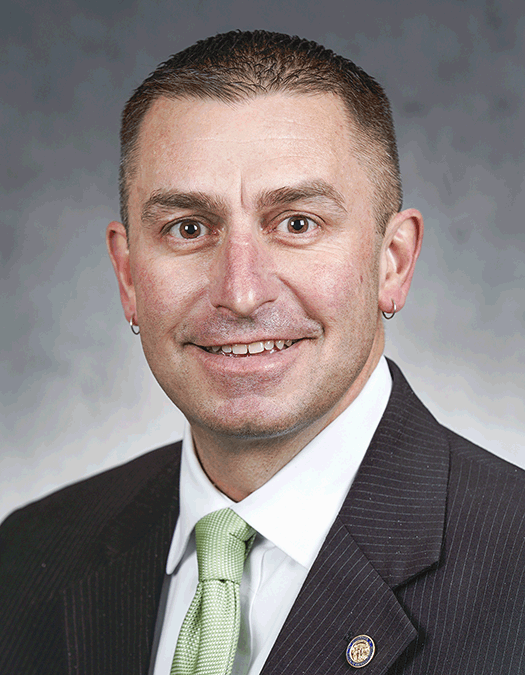
Rep. Josiah Hill
Sponsored bills
Maddy summaryHF 1418 transfers teacher grant programs from the Professional Educator Licensing and Standards Board (PELSB) to the Minnesota Department of Education. It requires the Department of Education to collaborate with PELSB and other agencies to produce an annual report by November 3 each even-numbered year, detailing state-funded programs aimed at increasing the racial and ethnic diversity of teachers. The report must include recommendations for policy changes, plans for sharing best practices among grant recipients, and whether an advisory council should be created to address teacher diversity shortages. This bill directly affects state education agencies, school districts receiving grants, and teacher recruitment programs focused on diversifying the workforce.
Maddy summaryHF 1550 allows Minnesota school districts to renew expiring capital projects referendums through a school board resolution instead of holding a new voter election, under specific conditions. It directly affects school districts with referendums nearing expiration that meet all renewal requirements. Key provisions require the renewal amount to match the expiring referendum, the renewal term to be no longer than the original term, and the board to hold a public hearing with a recorded vote before adopting a written resolution. The resolution must be submitted to the commissioner and county auditor by September 1, and cannot be used if the referendum was previously renewed via board action. This streamlines renewal for districts with unchanged project funding needs.
Maddy summaryHF 1588 appropriates $6.5 million from the general fund for Minnesota's Community Energy Transition Grant Program in fiscal year 2026. The funds are designated for the commissioner of employment and economic development to administer grants under Minnesota Statutes section 116J.55. This bill directly provides financial resources to local communities and organizations applying for energy transition projects, such as renewable energy installations or efficiency upgrades, without changing program eligibility or requirements. It is a procedural funding measure with no new policy provisions.
Maddy summaryHF 1415 increases funding for Minnesota's school unemployment aid program, which provides financial support to hourly school employees who face unemployment between academic terms. The bill appropriates specific additional funds from the general fund to the Department of Education for fiscal years 2026 and 2027. This directly affects hourly school workers, such as those in maintenance or summer programs, who qualify for unemployment aid under existing rules. The change simply adds more money to an existing account without altering eligibility or program structure.
Maddy summaryHF 846 allocates $3 million annually for 2026 and 2027 to fund registered special education apprenticeship programs. It provides $740,000 grants each year to four specific intermediate school districts (287, 288, 916, and 917) for these programs. The funds must cover program administration, apprentice stipends/tuition, mentor teacher stipends, and substitute teacher costs. This directly supports special education apprentices and their training partnerships with higher education institutions. The bill does not change existing laws but provides dedicated funding for these specific programs.
Maddy summaryHF 1113 appropriates $10 million from state bonds to fund Washington County's design and construction of a public works and environmental center. The bill authorizes the state to issue up to $10 million in bonds to cover this project, as permitted under Minnesota law. This funding directly supports Washington County's infrastructure development for public works operations and environmental services. The project will be financed through state bond proceeds, with funds allocated to the county for the facility's construction.
Maddy summaryHF 1020 establishes a working group within Minnesota's Department of Education to review the current age limit for children receiving special education services for developmental delay. The group, composed of specified education and disability advocacy representatives, will assess the impact of raising eligibility from age six to age seven and submit findings to the legislature by February 1, 2026. This bill directly affects children with developmental delays who may lose services at age six under current rules, though it does not change eligibility itself - only mandates a review of the policy. The working group will operate until its report is submitted, with no compensation for members.
Maddy summaryThis bill appropriates $1.6 million from state bond proceeds to fund specific wastewater infrastructure improvements in Scandia, Minnesota. The funds will support the purchase/installation of nitrate pretreatment equipment at the Bliss wastewater plant expansion and repair/rehabilitation of a primary lift station. The money is provided through state bonds authorized under Minnesota law, directly benefiting Scandia's public works projects without changing broader environmental or regulatory policy.
Maddy summaryHF 53 amends Minnesota's education finance law to adjust how school districts and charter schools calculate transportation funding. It increases a district's "transportation sparsity revenue" by 35% of the difference between its actual transportation costs (adjusted for previous years) and a calculated amount based on basic revenue and existing transportation aid. This change directly affects public school districts and charter schools by altering their formula for receiving state transportation funding. The adjustment applies to fiscal year 2026 and later, modifying existing funding calculations without creating new programs. The bill focuses on refining the method for distributing transportation funds, not on new policy outcomes.