

Maddy summaryHF 65 repeals the state's authority to adopt statewide health education standards for Minnesota public schools and cancels related funding. This bill directly affects public schools, as it removes the requirement for them to implement new statewide health standards (previously planned for implementation), allowing them to continue using locally developed health curricula instead. Key provisions include amending education statutes to clarify that "locally developed academic standards in health apply" without needing state adoption. The bill does not change standards for other subjects like math, science, or language arts, which remain subject to statewide requirements. The effective date for these changes is July 1, 2025.
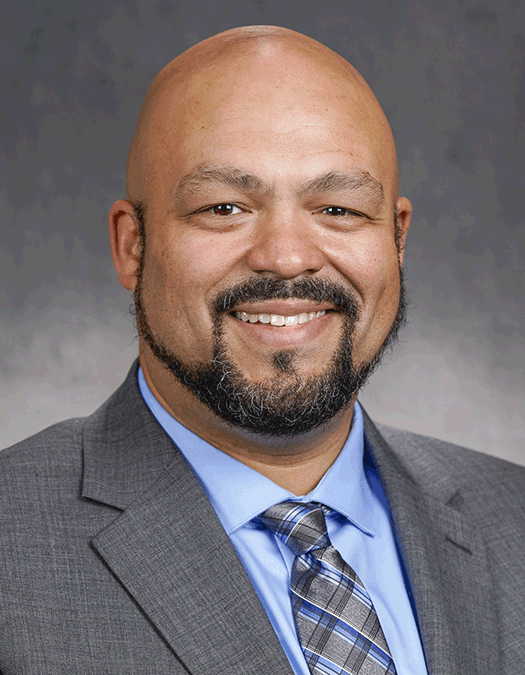
Rep. Walter Hudson
Sponsored bills
Maddy summaryHF 767 increases penalties for arson committed against political organizations or motivated by political reasons. It amends Minnesota Statutes 609.561, 609.563, 609.5631, and 609.5632 to add specific circumstances that elevate penalties. For example, arson targeting a building housing a political organization (under §609.561) carries a maximum 25-year prison sentence, while lesser offenses with political motivation face enhanced fines and jail terms. The law applies to crimes committed on or after August 1, 2025, and directly affects individuals who commit arson against political organizations or for political statements.
Maddy summaryThis bill defines "animal feedlot" in Minnesota law. It specifies that an animal feedlot is a confined area (either designed for manure accumulation or with animal density preventing vegetation) used for raising or holding animals. The definition explicitly excludes pastures and small poultry operations (12 or fewer chickens). This is a procedural definition change with no new regulations or requirements.
Maddy summaryHF 808 amends Minnesota Statutes section 3.971 to give the legislative auditor new authority to file civil lawsuits or criminal complaints regarding fraud or mismanagement in taxpayer-funded programs. It also grants county attorneys the power to prosecute similar fraud allegations under Minnesota law. The bill specifically adds two new provisions: one allowing the legislative auditor to act directly in court, and another enabling county attorneys to pursue these cases. These changes apply to programs funded by taxpayer money and do not affect other state departments' legal standing. The bill directly affects the legislative auditor and county attorneys in their oversight of government spending.
Maddy summaryHF 1043 appropriates $10.5 million from state bond proceeds to fund capital improvements at Wright Technical Center in Buffalo, Minnesota. The funds will cover predesign, construction, renovation, and equipment for mechanical, electrical, security systems, utility infrastructure, and site upgrades at the center and its affiliated facilities. The state will issue up to $10.5 million in bonds to provide this funding, following standard state bond procedures. This bill directly affects Wright Technical Center's physical infrastructure and operations.
Maddy summaryHF 636 removes the requirement for a permit to carry a firearm in public places for eligible Minnesotans, while creating an optional permit system. The bill amends Minnesota Statutes 624.714 to state that anyone not prohibited by state or federal law (and at least 21 years old) may carry a firearm without a permit in public places - defined as government-owned property or private property open to the public, excluding homes, businesses, gun shops, and hunting areas. An optional permit, which requires proof of pistol safety training and background checks for disqualifying offenses, remains available for those who choose it. This change directly affects eligible residents who currently need permits to carry firearms in public, eliminating that barrier while preserving the option for a permit.
Maddy summaryHF 762 protects crime victims whose vehicles were stolen or involved in certain accidents (like hit-and-runs) by prohibiting fees for towing or impounding their vehicles and banning sales of these vehicles for 180 days. It requires government agencies to reimburse victims if they sell a crime victim's vehicle and forbids charging victims any fines or fees related to their vehicle. The bill also mandates law enforcement to investigate stolen vehicle reports and provide victims with regular updates on the investigation status. These provisions directly affect victims of vehicle theft or crime-related accidents in Minnesota.
Maddy summaryHF 288 requires the Minnesota legislature to approve any extension of a declared emergency beyond five days. It mandates that certain executive orders and rules must be enacted by the legislature to have legal effect, rather than taking effect automatically under current rules. The bill defines key terms like "public health emergency" and "bioterrorism" to clarify when emergency powers apply. Additionally, it repeals specific criminal penalties related to emergency management procedures.
Maddy summaryThis Minnesota law updates family court rules to ensure unmarried parents are treated the same as married couples when determining child custody and parenting time. The bill mandates that courts prioritize scheduling expedited hearings within 30 days if a parent is denied access to their child for 14 consecutive days or faces financial hardship during a legal dispute. It also establishes new rights and responsibilities regarding assisted reproduction and directs the state to modernize legal terminology used in family law statutes. These changes aim to support children's relationships with both parents while providing faster relief for urgent situations involving access or support.
Maddy summaryThis law establishes new standards to protect African American children and those from other disproportionately represented groups within Minnesota's child welfare system. It requires social services agencies to make continuous, rigorous efforts to keep families together and prevent unnecessary removal of children from their homes. The act defines a higher level of care called "active efforts," which mandates that agencies involve families in planning services and respect their cultural values. Additionally, the legislation sets specific criteria for what constitutes a permanent adoptive placement and ensures that these protections apply alongside existing laws for Native American children.