

Maddy summaryThis bill establishes a legal framework for direct primary care service agreements in Minnesota, which are membership-style plans where patients pay a flat fee directly to a primary care provider for routine services. The legislation clarifies that these agreements are not considered insurance, meaning they do not require state licensure or certificates of authority and are exempt from standard insurance regulations. By explicitly excluding these agreements from the definition of a "health plan," the law allows providers to market and sell these services without navigating the complex requirements typically imposed on traditional health insurance products.
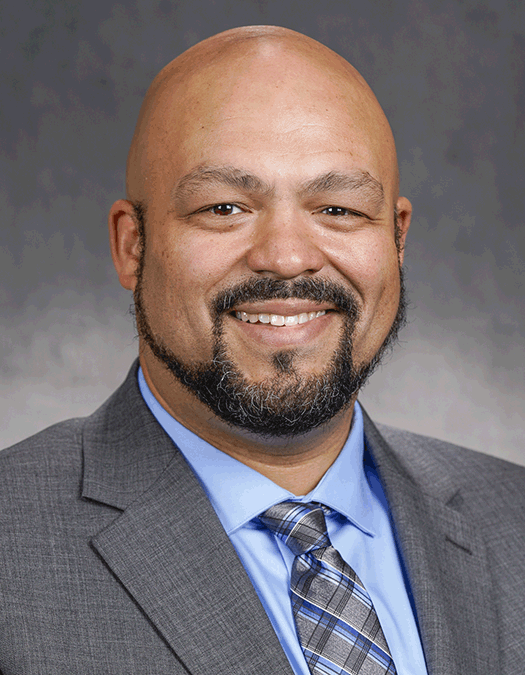
Rep. Walter Hudson
Sponsored bills
Maddy summaryThis bill requires businesses in Minnesota to accept United States currency, including Federal Reserve notes, as payment for goods and services. The rule applies to in-person transactions and allows sellers with multiple locations to comply by accepting cash at just one of their sites. However, banks, credit unions, and businesses that require security deposits or credit card numbers for potential damages are exempt from this requirement. Sellers who refuse cash payments face a civil penalty of up to $250 for each transaction or attempted transaction. The law will take effect on January 1, 2025.
Maddy summaryThis bill creates the Bail Abatement Nonprofit Exclusion (BANE) Act to prohibit nonprofit organizations from using their funds to pay bail on behalf of individuals arrested. Under the new law, nonprofits are barred from organizing or registering specifically to make payments to courts to satisfy bail conditions. The measure directly affects charitable groups and other nonprofit entities by restricting their ability to engage in bail-related financial activities.
Maddy summaryThis bill, known as the Intellectual Freedom Protection Act, applies to public colleges and universities in Minnesota by prohibiting them from requiring students or faculty to pledge allegiance to or support specific political ideologies, including those related to diversity, equity, inclusion, or patriotism. The law ensures that admissions, hiring, and promotion decisions cannot be based on the viewpoints expressed in any such pledges, while explicitly preserving the ability of institutions to enforce existing laws against discrimination and maintain academic freedom. To increase transparency, the bill mandates that these institutions publicly post all training materials and policies regarding nondiscrimination and bias on their websites. Finally, it creates a private right of action allowing individuals to sue for violations and grants the state attorney general the authority to file lawsuits and impose civil penalties of up to $100,000 per violation.
Maddy summaryThis bill establishes the Minnesota African American Family Preservation and Child Welfare Disproportionality Act to protect African American children and families from unnecessary removal from their homes. It creates a new advisory council and requires social services agencies to make "active efforts," which is a higher standard than usual, to keep these children safely with their families while respecting their cultural values. The legislation also mandates specific reports on how well these new protections are working and sets a future effective date of July 1, 2027.