

Maddy summaryHF 17 amends Minnesota's handgun permit law to create lifetime permits for carrying concealed handguns, replacing the previous temporary permits. It also reduces the application fee for these permits, capping it at $100 or the actual processing cost (whichever is lower), with $10 of each fee deposited into the general fund. The bill maintains existing requirements, including proof of firearm safety training (via certified courses or peace officer employment) and in-person application submissions with specific documents like training certificates and photo ID. This directly affects Minnesotans seeking or renewing concealed carry permits, streamlining the process by eliminating renewal fees and duration limits.
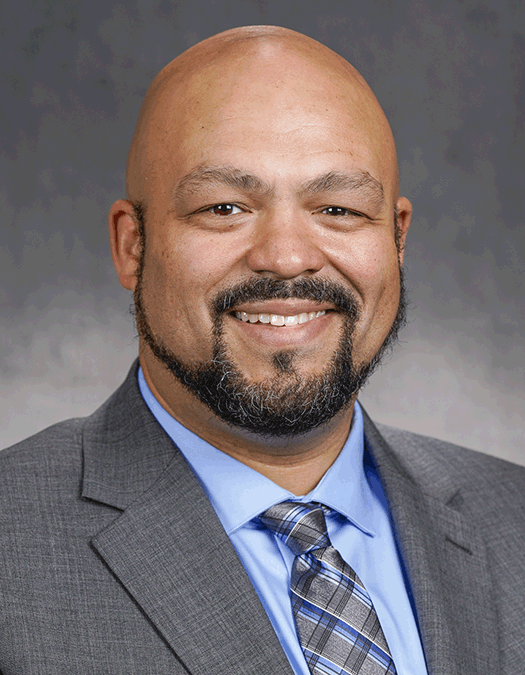
Rep. Walter Hudson
Sponsored bills
Maddy summaryHF 1590 establishes mandatory minimum prison sentences for individuals who maliciously punish children, specifically targeting cases involving severe physical injury. It affects parents, legal guardians, or caretakers who cause substantial or great bodily harm to children, with penalties increasing based on the child's age (under 4) and the injury's severity. For example, causing head/neck injuries to a child under 4 mandates at least one year in prison, while causing great bodily harm requires a minimum two-year sentence. The bill amends Minnesota Statute 609.377 and takes effect August 1, 2025.
Maddy summaryHF 1475 abolishes Minnesota's Metropolitan Council and transfers its core responsibilities to other state entities. Specifically, it moves the Council's duties to the commissioners of Administration and Natural Resources, shifts transportation and transit functions to the Department of Transportation, and creates a new metropolitan area sanitary sewer district. The bill also repeals land use planning provisions previously managed by the Council and ends its oversight of the Metropolitan Airports Commission. These changes reorganize regional governance for key services like transportation, environmental management, and sewer infrastructure across the metropolitan area.
Maddy summaryThis bill appropriates $10 million from state bonds to fund improvements for a regional water system serving Albertville, Hanover, and St. Michael. It authorizes the expansion of treatment capacity from 10 to 15 million gallons daily and addresses manganese and radium water quality issues. The funds will be used to design, construct, and equip necessary infrastructure through a grant to the joint powers water board. The state will issue bonds up to $10 million to cover these costs, with the project effective upon final enactment.
Maddy summaryHF 1566 requires landlords in Minnesota to make reasonable safety modifications for tenants with children who have autism, specifically when hazards like lakes, rivers, or other water bodies are near rental properties. Tenants must request these accommodations, and landlords can ask for documentation unless the child's condition is obvious. Landlords cannot retaliate against tenants making such requests and must adjust policies or property features to protect the child, unless the change would fundamentally alter the property. This bill directly affects tenants with autistic children and their landlords in rental housing.
Maddy summaryHF 1374 amends Minnesota's eligibility rules for the Challenge Incarceration Program, which allows certain incarcerated individuals to serve part of their sentence in a community-based setting. The bill adds specific categories of people who can no longer participate, including those convicted of violent crimes involving death or injury (like murder or assault), recent sex offenses, or crimes requiring sex offender registration. It also bars individuals with active warrants, less than 180 days left on their sentence, recent disciplinary issues in prison, or suspended disciplinary sanctions. The changes directly affect incarcerated Minnesotans seeking to transition to community supervision through this program.
Maddy summaryHF 2 requires state agency employees to immediately report suspected fraud to law enforcement and legislative committee leaders when they have reason to believe fraud exists in agency programs. It mandates that all state agencies post current organizational charts online with contact details for leadership and division heads. The bill strengthens grant management by requiring agencies to conduct unannounced monitoring visits before final payments for grants over $50,000 (and annually for grants over $250,000), perform financial reconciliations prior to disbursement, and withhold funds from grantees failing to submit required progress reports. Violating these grant management requirements constitutes a misdemeanor under the bill.
Maddy summaryHF 765 requires judges to impose longer prison sentences for repeat violent offenders in Minnesota. Specifically, it mandates aggravated sentences (up to the statutory maximum) for those convicted of a violent felony with two or more prior violent felony convictions and deemed a danger to public safety. The bill also requires consecutive sentencing for these offenders and prohibits probation, parole, work release, or early release until the full sentence is served - overriding several existing statutes. This applies only to violent offenders convicted of a felony on or after August 1, 2025, and excludes certain offenses like those under sections 152.023 or 152.024.
Maddy summaryHF 763 prohibits falsely impersonating a military service member, veteran, or public official with the intent to gain politically or to wrongfully obtain money, property, or other tangible benefits. The bill amends Minnesota Statutes to explicitly add "for political gain" as a prohibited motive, making such impersonation a misdemeanor. This law directly affects individuals who might impersonate these figures to influence elections, campaigns, or political activities. The policy change clarifies and expands existing protections under Minnesota law to address political misuse of identities.
Maddy summaryHF 768 prohibits Minnesota's Department of Human Rights from maintaining any database or collection of incidents involving protected speech. The bill amends Minnesota Statutes 363A.06 to explicitly state the department cannot collect or store data about protected speech - defined as speech protected under the U.S. or Minnesota Constitutions (including free speech, press, assembly, and association). This restriction applies directly to the Department of Human Rights' operations, preventing it from creating or using such databases for any purpose. The bill does not affect other data collection or reporting duties, such as the department's required biennial report on civil rights trends.