

Maddy summaryHF 2197 modifies Minnesota's individual income tax credits to better support families. It eliminates the "marriage penalty" by raising the income threshold at which the child credit phases out from $35,000 (married filing jointly) to $75,000, and from $29,500 to $37,500 for other filers. The bill also restricts the Working Family Credit to taxpayers with qualifying children and adjusts credit amounts based on earned income. These changes apply to tax years beginning after December 31, 2024, with inflation adjustments starting in 2025. The bill directly affects Minnesota taxpayers with children who qualify for these credits.
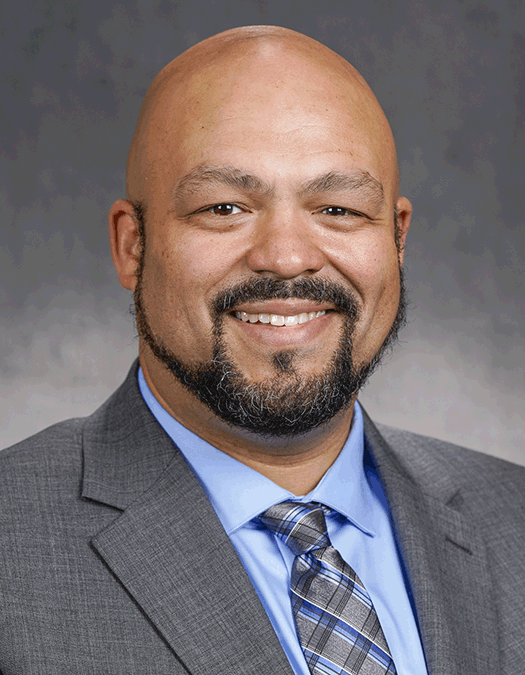
Rep. Walter Hudson
Sponsored bills
Maddy summaryHF 2310 reenacts Minnesota's existing prohibition on weather modification within state boundaries, directly affecting individuals or entities attempting activities like cloud seeding. The bill defines "weather modification" as intentionally altering weather through chemical or apparatus dispersal in the atmosphere, and prohibits such actions within Minnesota's borders or airspace above them. Violations are classified as misdemeanors, with each day of continued violation considered a separate offense. This law aims to protect public safety, health, and the environment by preventing unauthorized weather-altering activities.
Maddy summaryThis bill establishes a new funding program called "general education disparity aid" to support Minnesota school districts with lower per-student revenue. It calculates aid based on the difference between a district's revenue per student and the 20th percentile of all districts, multiplied by the district's adjusted student enrollment. The program begins in fiscal year 2026 and appropriates funds for 2026 and 2027 to provide this targeted support. It directly affects school districts with revenue below the 20th percentile benchmark, aiming to reduce funding disparities. The aid is calculated using existing revenue data from Minnesota Statutes sections 126C.10 and 126C.17.
Maddy summaryHF 877 amends Minnesota's Read Act to define "evidence-based" reading instruction as science-based, explicitly excluding the three-cueing system. It requires school districts to use approved literacy screeners and intervention models, and mandates the Department of Education to develop a literacy plan template and approve evidence-based intervention models by June 2025. The bill also cancels specific appropriations related to Read Act implementation. These changes take effect July 1, 2025, directly affecting Minnesota public schools, educators, and literacy programs.
Maddy summaryHF 764 eliminates the statute of limitations for prosecuting first-degree arson in Minnesota. This means prosecutors can file charges for any first-degree arson offense at any time, regardless of when it occurred. The bill amends Minnesota Statutes section 628.26 to remove the previous time limit (previously six years for some cases) specifically for violations of section 609.282 related to arson. It directly affects individuals who commit first-degree arson and the state's ability to pursue such cases, with the change applying to crimes committed on or after August 1, 2025.
Maddy summaryHF 3 requires Minnesota's legislative auditor to annually report to the legislature by February 1 on whether state agencies have implemented audit recommendations from the prior five years. The bill mandates that agencies' commissioners must also submit detailed reports by September 1 each year, specifically itemizing unaddressed recommendations and explaining why they weren't implemented. This directly affects all state agencies subject to legislative auditor reviews and their commissioners, who must now document progress on audit findings. The law creates a structured process for tracking accountability without altering agency funding or creating new programs.
Maddy summaryHF 1986 repeals a Minnesota law that previously prevented courts from considering whether seat belts were used in personal injury or property damage lawsuits involving vehicle accidents. This bill removes the restriction on using seat belt use as evidence in court cases. It directly affects individuals involved in motor vehicle accident lawsuits where seat belt usage might be relevant to determining liability. The key change is simply allowing courts to admit evidence about seat belt use, which was previously prohibited under Minnesota Statutes 2024, section 169.685, subdivision 4.
Maddy summaryHF 22, titled "Parent's Bill of Rights," establishes specific rights for parents of minor children (under 18) in Minnesota. It requires schools and healthcare institutions to respect parental authority over education, access to school/medical records, moral/religious training, and consent for medical procedures or recordings of minors. The bill prohibits employees from coercing children to withhold information from parents or discriminating against parents who exercise these rights. It explicitly states these rights do not override child abuse laws or court orders, and does not limit other existing parental rights. This bill directly affects parents, schools, and healthcare providers serving minors.
Maddy summaryHF 10 prohibits Minnesota state-funded financial assistance, including health coverage and college scholarships, for undocumented noncitizens. The bill explicitly excludes undocumented noncitizens (defined as those residing without U.S. Citizenship and Immigration Services approval) from MinnesotaCare (state health insurance) and the North Star Promise scholarship program. It amends state statutes to require that these programs deny eligibility to individuals without lawful immigration status. The policy change takes effect upon final enactment, with scholarship eligibility applying to awards beginning in the 2025-2026 academic year.
Maddy summaryHF 1463 appropriates $25 million annually (fiscal years 2026-2027) from the general fund for Minnesota town roads and $10 million annually for town bridges. The funds will be distributed under existing rules in Minnesota Statutes section 162.081 to support local road and bridge maintenance programs. This bill directly affects Minnesota's town road and bridge systems by providing dedicated state funding for upkeep. It does not create new policies or alter current distribution methods, only allocating existing budget resources.