

Maddy summaryThis bill limits a pedestrian's ability to sue a driver for injuries if the pedestrian was illegally blocking a roadway (violating traffic laws like section 609.74). It specifically states that a pedestrian who obstructs a roadway cannot sue a driver for harm caused if: (1) the driver used force to retreat/escape because they reasonably believed they or a passenger were in immediate danger of death or serious injury, and (2) the pedestrian was illegally blocking the road. The law applies to injuries occurring on or after August 1, 2025, and directly affects pedestrians who illegally obstruct roadways and drivers involved in such incidents. It removes the pedestrian’s legal right to seek compensation under these specific circumstances.
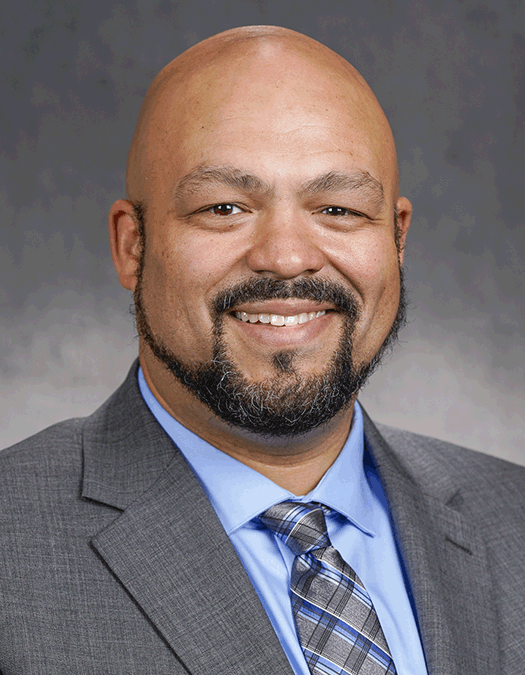
Rep. Walter Hudson
Sponsored bills
Maddy summaryHF 2807 expands Minnesota's definition of "essential employees" to include medical examiners, coroners, medical death technicians, medical death investigators, correctional facility guards, confidential employees, supervisory staff, assistant county/city attorneys, principals, and assistant principals. The bill adds these roles to the existing list, which previously covered firefighters, police dispatchers, and health care workers. It clarifies that for state employees, all law enforcement, public safety, health care, correctional guards, and supervisory unit employees are considered essential, regardless of severance status. For University of Minnesota employees, nursing professionals and supervisory staff in specific units are now classified as essential. This change directly affects these expanded categories of public sector workers in their eligibility for related labor protections under current law.
Maddy summaryHF 2648 prohibits certain sex offenders convicted of crimes against minors under 18 from accessing social media platforms where users under 18 can interact. It requires these individuals on parole or probation to disclose all social media account details (including usernames and passwords) to their supervising agent and bans access to platforms allowing minor users. The law defines "social media platform" narrowly to exclude email, search engines, and business communication tools. The commissioner must annually publish a list of compliant platforms for probation agents to enforce these restrictions. This directly affects sex offenders sentenced under Minnesota statutes 609.342-609.3458 for offenses involving minors under 18.
Maddy summaryHF 1821 appropriates $ for fiscal years 2026 and 2027 from Minnesota's general fund to provide supplemental security grants to nonprofits. It directly affects nonprofits that have already received federal grant approval through the Emergency Management Agency's nonprofit security program, allowing them to access state funds without submitting new applications. The bill limits total funding per nonprofit to $75,000 across both federal and state programs, with grants awarded based on the federal program's ranking order. This ensures nonprofits can cover security costs without extra paperwork, using funds already allocated by the federal government.
Maddy summaryHF 2754 requires an independent audit of the Minnesota Housing Finance Agency's compliance with equal opportunity laws and programs, specifically focusing on disparities in housing access for African Americans. It appropriates funds from the general fund for fiscal year 2026 to hire an auditor and establish a citizen oversight committee, working with the Council for Minnesotans of African Heritage. The committee must inventory relevant equal opportunity laws, oversee the audit, and submit findings and recommendations to the governor and legislative committees before the 2026 legislative session begins. This bill directly affects the agency's operations and accountability regarding fair housing practices.
Maddy summaryHF 1341 designates January 9 as Law Enforcement Appreciation Day in Minnesota, requiring the governor to issue an annual proclamation. It encourages school districts to partner with law enforcement agencies to create middle and high school "explorer" programs about law enforcement careers, which may count as course credit. The bill appropriates $6 million for 2026-2027 to reimburse agencies for peace officer training and $1 million for 2026 to fund pathway-to-policing programs that help recruit diverse candidates through local government grants. These provisions directly affect schools, law enforcement agencies, and local governments by supporting career education and training funding.
Maddy summaryHF 2420 establishes the Commission on Government Efficiency and Ethics to investigate allegations of fraud in state-funded programs and undisclosed legislative conflicts of interest. The commission will maintain an anonymous hotline and website for reporting, offer up to $5,000 rewards for reports leading to convictions or expulsions, and conduct investigations or forensic audits of state agencies. It requires public officials and entities handling public funds to cooperate with investigations and must report credible fraud evidence to law enforcement or legislative committees. The commission also submits annual reports with recommendations to prevent fraud and conflicts of interest. This bill directly affects state program administrators, legislators, and any individuals reporting misconduct.
Maddy summaryThis bill recognizes Minnesota's historic state flag (described as a blue flag with a central emblem featuring 19 stars, the word "MINNESOTA," and scenes from the Great Seal) and grants all Minnesotans the right to display it. It requires the lieutenant governor to set standards for its display on state property, mandating it be shown during specified holidays and on Capitol grounds during legislative sessions. The bill also allows the historic flag to be displayed on other public property for ceremonial purposes, while requiring it to be placed beneath the official state flag when both are displayed together. It directly affects all Minnesotans who display the flag and government entities managing public property.
Maddy summaryHF 2412 amends Minnesota Statutes to create a formal process for attorneys to access electronic court records through the Minnesota Government Access system. Licensed attorneys admitted in Minnesota can apply for an account to view and print case documents in state district courts. Government attorneys and civil legal services staff will access records free of charge, while private attorneys must pay a fee established by the judicial branch. The bill directly affects all attorneys seeking electronic access to court records across Minnesota's district courts. This changes the existing access framework by standardizing account eligibility and cost structures.
Maddy summaryHF 491 appropriates $250,000 for fiscal year 2026 and $250,000 for fiscal year 2027 from the general fund to provide grants to Hometown Hero Outdoors, a Stillwater-based nonprofit. The funding supports mental health services and outdoor recreational activities for current and former law enforcement officers, firefighters, and emergency medical services personnel. The bill directs these services to promote positive mental health, longevity, quality of life, and interactions with mental health professionals through organized outdoor programs. It does not create new policy but allocates specific funds to an existing nonprofit for targeted support of first responders.