

Maddy summaryHF 3101, the Intellectual Freedom Protection Act, prohibits Minnesota's public colleges and universities from requiring students or faculty to pledge support for or opposition to political ideologies (including diversity, equity, and inclusion statements) as a condition for admission, employment, or promotion. It creates a private right for individuals to sue institutions for violations, allowing courts to order injunctions, damages, and attorney fees, while also granting the attorney general authority to seek court orders and impose $100,000 civil penalties per violation. The bill explicitly does not restrict academic freedom, faculty teaching on sensitive topics, compliance with antidiscrimination laws, or consideration of professional qualifications. It also mandates that institutions publicly post all diversity-related policies and training materials online. The law applies to all public postsecondary institutions in Minnesota, including the University of Minnesota system.
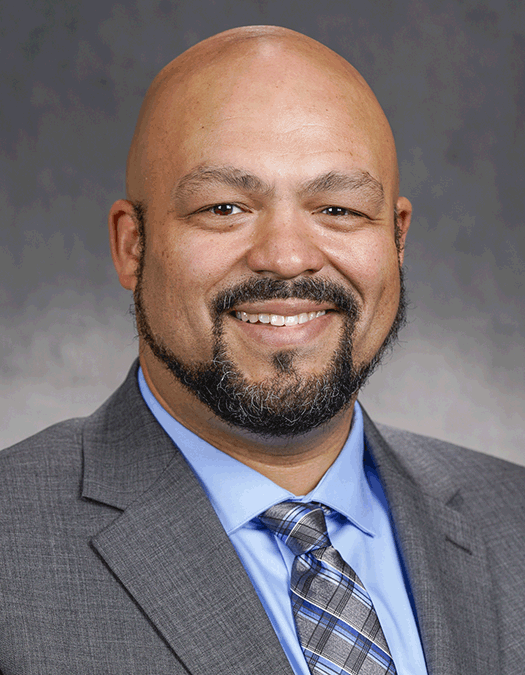
Rep. Walter Hudson
Sponsored bills
Maddy summaryHF 2825 amends Minnesota law to allow background checks for private security and detective licenses to access expunged conviction records without requiring a court order. It specifically adds private security industry applicants (covered under sections 326.3381 and 326.336) to existing categories where expunged records may be reviewed for employment. This change directly affects individuals seeking or holding licenses in Minnesota's private security sector who have had prior convictions expunged. The bill does not alter expungement procedures but clarifies that background checks for these specific licenses can consider expunged records. The policy change applies to convictions expunged under Minnesota's statutes, maintaining existing restrictions on other uses of sealed records.
Maddy summaryHF 19 establishes education savings accounts (ESAs) for Minnesota students from low-income households, defined as families earning no more than four times the income threshold for free school meals. The bill allows parents to use state funds to pay for qualifying education expenses - including tuition at eligible nonpublic schools, tutoring, approved curriculum, and school supplies - at participating schools or providers. Participation is capped at 5% of public school enrollment in the first year, increasing by 3% annually, with priority given to kindergarten students and those who attended public school full-time the prior year. The program directly affects eligible students (ages 18 and under) and their families, with funds restricted to approved educational services and materials.
Maddy summaryHF 2949 prohibits Minnesota legislators and executive branch appointees (including commissioners and deputy commissioners) from receiving compensation from any nonprofit organization that receives state grant funding. The bill amends Minnesota Statutes to add this restriction to existing rules governing private employment for public officials, explicitly covering both current officeholders and former commissioners within one year of leaving their position. Key provisions include banning compensation from nonprofits receiving state grants, regardless of where the work is performed, and requiring legislative committees to enforce these rules. This directly affects state lawmakers and executive appointees who might otherwise work for or receive payment from nonprofits receiving state grants. The policy change aims to prevent potential conflicts of interest between public office and nonprofit grant recipients.
Maddy summaryHF 2936 requires Minnesota's Commissioner of Corrections to seek legislative approval before implementing certain new or amended rules that would cost over $25,000 annually for any jail, lockup, or workhouse to comply with. If the commissioner determines compliance costs exceed this threshold, or if an administrative law judge disapproves that determination, the affected facility can request a temporary exemption until the legislature approves the rule. The bill amends Minnesota Statutes to add this requirement for legislative review prior to implementation of high-cost correctional rules. This directly affects local correctional facilities by delaying rule implementation until legislative approval is obtained.
Maddy summaryHF 2961 expands Minnesota's sales tax exemption for certain restaurant meals and drinks. It adds two new exemptions: (1) complimentary meals and beverages (including alcohol) provided to customers at no cost, and (2) employee meals and non-alcoholic beverages purchased by restaurants. These exemptions apply to restaurants defined under Minnesota Statutes §157.15, subdivision 12. The changes take effect July 1, 2025, removing sales tax from these specific transactions.
Maddy summaryHF 2803 requires solar and wind energy facilities in Minnesota to be certified as child labor free before receiving permits, and mandates that manufacturers certify electric vehicle batteries, solar panels, and wind systems sold in the state contain no child labor in their production. The bill applies directly to energy developers seeking permits and manufacturers of these specific clean energy products. It defines "child labor" using International Labor Organization standards and requires certification documentation for compliance. Violations would trigger penalties under Minnesota's existing consumer protection laws (section 325D.56). The law focuses on supply chain transparency for renewable energy products sold within Minnesota.
Maddy summaryHF 2805 eliminates the requirement for a permit to carry a firearm in public places for most Minnesotans who are legally allowed to own guns. It creates an optional permit system for those who want one, requiring applicants to be at least 21, have pistol safety training, and not be prohibited from firearm possession under state or federal law. The bill defines "public place" broadly (excluding homes, businesses, gun shops, and hunting areas) where permitless carry is allowed. It directly affects law-abiding firearm owners seeking to carry openly without a permit, while the optional permit provides a standardized process for those who prefer it.
Maddy summaryHF 2806 prohibits Minnesota's State Board of Investment from investing in or contracting with companies that boycott mining, energy production, agricultural production, or commercial lumber. It requires the Board to divest from such companies by July 2030 and bans state agencies from entering contracts with them. The bill defines "boycott" as actions targeting companies that don't exceed environmental standards beyond legal requirements. State agencies must report annually on investments and contracts affected by this law. This directly impacts Minnesota's $100+ billion investment portfolio and state procurement decisions.
Maddy summaryThis bill amends Minnesota Statutes section 609.54 to clarify sentencing thresholds for embezzling public funds. It sets specific penalties based on the amount stolen: up to $2,500 (max 5 years in prison or $10,000 fine), $2,500-$100,000 (max 10 years or $20,000), or $100,000+ (max 20 years or $50,000). The law directly affects public officials or employees convicted of embezzling public funds, such as government employees or contractors handling public money. It takes effect August 1, 2025, and applies to crimes committed on or after that date.