

Maddy summaryHF 2525 establishes a state program to provide free hearing protection products meeting specific safety standards to Minnesota public safety officers. The program, funded by a $2 million appropriation from the general fund for fiscal year 2026, covers eligible peace officers, firefighters, and emergency medical providers. Products must have a minimum 25 decibel noise reduction rating and maximum 80 decibel output. Applications are processed in order received while supplies last, with no cost to applicants.
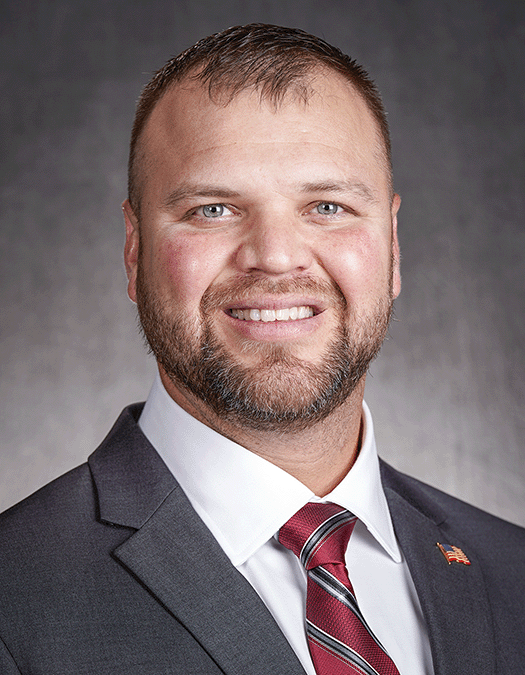
Rep. Bidal Duran
Sponsored bills
Maddy summaryHF 2949 prohibits Minnesota legislators and executive branch appointees (including commissioners and deputy commissioners) from receiving compensation from any nonprofit organization that receives state grant funding. The bill amends Minnesota Statutes to add this restriction to existing rules governing private employment for public officials, explicitly covering both current officeholders and former commissioners within one year of leaving their position. Key provisions include banning compensation from nonprofits receiving state grants, regardless of where the work is performed, and requiring legislative committees to enforce these rules. This directly affects state lawmakers and executive appointees who might otherwise work for or receive payment from nonprofits receiving state grants. The policy change aims to prevent potential conflicts of interest between public office and nonprofit grant recipients.
Maddy summaryHF 2936 requires Minnesota's Commissioner of Corrections to seek legislative approval before implementing certain new or amended rules that would cost over $25,000 annually for any jail, lockup, or workhouse to comply with. If the commissioner determines compliance costs exceed this threshold, or if an administrative law judge disapproves that determination, the affected facility can request a temporary exemption until the legislature approves the rule. The bill amends Minnesota Statutes to add this requirement for legislative review prior to implementation of high-cost correctional rules. This directly affects local correctional facilities by delaying rule implementation until legislative approval is obtained.
Maddy summaryHF 1295 amends Minnesota law to include children's advocacy centers as a program eligible to receive 70% of certain fines collected from offenders convicted of specific crimes, such as those involving child abuse or exploitation. The bill requires courts to collect a minimum fine of 30% of the maximum penalty for these crimes and forward 70% of that amount to a local victim assistance program, now explicitly including children's advocacy centers. If multiple programs serve the county, courts may choose which one receives funds based on the crime type and program needs; if no program is available, funds go to the state general fund. This ensures children's advocacy centers can directly access funding to provide services for child victims.
Maddy summaryHF 1039 requires the State Board of Civil Legal Aid to submit an annual report to legislative committees by January 15 in odd-numbered years. The report must include data on cases and individuals served by each legal aid organization receiving state funds, broken down by organization and geographic region where possible. The bill mandates that this data be provided in aggregate form to protect the privacy of clients. This affects the State Board and all legal aid grant recipients funded under Minnesota Statutes section 480.242.
Maddy summaryHF 2950 requires Minnesota counties to provide state-funded medical assistance and MinnesotaCare coverage to individuals incarcerated in county jails, directly affecting jail inmates who meet standard eligibility criteria. The bill amends statutes to clarify that county jail inmates are eligible for state-funded medical programs (not federally funded assistance) and establishes that counties must cover medical costs up to the standard medical assistance payment rate. It also mandates that inmates pay co-payments from their funds where possible, with counties able to seek reimbursement from inmates who can afford it. The law ensures jail inmates can access medical care without requiring federal funding and updates payment rules for county correctional facilities.
Maddy summaryHF 1936 appropriates $1.25 million for fiscal year 2026 and $1.25 million for fiscal year 2027 from the workforce development fund to the Minnesota Alliance of Boys and Girls Clubs. The funds will support a statewide youth job skills and career development program focused on early access to education, work-based learning, STEM pathways, career exploration, and first job placement through community partnerships. The program must include career guidance and life skills components, and requires a 25% match from nonstate resources. This is a one-time funding appropriation for a specific youth workforce initiative.
Maddy summaryHF 2820 allocates $100,000 for fiscal year 2026 and $100,000 for fiscal year 2027 from the state general fund to the commissioner of veterans affairs. The funds are specifically designated to provide a grant to the YMCA of the North for three programs: Military and Veteran Family Retreats, Military Child BOLD and GOLD Outdoor Leadership Programs, and Military and Veteran Service Program Discounts. This bill directly supports veterans, military families, and military children through these targeted services. The funding is a one-time appropriation for these established programs, with no new policy requirements.
Maddy summaryHF 1375 repeals Minnesota Statutes section 626.892, which established a specific process for selecting arbitrators in peace officer grievance cases. This repeal removes the requirement for a roster of six qualified arbitrators, defined qualifications (including cultural competency training), and fee schedules for resolving disputes over disciplinary actions, discharge, or termination of licensed peace officers under collective bargaining agreements. The change directly affects peace officers and law enforcement agencies handling such grievances.
Maddy summaryHF 2812 requires Minnesota's Commissioner of Corrections to charge fees for incarcerated people's communication services (like phone calls, video, or messaging), but only up to the actual cost of providing those services. It mandates that voice calls remain free for both the incarcerated person and the recipient, prohibits state agencies from profiting from these services (except for pre-2023 contracts), and requires facilities to maintain in-person visitation programs unless an emergency exists. The bill also adds reporting requirements for the Department of Corrections to track fees, spending, and usage of communication services. This directly affects incarcerated individuals, their families, and correctional facilities in Minnesota.