

Maddy summaryHF 3453 amends Minnesota Statutes section 152.027 to raise the legal age for possessing kratom from 18 to 21 years. It makes it a gross misdemeanor to sell kratom to anyone under 21 and a misdemeanor for anyone under 21 to possess it. The bill directly affects minors under 21 and businesses selling kratom, prohibiting sales to this age group and restricting their possession. The change applies to crimes committed on or after August 1, 2026. This is a substantive policy change altering age restrictions under Minnesota's controlled substances law.

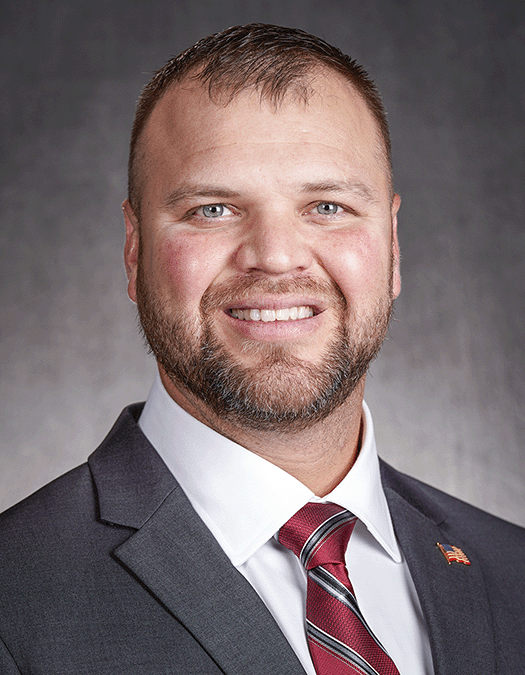
Rep. Bidal Duran
Sponsored bills
Maddy summaryThis bill modifies Minnesota's gambling laws by increasing the maximum cash prize for paddle tickets from $70 to $200 and raising the maximum ticket price from $2 to $5. It directly affects gambling organizations that sell paddle tickets, which are a type of lottery game. The changes are made to Minnesota Statutes 2024, section 349.211, subdivision 2b, which governs paddlewheel prizes.
Maddy summaryThis bill modifies prize and ticket limits for paddlewheel gambling in Minnesota. It directly affects organizations that operate paddlewheel games by changing the maximum cash prize to $70 and setting a merchandise prize limit at $200 fair market value. The legislation also increases the maximum ticket price from $2 to $5. These changes update Minnesota Statutes 349.211, subdivision 2b to reflect the new gambling regulations.
Maddy summaryHF 3522 allows Minnesota's Commissioner of Veterans Affairs to close state veterans homes when required by federal health regulators (like Medicare/Medicaid) after receiving an involuntary termination notice. It specifically permits closure only after safely transferring all residents to appropriate care settings under state law. The bill modifies existing rules by removing a prior restriction that prevented closures without new legislation enacted after 2015. This change directly affects veterans homes and their residents, ensuring compliance with federal requirements while mandating advance notice to the governor and relevant legislative committees. The law does not authorize new closures but aligns state procedures with federal healthcare regulations.
Maddy summaryThis bill makes records from Minnesota's state guardian ad litem program available to the public under specific access rules. It directly affects the State Guardian Ad Litem Board and members of the public who seek information about the program's operations. The key change requires that these records be treated according to the established Rules of Public Access to Records of the Guardian Ad Litem Program, while allowing the Board to suggest updates to these rules for the Supreme Court to review. By amending existing state statutes, the legislation formalizes how information from this child welfare program is shared with the public.
Maddy summaryThis bill temporarily suspends the state motor fuels tax in Minnesota for a specific period in 2026, directly affecting drivers, fuel retailers, and businesses that purchase gasoline and diesel. Under the legislation, the tax rate is set to zero cents per gallon or per thousand cubic feet for all fuel types during the designated timeframe, which begins shortly after the bill is enacted and ends in early September 2026. To offset the lost revenue from this suspension, the state will transfer money from its general fund to the Department of Transportation to cover the costs that would have been collected from fuel taxes. The bill also allocates a one-time appropriation to the Department of Revenue to cover the administrative expenses required to implement this temporary tax pause.
Maddy summaryHF 3490 authorizes Minnesota to participate in a federal tax credit program by establishing rules for scholarship-granting organizations (SGOs). These SGOs must be 501(c)(3) nonprofits that spend at least 90% of funds on student scholarships, verify household income, prioritize returning students/siblings, and avoid targeting specific students. Organizations must report annually to the Minnesota Department of Education, which will post a public list of approved SGOs. The bill clarifies it does not grant schools additional control over nonpublic schools or their students.
Maddy summaryThis bill lowers the minimum age at which a child can be charged with serious crimes in Minnesota from thirteen to ten years old, starting on August 1, 2026. It directly affects children aged ten or older who commit violent offenses, such as murder or attempted murder, by allowing them to be treated as delinquent rather than children in need of protection. The law includes specific exceptions, such as excluding first-degree murder committed by children over sixteen and excluding certain sexual exploitation cases. Additionally, the bill modifies the definition of a "child in need of protection or services" by removing the clause that allows children under ten to be placed in the foster care system for delinquent acts, with a temporary exception for violent crimes committed by those aged ten and older.
Maddy summaryThis bill updates Minnesota laws to change the age at which a child can be classified as a delinquent child or a child in need of protection or services. It primarily affects the state's juvenile justice and child welfare systems by delaying the implementation of a previous rule that would have excluded children under 13 from these categories. The legislation sets a new effective date of August 1, 2027, ensuring that children under 13 who commit acts before turning 13 will no longer be processed under these specific legal definitions after that date. By removing the exclusion for young children, the bill allows the state to apply its current definitions to their actions once the new timeline begins.
Maddy summaryHF 3727 increases property tax relief for Minnesota veterans with service-connected disabilities by raising the market value exclusion amounts. Veterans with a 70% or higher disability rating now qualify for a $200,000 exclusion (up from $150,000), while those with a total and permanent 100% disability qualify for $400,000 (up from $300,000). The bill applies to veterans owning their primary residence ("homestead") in Minnesota, requiring certification of disability by the U.S. Department of Veterans Affairs and honorable military discharge. Surviving spouses of qualifying veterans may also inherit this tax benefit under specific conditions. This change directly reduces taxable value for eligible veterans’ primary homes, lowering their property tax burden.