

Maddy summaryHF 20 clarified which data maintained by Minnesota's Attorney General's Office must be treated as "private data" under state law. It specifically designated five categories as private: disciplinary records (excluding public hearings), non-final administrative communications, consumer complaint data (excluding confidential data), inactive investigative files, and detailed home protection hotline information (like mortgage details and income). This change directly affects the Attorney General's Office by requiring them to handle these specific data types with privacy protections. The bill was introduced in 2025 but was not passed by the legislature and was laid on the table.
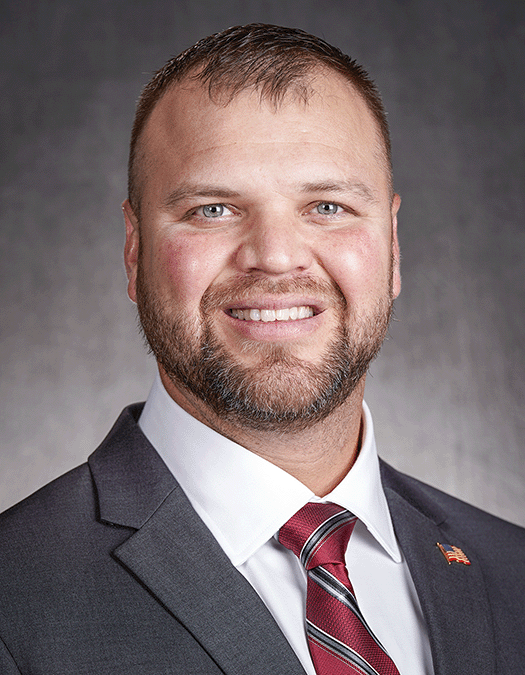
Rep. Bidal Duran
Sponsored bills
Maddy summaryHF 1396 expands Minnesota law enforcement's permitted uses of drones (unmanned aerial vehicles). It adds 10 specific scenarios where police may deploy drones, including conducting threat assessments before events, gathering evidence after serious traffic collisions, searching for missing persons, and collecting information with reasonable suspicion of crime. The bill modifies Minnesota Statutes section 626.19, subdivision 3, to authorize these uses while requiring written consent for private property use and written requests from other government entities. This directly affects all Minnesota law enforcement agencies operating drones under current statutes. The changes focus on operational safety, evidence preservation, and public safety during specific high-risk situations.
Maddy summaryHF 1998 clarifies and updates victim notification procedures for law enforcement and prosecutors when cases involving domestic assault, criminal sexual conduct, harassment, stalking, or violations of protection orders are not prosecuted. The bill requires prosecutors to notify victims via phone first, then email or mail, and to document dismissal reasons - especially if a witness is unavailable - while also informing victims about obtaining protection orders without fees. It updates the model notices that must be provided to victims at initial contact and after charges, including current information on victim services, reparations, and support resources. These changes standardize and improve communication to ensure victims consistently understand their rights and available assistance.
Maddy summaryHF 2881 appropriates $4.9 million from the general fund for the Human Trafficking Investigators Task Force for fiscal years 2026 and 2027, with the same amount continuing annually thereafter. This funding directly supports the task force's operations, enabling it to investigate and combat human trafficking within Minnesota. The bill provides specific, concrete financial resources without altering existing laws or creating new obligations.
Maddy summaryHF 8 streamlines Minnesota's environmental permitting process to improve efficiency and transparency. It sets specific timeframes (90 days for simpler permits, 150 days for complex ones), requires the Pollution Control Agency to issue separate construction and operation permits for certain facilities, and mandates that petitioners for environmental assessments must live in affected or neighboring counties. The bill also eliminates preliminary environmental assessment steps for projects requiring full environmental impact statements and requires the agency to publish annual reports tracking permitting progress. These changes directly affect developers, landowners, and the Pollution Control Agency in processing environmental permits.
Maddy summaryHF 538 modifies Minnesota's law on when police may use deadly force, specifically preventing officers from using lethal force solely to stop a person from harming themselves (e.g., in a suicide situation). The bill requires that if an officer uses deadly force to protect someone from apparent death, they must instead reasonably believe the person poses an immediate threat of death or serious injury to others, meeting specific criteria like the threat being specific, likely to occur, and needing immediate action. This change directly affects Minnesota police officers and individuals in crisis, aiming to limit unnecessary lethal force while maintaining existing standards for protecting officers or the public from violence.
Maddy summaryHF 19 establishes education savings accounts (ESAs) for Minnesota students from low-income households, defined as families earning no more than four times the income threshold for free school meals. The bill allows parents to use state funds to pay for qualifying education expenses - including tuition at eligible nonpublic schools, tutoring, approved curriculum, and school supplies - at participating schools or providers. Participation is capped at 5% of public school enrollment in the first year, increasing by 3% annually, with priority given to kindergarten students and those who attended public school full-time the prior year. The program directly affects eligible students (ages 18 and under) and their families, with funds restricted to approved educational services and materials.
Maddy summaryThis bill allows law enforcement to use mobile tracking devices (like GPS trackers) on vehicles fleeing from police officers, which was previously prohibited under state law. It directly affects police departments and officers by expanding their tools for tracking vehicles during high-speed pursuits. The key change amends Minnesota Statutes to create an exception for "fleeing motor vehicles," defining "flee" using existing law (section 609.487, subdivision 1). The policy change takes effect August 1, 2025, for crimes committed on or after that date.
Maddy summaryHF 2938 allows individuals involved in traffic collisions to access unredacted data from body cameras or other portable recording systems used in their collision investigation, rather than receiving only redacted versions. This directly affects collision victims, their representatives, and law enforcement agencies that must provide the data. The bill amends Minnesota law to require unredacted data access for collision reports under section 169.09, with limited exceptions: if access would interfere with an active investigation, the data is offensive, or it's classified non-public. Agencies denying access must provide a written explanation and information about seeking court review. This changes the default from redacted to unredacted data sharing for collision investigations.
Maddy summaryHF 2342 appropriates $1.5 million for each of fiscal years 2026 and 2027 to fund academic assistance programs through the Minnesota Alliance of Boys and Girls Clubs. The grant directly supports youth, particularly those needing the most academic help, by funding homework help, tutoring, the Exact Path personalized learning program (for K-12 math, reading, and language arts), literacy/STEM activities, mentorship, and attendance strategies. The recipient must provide a 25% nonstate funding match, and any unused 2026 funds carry over to 2027. This is a funding bill focused on concrete program support, not procedural changes.