

Maddy summaryHF 1840 amends Minnesota Statutes section 200.031 to establish a specific standard for determining the residence of individuals under civil commitment orders. It states that such individuals' residence is defined as their last known residential address prior to the commitment order, rather than their current location in a facility. This change directly affects people subject to civil commitment under chapters 253B or 253D of Minnesota law. The bill updates the existing voting residence rules to clarify that commitment status does not automatically change an individual's voting residence. This is a technical amendment to existing election law, not a new policy.
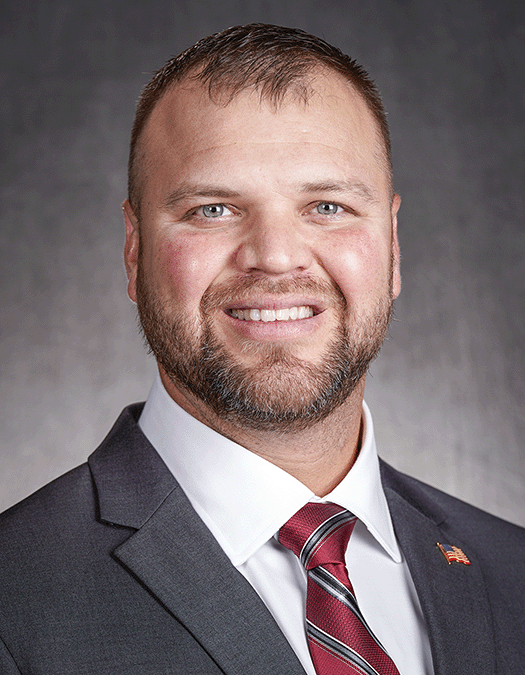
Rep. Bidal Duran
Sponsored bills
Maddy summaryHF 2527 establishes a 30 miles per hour speed limit on a specific segment of Beltrami County State-Aid Highway 20, from the intersection with Highway 21 to the entrance of Lake Bemidji State Park. The bill directly affects drivers traveling on this highway segment and requires the Beltrami County engineer to install appropriate speed limit signs. It amends Minnesota Statutes by adding a new subdivision to section 169.14, overriding standard speed limits for this location. The new speed limit takes effect the day after the bill is enacted, once the required signs are installed.
Maddy summaryHF 2648 prohibits certain sex offenders convicted of crimes against minors under 18 from accessing social media platforms where users under 18 can interact. It requires these individuals on parole or probation to disclose all social media account details (including usernames and passwords) to their supervising agent and bans access to platforms allowing minor users. The law defines "social media platform" narrowly to exclude email, search engines, and business communication tools. The commissioner must annually publish a list of compliant platforms for probation agents to enforce these restrictions. This directly affects sex offenders sentenced under Minnesota statutes 609.342-609.3458 for offenses involving minors under 18.
Maddy summaryHF 128 increases criminal penalties for individuals engaging in prostitution with minors in Minnesota. The bill raises maximum sentences and fines based on the minor's age: up to 30 years or $40,000 for victims under 14, 20 years or $40,000 for those aged 14-15, 15 years or $30,000 for those aged 14-15 (for the act itself), and 10 years or $20,000 for victims aged 16-17. It also increases penalties for hiring minors for sexual acts across all age groups. The bill applies to crimes committed on or after its effective date of August 1, 2025.
Maddy summaryHF 195 exempts property owned and operated by congressionally chartered veterans service organizations from Minnesota property taxes. The bill removes the standard property tax classification rate for this specific property and establishes a direct tax exemption. It requires the commissioner of veterans affairs to annually provide a list of qualifying organizations to the commissioner of revenue by January 1. The exemption takes effect for property assessments beginning in 2026.
Maddy summaryHF 982 creates a new education benefit in Minnesota for dependents of disabled veterans. It provides full tuition, mandatory fees, and book coverage (after subtracting other aid) for dependents of veterans with a 100% permanent disability, and 50% coverage for dependents of veterans with a 70%+ disability rating. The benefit applies to undergraduate programs at Minnesota state colleges, universities, or the University of Minnesota Board of Regents institutions. Eligible students must be enrolled at these institutions, and institutions apply for the benefit on their behalf through the Office of Higher Education.
Maddy summaryHF 2420 establishes the Commission on Government Efficiency and Ethics to investigate allegations of fraud in state-funded programs and undisclosed legislative conflicts of interest. The commission will maintain an anonymous hotline and website for reporting, offer up to $5,000 rewards for reports leading to convictions or expulsions, and conduct investigations or forensic audits of state agencies. It requires public officials and entities handling public funds to cooperate with investigations and must report credible fraud evidence to law enforcement or legislative committees. The commission also submits annual reports with recommendations to prevent fraud and conflicts of interest. This bill directly affects state program administrators, legislators, and any individuals reporting misconduct.
Maddy summaryHF 1120 establishes Minnesota's "Keep it Clean" program to prevent water pollution from garbage and human waste left on ice during winter activities on state waters. The bill directly affects local governments and nonprofit organizations by creating a grant program to fund projects like installing winter-ready waste stations, providing seasonal waste disposal services, increasing winter patrols, and running education campaigns. Key provisions include funding for infrastructure (e.g., dumping stations), enforcement support, and community outreach to promote responsible winter use. The bill appropriates state funds for the program's administration and grants, with at least a portion dedicated to local projects.
Maddy summaryHF 2378 expands the list of people ineligible for earned incentive release credit under Minnesota's Rehabilitation and Reinvestment Act. The bill adds specific offenses to the existing ineligibility criteria, including crimes resulting in death, first/second-degree criminal sexual conduct, sexual conduct with minors under 16, child pornography/exploitation, violent crimes involving weapons, and crimes with mandatory minimum sentences. These changes directly affect incarcerated individuals convicted of these specific offenses who would otherwise qualify for the credit. The law amends Minnesota Statutes sections 244.45 (ineligibility) and 244.46 (applicability) to include these additional categories.
Maddy summaryHF 2448 prohibits counties, cities, and towns in Minnesota from banning the sale of flavored tobacco products, such as those with fruit, chocolate, mint, or candy flavors. It amends Minnesota Statutes to state that local governments may not enact ordinances that ban these products or create regulations making their sale impossible within their boundaries. The bill specifically defines "flavored products" as tobacco or nicotine products with non-tobacco tastes distinguishable before or during consumption. This law overrides any existing or future local ordinances attempting to restrict or ban such sales, while allowing local governments to maintain other tobacco sales regulations. The bill takes effect the day after final enactment.