

Maddy summaryHF 1496 requires Minnesota voters applying for absentee ballots to verify their identity before the ballot is mailed. The bill amends election law to mandate that applicants provide a Minnesota driver's license number, state ID number, or last four Social Security digits. The secretary of state must verify this information against government databases before county auditors can mail ballots. This applies to all absentee ballot applicants except those in town elections held in March. The law aims to prevent fraudulent applications by confirming voter identities prior to ballot delivery.
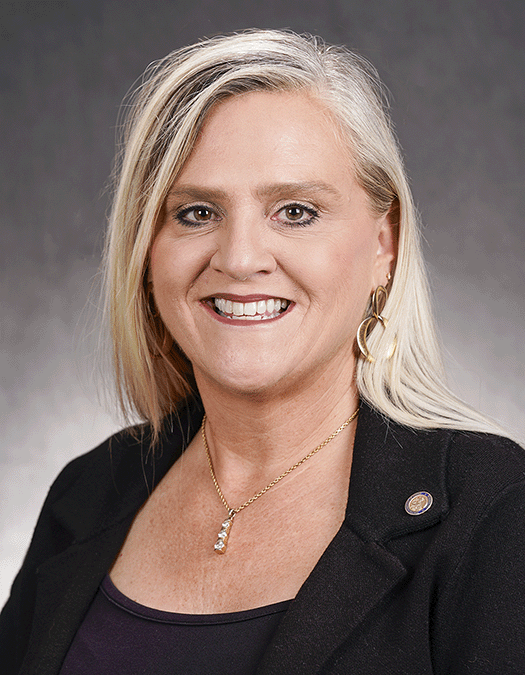
Rep. Pam Altendorf
Sponsored bills
Maddy summaryHF 23 amends Minnesota Statutes section 181.932 to strengthen whistleblower protections for public employees. It expands the list of protected disclosures to include reporting gross mismanagement or waste of public funds (subsection 7), clarifies protections for health care quality concerns (subsection 4), and adds specific scenarios like reporting truthful scientific studies (subsection 5) or classified service communications about state services (subsection 6). These changes directly affect state and local government employees who report violations of law, safety risks, or financial misconduct. The bill modifies existing anti-retaliation language to explicitly cover these new disclosure types while maintaining that protected disclosures cannot override other legal data protections.
Maddy summaryHF 25 establishes a state grant program administered by Minnesota's Department of Health to fund nonprofit women's pregnancy centers and maternity homes. The program provides financial support for services like housing, medical care, parenting education, and mental health resources to help pregnant women and new mothers - particularly those facing homelessness or crisis - carry pregnancies to term and care for their children. Eligible organizations must be nonprofits offering free or low-cost services without promoting abortion, providing abortion care, or referring women to abortion providers. Grant funds cannot be used for abortion-related activities, and strict privacy rules require written consent before sharing personal information about clients. The bill appropriates state funds for this program while reducing other health-related appropriations.
Maddy summaryHF 2197 modifies Minnesota's individual income tax credits to better support families. It eliminates the "marriage penalty" by raising the income threshold at which the child credit phases out from $35,000 (married filing jointly) to $75,000, and from $29,500 to $37,500 for other filers. The bill also restricts the Working Family Credit to taxpayers with qualifying children and adjusts credit amounts based on earned income. These changes apply to tax years beginning after December 31, 2024, with inflation adjustments starting in 2025. The bill directly affects Minnesota taxpayers with children who qualify for these credits.
Maddy summaryHF 2310 reenacts Minnesota's existing prohibition on weather modification within state boundaries, directly affecting individuals or entities attempting activities like cloud seeding. The bill defines "weather modification" as intentionally altering weather through chemical or apparatus dispersal in the atmosphere, and prohibits such actions within Minnesota's borders or airspace above them. Violations are classified as misdemeanors, with each day of continued violation considered a separate offense. This law aims to protect public safety, health, and the environment by preventing unauthorized weather-altering activities.
Maddy summaryHF 2190 appropriates $1.25 million from the clean water fund for Fillmore, Goodhue, Houston, Wabasha, and Winona Counties to clean and repair earthen dams and associated flood protection structures. The funds must be used specifically for maintenance work on these infrastructure projects, with no portion allowed for administrative costs. Each county receiving funds must report by October 1, 2026, to legislative committees about how the money was spent. This bill directly affects the five specified counties by providing targeted funding for critical water infrastructure upkeep.
Maddy summaryHF 656 allows child care centers and family child care providers in Minnesota to request variances (exceptions) from certain licensing rules, such as capacity limits or staff qualification requirements, as long as health and safety are not compromised. Providers must submit a form explaining why they cannot meet a rule and how they will achieve the rule's intent through alternative measures, including a training plan for staff if applicable. For capacity variances, the center must be within 100 square feet of the required space based on staff qualifications. The commissioner can grant temporary or permanent variances, but permanent ones require reporting changes and expire if conditions alter.
Maddy summaryHF 700 creates the "Minnesota Women's Bill of Rights" by establishing specific biological definitions for sex-related terms in all state statutes, rules, and agency policies. It defines "woman" as an adult human of female sex, "girl" as a female minor, and "sex" as biological sex assigned at birth (with only two sexes), explicitly stating gender identity cannot substitute for "sex." The bill requires state agencies, schools, and public entities to use these definitions when collecting data on sex, including in vital statistics and antidiscrimination compliance. It also prohibits using terms like "gender identity" as synonyms for "sex" in official contexts. This bill directly affects how Minnesota state government classifies individuals in all legal and administrative documents.
Maddy summaryHF 1800 modifies Minnesota's voting administration rules, primarily affecting voters registering on election day and residential facilities. It establishes new requirements for "vouching," allowing registered voters or eligible facility employees to personally vouch for new voters in their precinct - limiting each voter to vouching for up to eight people per election day. Residential facilities (like shelters, nursing homes, or transitional housing) must provide employee lists to county auditors 20 days before elections, and election judges must document vouching on public forms. The bill also adds reporting requirements, clarifies election judge party affiliation rules, and includes criminal penalties for violations, but does not specify the exact penalties in the provided text.
Maddy summaryHF 1253 modifies Minnesota's absentee ballot procedures for certain voters. It shortens the timeline for mailing absentee ballots from 46 days to 28 days before elections (Minnesota Statutes 2024, § 203B.06, subd. 3) and moves the deadline for returning ballots from 8:00 p.m. to 3:00 p.m. on election day (§ 203B.08, subd. 1). The bill also prohibits correctional facilities from receiving absentee ballots, requiring county auditors to reject applications with correctional facility addresses (§ 203B.06, subd. 2). These changes directly affect absentee voters, election officials managing ballot distribution, and correctional facilities.