

Maddy summaryHF 11 delays the implementation of Minnesota's Paid Leave Law from 2026 to 2027, affecting employers, employees, and state agencies responsible for administering the program. The bill amends multiple statute sections to adjust key dates, including the start of employer premium payments (now January 1, 2027) and administrative requirements like public outreach and annual reporting. This one-year delay provides additional time for businesses to prepare for the new paid leave program without changing the law's core requirements. The law's substance - such as premium rates and fund management - remains unchanged, only the rollout timeline is extended.
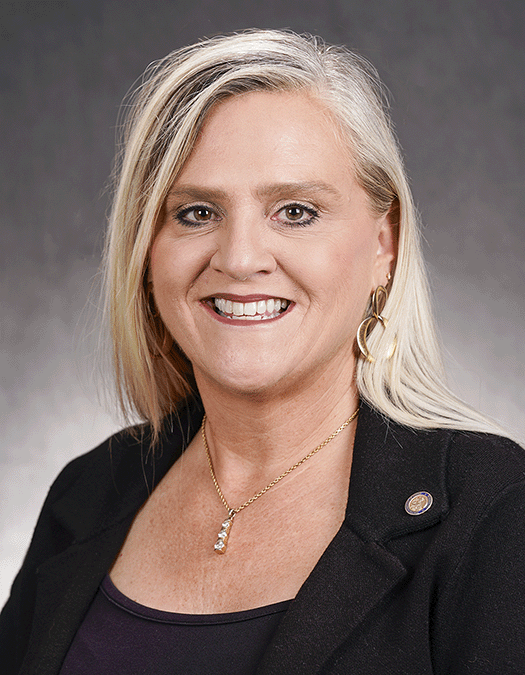
Rep. Pam Altendorf
Sponsored bills
Maddy summaryHF 877 amends Minnesota's Read Act to define "evidence-based" reading instruction as science-based, explicitly excluding the three-cueing system. It requires school districts to use approved literacy screeners and intervention models, and mandates the Department of Education to develop a literacy plan template and approve evidence-based intervention models by June 2025. The bill also cancels specific appropriations related to Read Act implementation. These changes take effect July 1, 2025, directly affecting Minnesota public schools, educators, and literacy programs.
Maddy summaryHF 2074 reinstates Minnesota's previous teaching standards of effective practice by voiding specific rule amendments. The bill directly affects public school teachers and administrators in Minnesota, reversing changes made to Minnesota Rules, part 8710.2000, which were published in the State Register (volume 47, page 988). The key mechanism is declaring those rule amendments "void and do not take effect." This bill restores the prior standards governing teaching practices without creating new requirements. It becomes effective the day after final enactment.
Maddy summaryThis bill modifies Minnesota's requirements for noncompliant driver's licenses and identification cards (issued to applicants using foreign documents). It requires the state Department of Public Safety to collect specific data about foreign documents used (country of origin, document type, and prior submissions), while prohibiting the sharing of immigration status data - such as documents proving citizenship or legal presence - with federal immigration enforcement agencies. The bill classifies immigration status data as private and restricts its sharing only to specific purposes, like improving voter registration accuracy, jury selection, or processing certain federal immigration forms. It directly affects applicants seeking noncompliant licenses and state agencies handling license applications.
Maddy summaryHF 3 requires Minnesota's legislative auditor to annually report to the legislature by February 1 on whether state agencies have implemented audit recommendations from the prior five years. The bill mandates that agencies' commissioners must also submit detailed reports by September 1 each year, specifically itemizing unaddressed recommendations and explaining why they weren't implemented. This directly affects all state agencies subject to legislative auditor reviews and their commissioners, who must now document progress on audit findings. The law creates a structured process for tracking accountability without altering agency funding or creating new programs.
Maddy summaryHF 893 clarifies and strengthens Minnesota's self-defense laws by eliminating the requirement to retreat before using force when defending one's home or person. It expands the definition of "dwelling" to include occupied vehicles, porches, decks, and adjacent structures, and creates a legal presumption that someone entering a dwelling by stealth or force poses an imminent threat. The bill allows individuals to use deadly force without retreating in certain situations, such as when preventing a forcible felony or imminent harm to themselves or others. This directly affects Minnesotans using self-defense, particularly in home or vehicle defense scenarios.
Maddy summaryHF 898 withdraws Minnesota from the National Popular Vote Interstate Compact, a multi-state agreement that would have awarded the state's presidential electors based on the national popular vote. The bill amends Minnesota election law to revert to the state's existing method for selecting presidential electors: candidates are nominated by party conventions and elected based on congressional district and statewide vote totals, rather than the national popular vote. This change directly affects how Minnesota's 10 presidential electors are chosen in future elections. The bill repeals Minnesota Statutes sections 208.051 and 208.052, which had implemented the compact.
Maddy summaryHF 22, titled "Parent's Bill of Rights," establishes specific rights for parents of minor children (under 18) in Minnesota. It requires schools and healthcare institutions to respect parental authority over education, access to school/medical records, moral/religious training, and consent for medical procedures or recordings of minors. The bill prohibits employees from coercing children to withhold information from parents or discriminating against parents who exercise these rights. It explicitly states these rights do not override child abuse laws or court orders, and does not limit other existing parental rights. This bill directly affects parents, schools, and healthcare providers serving minors.
Maddy summaryHF 10 prohibits Minnesota state-funded financial assistance, including health coverage and college scholarships, for undocumented noncitizens. The bill explicitly excludes undocumented noncitizens (defined as those residing without U.S. Citizenship and Immigration Services approval) from MinnesotaCare (state health insurance) and the North Star Promise scholarship program. It amends state statutes to require that these programs deny eligibility to individuals without lawful immigration status. The policy change takes effect upon final enactment, with scholarship eligibility applying to awards beginning in the 2025-2026 academic year.
Maddy summaryHF 1839 repeals specific diversity, equity, and inclusion requirements in Minnesota's K-12 public education system. It removes mandates for schools to teach about Indigenous treaties, boarding schools, languages, sovereignty, and cultural contributions as part of curriculum standards. The bill amends or repeals several Minnesota Statutes (including sections 120B.021, 120B.11, and 121A.212) that previously required embedding these topics into academic standards and teacher training. This directly affects all Minnesota public schools serving prekindergarten through grade 12. The change eliminates required instructional content related to Indigenous history and cultural education in state-mandated curricula.