

Maddy summaryHF 1463 appropriates $25 million annually (fiscal years 2026-2027) from the general fund for Minnesota town roads and $10 million annually for town bridges. The funds will be distributed under existing rules in Minnesota Statutes section 162.081 to support local road and bridge maintenance programs. This bill directly affects Minnesota's town road and bridge systems by providing dedicated state funding for upkeep. It does not create new policies or alter current distribution methods, only allocating existing budget resources.
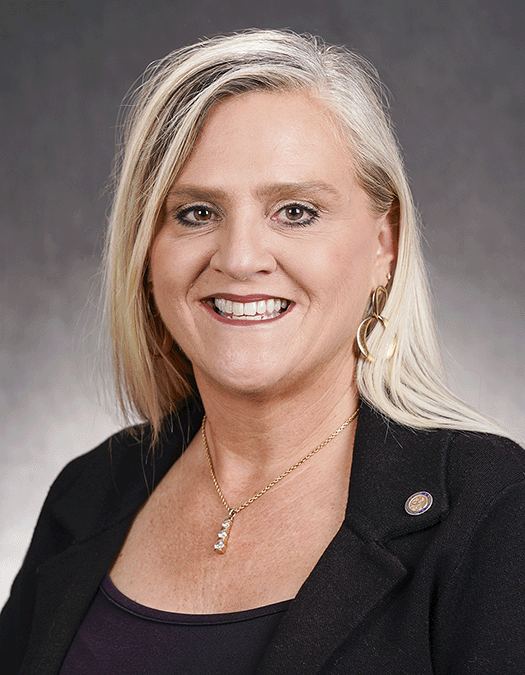
Rep. Pam Altendorf
Sponsored bills
Maddy summaryHF 17 amends Minnesota's handgun permit law to create lifetime permits for carrying concealed handguns, replacing the previous temporary permits. It also reduces the application fee for these permits, capping it at $100 or the actual processing cost (whichever is lower), with $10 of each fee deposited into the general fund. The bill maintains existing requirements, including proof of firearm safety training (via certified courses or peace officer employment) and in-person application submissions with specific documents like training certificates and photo ID. This directly affects Minnesotans seeking or renewing concealed carry permits, streamlining the process by eliminating renewal fees and duration limits.
Maddy summaryThis bill modifies Minnesota's renewable energy standards by expanding which hydroelectric projects count toward clean energy goals (including facilities over 100 megawatts if operating since 2023). It allows electric utilities to request delays in meeting renewable, solar, or carbon-free energy requirements if the commission determines it serves the public interest, considering factors like cost impacts and system reliability. The bill also expands sales tax exemptions for residential heating fuels and electricity, and prohibits demolition of fossil-fuel power plants under specific conditions. Additional provisions include supporting carbon capture technology and removing barriers to new nuclear power plants.
Maddy summaryHF 72 prohibits entities or organizations receiving state funding from making campaign expenditures or spending money on political activities. It directly affects nonprofits and other groups that receive state funds through direct appropriations, competitive grants, or other legislatively named funding programs. The law bans using any state-funded money for political purposes, including supporting candidates or ballot measures, effective July 1, 2025. This policy change aims to separate public funds from political campaign activities.
Maddy summaryHF 1513 requires Minnesota voters to present a photo ID when registering to vote and when casting a ballot. It creates a new state-issued voter ID card, which can be obtained without fees for vital records needed to verify identity (per Section 3.1-3.3). The bill establishes provisional ballots for voters who lack ID but provide required documentation, and mandates annual reports on ID card usage. These changes take effect June 1, 2026, and apply to all voters participating in Minnesota elections.
Maddy summaryHF 1730 provides $1.75 million in state funding for drinking water infrastructure improvements in Red Wing. The bill appropriates money from state bonds to the city of Red Wing for renovating a water storage facility and replacing an old water booster station with a new one at Sorin's Bluff Reservoir. This funding covers design and construction work to upgrade the city's drinking water system. The state will issue bonds to cover the costs, following standard bond procedures under Minnesota law.
Maddy summaryHF 1475 abolishes Minnesota's Metropolitan Council and transfers its core responsibilities to other state entities. Specifically, it moves the Council's duties to the commissioners of Administration and Natural Resources, shifts transportation and transit functions to the Department of Transportation, and creates a new metropolitan area sanitary sewer district. The bill also repeals land use planning provisions previously managed by the Council and ends its oversight of the Metropolitan Airports Commission. These changes reorganize regional governance for key services like transportation, environmental management, and sewer infrastructure across the metropolitan area.
Maddy summaryHF 1495 allows candidates, their representatives, and political parties to observe absentee ballot processing and recounts in Minnesota. The bill specifies that candidates may have one representative present during absentee ballot envelope acceptance/rejection and one additional representative when ballots are opened and counted. During recounts, candidates may have one representative observe ballot sorting and one additional for counting, with all observation occurring in designated public viewing areas. The bill requires election officials to ensure observers do not interfere with ballot handling while maintaining transparency in these specific election procedures.
Maddy summaryHF 1494 requires voters who register on election day to cast provisional ballots instead of regular ballots. This applies to anyone registering in person at their polling place on election day, who must provide proof of residence and complete a registration application with an oath. The bill amends several election statutes to implement this change, including updating provisions about election day registration procedures. It directly affects voters registering for the first time or updating their registration on election day, ensuring their ballots are processed as provisional until verified. The bill makes technical changes to election law to align with this new requirement.
Maddy summaryThis bill expands Minnesota's sales tax exemption to include additional baby products, directly affecting parents and caregivers who purchase these items. It adds baby wipes, cribs and bassinets (including mattresses and sheets), changing tables and pads, strollers, car seats and bases, baby swings, bottle sterilizers, and infant eating utensils to the list of tax-exempt items. The exemption applies to sales and purchases made after June 30, 2025. This change removes sales tax from these specific baby products, aligning with the existing exemption for items like breast pumps and baby bottles.