

Maddy summaryHF 1447 amends Minnesota campaign finance law to require disclosure of donors who contribute $200 or less and live outside the district represented by a legislative candidate. Currently, small donors within a candidate's district are exempt from full disclosure; this bill eliminates that exemption for out-of-district small donors. The key provision adds these contributors to public campaign finance reports, listing their name, address, employer, and contribution amount/date. It directly affects candidates running for Minnesota House or Senate seats, increasing transparency about local campaign funding sources. The change applies to all contributions under $200 from non-local donors, regardless of the candidate's district.
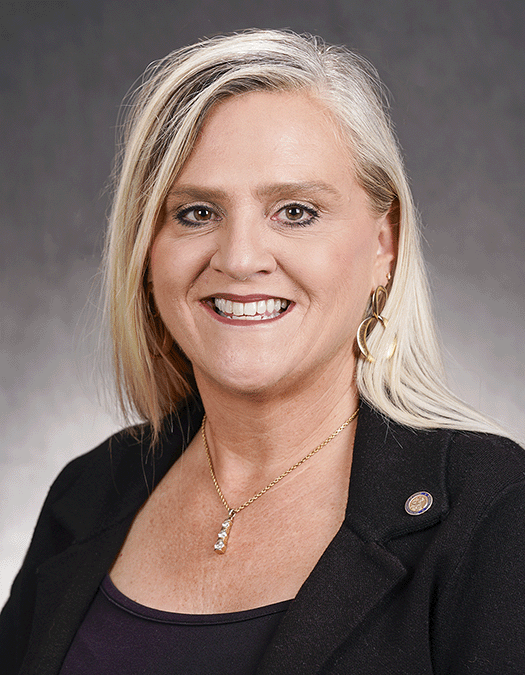
Rep. Pam Altendorf
Sponsored bills
Maddy summaryHF 1405 amends Minnesota campaign finance rules to require full disclosure of all contributors for legislative or statewide candidates and ballot questions. It lowers the disclosure threshold from $500 to $200 per contributor per year, mandating that campaigns report each contributor's name, address, occupation, and contribution amounts in alphabetical order. This applies directly to candidates running for state legislature or statewide offices, as well as committees supporting ballot questions. The bill changes existing reporting requirements under Minnesota Statutes 2024, section 10A.20, subdivision 3, by expanding transparency for smaller donations.
Maddy summaryHF 2 requires state agency employees to immediately report suspected fraud to law enforcement and legislative committee leaders when they have reason to believe fraud exists in agency programs. It mandates that all state agencies post current organizational charts online with contact details for leadership and division heads. The bill strengthens grant management by requiring agencies to conduct unannounced monitoring visits before final payments for grants over $50,000 (and annually for grants over $250,000), perform financial reconciliations prior to disbursement, and withhold funds from grantees failing to submit required progress reports. Violating these grant management requirements constitutes a misdemeanor under the bill.
Maddy summaryHF 1411, the Bail Abatement Nonprofit Exclusion (BANE) Act, prohibits Minnesota nonprofits from registering to pay bail for individuals or to courts to satisfy bail conditions. The law directly affects nonprofits that might have intended to operate bail payment services. It adds a new provision to Minnesota law making such activity illegal under nonprofit registration rules. This bill does not change existing bail procedures but specifically prevents nonprofits from entering the bail payment industry.
Maddy summaryHF 368 amends Minnesota election law to clarify penalties for improper handling of absentee ballots. It specifically prohibits compensation structures that pay individuals based on the number of absentee ballots solicited, collected, or delivered (e.g., commission-style pay or bonuses for volume). The bill also bans requiring staff to collect a minimum number of ballots or reducing pay for failing to meet such quotas. These changes apply to anyone handling absentee ballots for compensation, with violations classified as petty misdemeanors. The law updates existing penalties under Minnesota Statutes §203B.03 to address modern ballot collection practices.
Maddy summaryHF 14 proposed a temporary moratorium on most light rail transit project development spending by the Metropolitan Council in seven Minnesota counties (Anoka, Carver, Dakota, Hennepin, Ramsey, Scott, and Washington). The bill prohibited funds for planning, design, environmental analysis, land acquisition, and construction of new light rail projects, but exempted the Southwest Light Rail (Green Line Extension) and prior contractor payments. The moratorium would have expired once the Green Line Extension began revenue operations. The bill was introduced, amended, and ultimately not passed by the legislature.
Maddy summaryHF 127 increases criminal penalties for creating, distributing, or possessing sexually explicit materials involving children in Minnesota. The bill raises maximum prison sentences for standard violations from 7 to 10 years (up to 25 years with aggravating factors) and increases fines from $10,000 to $40,000. It specifically targets offenders who possess such materials involving minors under 14, have prior sex offense convictions, or are registered predatory offenders. These changes directly affect individuals engaging in these acts, strengthening penalties under Minnesota Statutes sections 617.246 and 617.247.
Maddy summaryHF 499 extends the validity period for temporary nursing permits in Minnesota from 60 to 90 days. It directly affects nurses applying for licensure by endorsement (from another state) or reregistration after completing a refresher course, who currently hold temporary permits. The bill amends Minnesota Statutes section 148.212 by changing the permit duration in two specific scenarios: (1) for out-of-state licensed nurses awaiting board action, and (2) for nurses in structured refresher programs. This change provides a longer grace period for these applicants to secure full licensure without interruption. The bill makes a specific, concrete change to permit timelines with no additional provisions.
Maddy summaryHF 64 establishes the Office of Achievement and Innovation within Minnesota's Department of Education to help school districts and charter schools research and adopt innovative teaching practices focused on literacy, math, science, and career readiness. The office will maintain a central resource for educational strategies and vet nonprofit organizations that support student achievement, requiring nonprofits to submit financial records, program history, and legal compliance documentation. It modifies the state budget to allocate $2 million annually for the new office's staffing, separate from other equity, diversity, and inclusion funding. The office provides advisory support only - its guidance is not binding on schools.
Maddy summaryHF 324 prohibits Minnesota state financial assistance for noncitizens, including both documented and undocumented individuals. The bill defines "state financial assistance" as any payment, grant, loan, or subsidy funded by state tax revenue - covering programs like cash aid, housing support, or food assistance. It explicitly bars noncitizens from accessing these state-funded benefits, regardless of their immigration status. This policy change applies to all state programs using tax dollars, not federal programs or private assistance.