

Maddy summaryThis bill modifies reimbursement rules for ambulance services in Minnesota covering volunteer ambulance attendants' education costs. It sets specific reimbursement amounts: $1,200 for initial EMT training, $400 for continuing EMT courses, $600 for initial EMR training, and $200 for continuing EMR courses. Eligible ambulance services must have handled 5,000 or fewer emergency calls in the prior year. The bill appropriates $100,000 annually for fiscal years 2026 and 2027 to fund these reimbursements under Minnesota Statutes §144E.35.
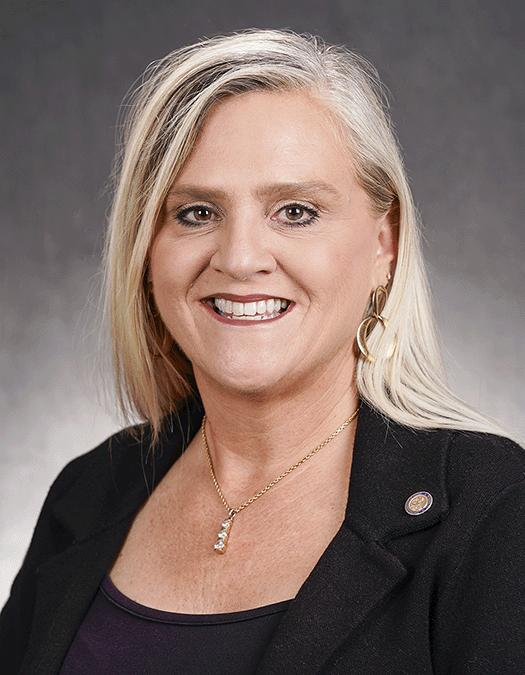
Rep. Pam Altendorf
Sponsored bills
Maddy summaryHF 190 requires the Metropolitan Council to publish monthly ridership data for all transit routes (including original funding projections) and quarterly crime statistics broken down by transit mode and crime type. The bill mandates that these reports be posted on the Council's website within 60 days of each month and quarter, with each report remaining accessible for at least five years. This directly affects the Council's reporting obligations and provides the public with transparent, regularly updated information on transit usage and safety. The law does not change transit operations or funding but standardizes data disclosure for accountability.
Maddy summaryHF 65 repeals the state's authority to adopt statewide health education standards for Minnesota public schools and cancels related funding. This bill directly affects public schools, as it removes the requirement for them to implement new statewide health standards (previously planned for implementation), allowing them to continue using locally developed health curricula instead. Key provisions include amending education statutes to clarify that "locally developed academic standards in health apply" without needing state adoption. The bill does not change standards for other subjects like math, science, or language arts, which remain subject to statewide requirements. The effective date for these changes is July 1, 2025.
Maddy summaryHF 655 amends Minnesota's child care licensing rules to allow family child care providers to exclude up to two of their own children when calculating licensed capacity. This directly affects home-based child care providers who operate from their residences. The bill requires the Commissioner of Children, Youth, and Families to update Minnesota Rules (part 9502.0365) to exclude the provider's own children from the capacity count. The change simplifies capacity calculations for these providers without requiring new licensing standards.
Maddy summaryHF 638 prohibits Minnesota cities, counties, townships, and school districts from adopting or enforcing ranked-choice voting (RCV) for local elections. The bill defines RCV as any system where voters rank candidates by preference, and states that any local rules conflicting with this prohibition are void. It directly affects all local governments seeking to implement RCV for local offices, preventing them from using this voting method. The law takes effect after enactment and applies to future elections. This is a policy change restricting local election method choices, not a procedural or commemorative measure.
Maddy summaryHF 896 amends Minnesota law to permit certain retired law enforcement officers who are authorized to carry firearms to possess them on school property, changing the penalty from a felony to a misdemeanor. It directly affects retired officers with valid firearm authorization, allowing them to carry weapons in schools under specific conditions. The key provision modifies Minnesota Statutes § 609.66, subdivision 1d, to exempt these officers from the general prohibition on firearms in schools (which typically carries felony penalties), while clarifying that such firearms cannot be forfeited. The bill applies to authorized officers on school property but does not override existing rules for active officers or other exceptions. It becomes effective August 1, 2025.
Maddy summaryHF 899 modifies Minnesota's prohibition on American Indian mascots in public schools, effective September 1, 2026. It bans schools from using names, symbols, or images depicting American Indian tribes or traditions as mascots, nicknames, or team names - except for schools on tribal reservations with at least 95% American Indian students. The bill requires non-compliant districts to report progress by specific dates and establishes a $2,026,000 fund to reimburse schools for replacing prohibited mascots on uniforms, signage, and facilities. Schools applying for funding can delay compliance until their request is approved, with funds available until July 1, 2028.
Maddy summaryHF 892 allows Minnesota parents to opt their children out of school face covering requirements without needing to provide a reason or health documentation. It applies to all public school districts and charter schools that require face coverings on school premises. Schools must permit the opt-out upon parent notification and cannot discipline students or treat them differently for this choice. The law takes effect the day after it is signed into law.
Maddy summaryHF 894 amends Minnesota law to explicitly exclude undocumented noncitizens from eligibility for MinnesotaCare, the state's health insurance program. The bill defines "undocumented noncitizens" as individuals residing in the U.S. without approval from U.S. Citizenship and Immigration Services. This change directly affects noncitizens without legal immigration status who previously qualified for MinnesotaCare, while maintaining eligibility for U.S. citizens, nationals, and lawfully present noncitizens under existing rules. The amendment takes effect the day after final enactment.
Maddy summaryHF 636 removes the requirement for a permit to carry a firearm in public places for eligible Minnesotans, while creating an optional permit system. The bill amends Minnesota Statutes 624.714 to state that anyone not prohibited by state or federal law (and at least 21 years old) may carry a firearm without a permit in public places - defined as government-owned property or private property open to the public, excluding homes, businesses, gun shops, and hunting areas. An optional permit, which requires proof of pistol safety training and background checks for disqualifying offenses, remains available for those who choose it. This change directly affects eligible residents who currently need permits to carry firearms in public, eliminating that barrier while preserving the option for a permit.