

Maddy summaryHF 2686 requires cities, counties, and towns to formally approve any intercity or commuter rail project before planning or construction can begin. The commissioner of transportation must obtain approval through either a local government resolution or a majority vote in a general election. After local approval, the commissioner must submit the project's physical design to affected local governments at least 30 days before a public hearing on the advanced corridor plan. This bill directly affects local governments, the commissioner, and rail project developers by mandating community input at multiple stages of rail project planning.
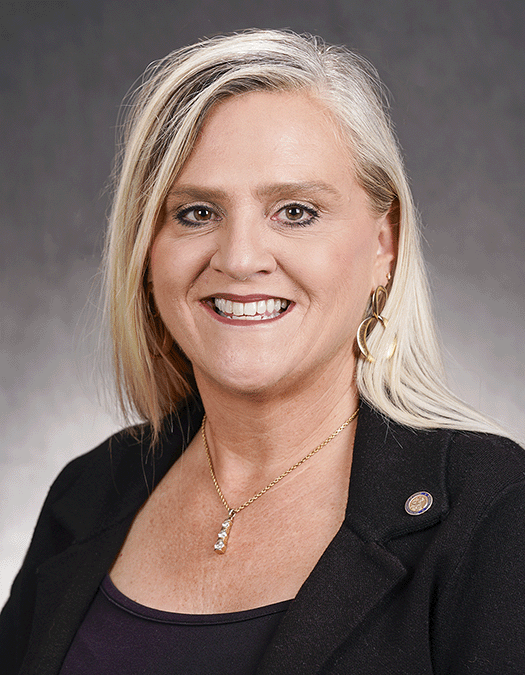
Rep. Pam Altendorf
Sponsored bills
Maddy summaryHF 2648 prohibits certain sex offenders convicted of crimes against minors under 18 from accessing social media platforms where users under 18 can interact. It requires these individuals on parole or probation to disclose all social media account details (including usernames and passwords) to their supervising agent and bans access to platforms allowing minor users. The law defines "social media platform" narrowly to exclude email, search engines, and business communication tools. The commissioner must annually publish a list of compliant platforms for probation agents to enforce these restrictions. This directly affects sex offenders sentenced under Minnesota statutes 609.342-609.3458 for offenses involving minors under 18.
Maddy summaryHF 2063 designates July 2 each year as "1st Minnesota Day" to honor the 262 men of the 1st Minnesota Regiment who fought for the Union at the Battle of Gettysburg on July 2, 1863. The bill requires the governor to issue an annual proclamation, encourages schools to teach about the regiment's Civil War role, and mandates that the Minnesota Historical Society's replica regimental flag be flown at the State Capitol on July 2. It directly affects state government officials, public schools, and Capitol operations through these ceremonial requirements. The bill establishes a recurring observance without creating new taxes, regulations, or funding.
Maddy summaryHF 2682 appropriates $6,000 from Minnesota's general fund to provide a $1,200 bonus to eligible veterans who served in qualifying campaigns under Minnesota law but did not receive a bonus under existing provisions (Minnesota Statutes, section 197.79). Veterans must submit military discharge documents (DD214) confirming their service to the state veterans affairs commissioner by December 31, 2028, to qualify for the payment. The funds are available until June 20, 2029, to cover eligible bonus payments. This bill directly affects veterans meeting specific service criteria who were previously excluded from bonus eligibility under current state law.
Maddy summaryHF 1580 amends Minnesota law to require medical personnel to provide immediate care to infants born alive during abortion procedures. The bill mandates that such infants be recognized as human persons under the law and that all reasonable medical measures, consistent with standard practice, be taken to preserve their life and health, including proper medical documentation. This directly affects healthcare providers performing abortions in Minnesota who encounter infants born alive. The law takes effect the day after final enactment. It focuses solely on medical care protocols for surviving infants, not on changing abortion access or legality.
Maddy summaryHF 2192 eliminates Minnesota's North Star Promise scholarship program and redirects any unspent funds from its special revenue account to the state grant program. The bill repeals the program's funding statute (Minnesota Statutes §136A.1465) and requires transferring unencumbered balances to the state grant program by July 2025, with the account closed by August 2025. This affects future scholarship recipients who would have qualified for North Star Promise, as the program will no longer provide aid starting fall 2025. The state grant program will now receive these redirected funds, though the bill does not create new scholarship eligibility or funding.
Maddy summaryThis bill recognizes Minnesota's historic state flag (described as a blue flag with a central emblem featuring 19 stars, the word "MINNESOTA," and scenes from the Great Seal) and grants all Minnesotans the right to display it. It requires the lieutenant governor to set standards for its display on state property, mandating it be shown during specified holidays and on Capitol grounds during legislative sessions. The bill also allows the historic flag to be displayed on other public property for ceremonial purposes, while requiring it to be placed beneath the official state flag when both are displayed together. It directly affects all Minnesotans who display the flag and government entities managing public property.
Maddy summaryThis bill authorizes the Minnesota Department of Transportation (MnDOT) to research autonomous mower technology for use on state-owned properties like rest areas, highway rights-of-way, and other public spaces. It requires MnDOT to study safety, cost-benefit, worker impact, and commercial availability, with a focus on Minnesota-based companies for any equipment purchases. The bill appropriates $150,000 in fiscal year 2026 for this research and mandates a detailed report by February 15, 2027, covering pilot project plans, cost analyses, and safety evaluations. The research directly affects MnDOT operations and could influence future roadside maintenance practices.
Maddy summaryHF 897 amends Minnesota law to prohibit exposing children and vulnerable adults to fentanyl, methamphetamine, or related substances in specific locations. It makes it illegal for anyone to knowingly cause or permit such exposure in places like homes, public buildings, or overnight accommodations where children or vulnerable adults might be present. The bill adds criminal penalties for violations, including for exposing individuals to fentanyl (newly specified in the amendment) or methamphetamine-related materials. This directly affects caregivers, property owners, and anyone in environments where children or vulnerable adults could be present.
Maddy summaryHF 4 proposes a constitutional amendment requiring Minnesota to return budget surplus funds to taxpayers. If approved, it would create a "Minnesota tax relief account" funded by revenue exceeding 105% of projected spending, using those funds to refund or reduce property and income taxes. Taxpayers would receive direct refunds or tax reductions, but only up to the amount they owe in taxes, with the account funded annually from the state's general fund surplus. The amendment must be voted on by voters in the 2026 general election.