

Maddy summaryHF 24 amends Minnesota Statutes section 145.423 to require that infants born alive during an abortion be immediately recognized as human persons under the law and receive medical care. The bill mandates that medical personnel take "all reasonable measures consistent with good medical practice" to preserve the life and health of such infants, including compiling appropriate medical records. It directly affects healthcare providers performing abortions in Minnesota by establishing specific medical care obligations for infants born alive. The proposed changes would have taken effect the day after enactment, though the bill was not passed.
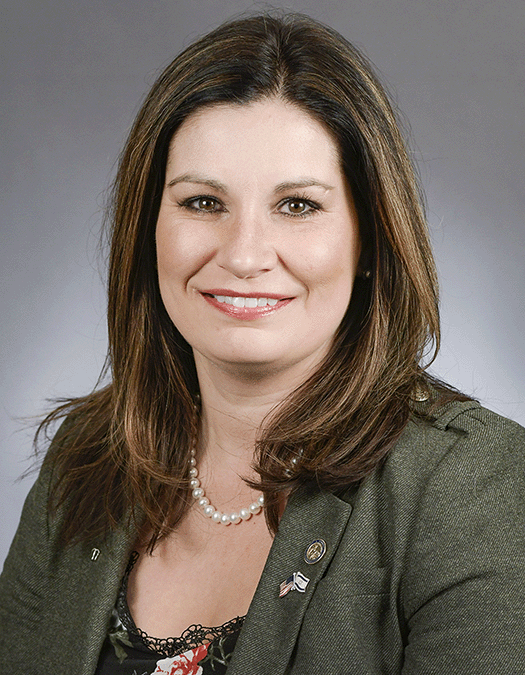
Rep. Mary Franson
Sponsored bills
Maddy summaryHF 2313 prohibits installing smartphone software that secretly tracks another person's location, microphone, camera, or text messages without their consent. It requires such apps to be clearly visible on a device and mandates two-factor authentication at installation and monthly to prevent unauthorized use. The bill directly affects individuals whose smartphones might be monitored without permission, while allowing exceptions for parents tracking minors, employers with written notice for business purposes, and law enforcement with proper authorization. Key provisions include requiring conspicuous app displays, mandatory identity verification for monitoring apps, and banning unauthorized collection of geolocation or device data.
Maddy summaryHF 261 appropriates $250,000 for fiscal year 2026 and $250,000 for fiscal year 2027 to fund horse-assisted mental health therapy for eligible first responders in Minnesota. It directly affects active or retired peace officers, firefighters (full-time and volunteer), ambulance personnel, 911 telecommunicators, and correctional officers suffering from job-related trauma or PTSD. The funds will go to Abijah's on the Backside for therapy services, requiring two reports detailing program costs, participants, and outcomes by 2026 and 2028. This is a one-time appropriation to support existing mental health services for first responders, not a new statewide program.
Maddy summaryHF 11 delays the implementation of Minnesota's Paid Leave Law from 2026 to 2027, affecting employers, employees, and state agencies responsible for administering the program. The bill amends multiple statute sections to adjust key dates, including the start of employer premium payments (now January 1, 2027) and administrative requirements like public outreach and annual reporting. This one-year delay provides additional time for businesses to prepare for the new paid leave program without changing the law's core requirements. The law's substance - such as premium rates and fund management - remains unchanged, only the rollout timeline is extended.
Maddy summaryHF 1974 creates a new tax benefit for employees of critical access dental clinics in Minnesota. It allows these employees to exclude student loan payments made by their employers from their taxable income, effectively reducing their state income tax burden. The bill defines "critical access dental clinics" as those designated under state law (section 256B.76, subdivision 4) and specifies that employer payments must meet IRS criteria for educational assistance. This provision applies to taxable years beginning after December 31, 2025.
Maddy summaryHF 10 prohibits Minnesota state-funded financial assistance, including health coverage and college scholarships, for undocumented noncitizens. The bill explicitly excludes undocumented noncitizens (defined as those residing without U.S. Citizenship and Immigration Services approval) from MinnesotaCare (state health insurance) and the North Star Promise scholarship program. It amends state statutes to require that these programs deny eligibility to individuals without lawful immigration status. The policy change takes effect upon final enactment, with scholarship eligibility applying to awards beginning in the 2025-2026 academic year.
Maddy summaryHF 415 would allow Minnesota taxpayers to subtract their overtime pay from taxable income when filing state income taxes. It specifically covers wages, salaries, tips, and other compensation earned for hours worked beyond the standard workweek under Minnesota or federal law. This change reduces taxable income for eligible workers, potentially lowering their state tax burden. The provision takes effect for tax returns filed in 2025 and later.
Maddy summaryHF 819 establishes the Minnesota Sustainable Foraging Task Force to develop science-based recommendations for foraging regulations on state lands. The task force, composed of 16 diverse members including Indigenous knowledge holders, scientists, conservation representatives, and foraging advocates, must gather data on foraging impacts, review current rules, and create guidelines balancing public access with ecological protection. It is required to produce a report with specific, actionable recommendations - including a permitting model allowing volunteer options - by December 1, 2026. The bill directly affects Minnesotans who forage on public lands and aims to guide future regulations through data-driven, inclusive processes.
Maddy summaryHF 1786 amends Minnesota law to allow cities to issue on-sale liquor licenses to licensed cosmetology salons. This change directly affects cosmetology salons that already hold valid state licenses under section 155A.29, enabling them to serve alcohol on-site. The bill adds cosmetology salons to the list of approved establishments (previously including hotels, restaurants, and clubs) eligible for such licenses. The amendment modifies Minnesota Statutes section 340A.404, subdivision 1, and takes effect upon final enactment.
Maddy summaryHF 1160 appropriates funds from the general fund for a one-time grant to Union Gospel Mission Twin Cities, a 501(c)(3) nonprofit organization. The grant will support the design and construction of a new women and children's family shelter and transitional housing at 376 Western Avenue in St. Paul, as well as capital improvements at the men's campus at 435 University Avenue East in St. Paul. The appropriation is designated for fiscal year 2026 and remains available until the projects are completed or abandoned. This bill directly provides funding for specific facility projects at the nonprofit's St. Paul locations.