

Maddy summaryHF 434 amends Minnesota law to allow the importation of live Cervidae (deer, elk, moose, etc.) into the state for certain accredited facilities. Specifically, it permits importation by facilities accredited by the Association of Zoos and Aquariums (AZA), provided animals come from herds in certified chronic wasting disease (CWD) programs and meet testing requirements. The bill maintains existing CWD prevention rules but creates a specific exception for AZA-accredited institutions, including allowing importation of semen from certified herds and orphaned non-CWD-susceptible animals after risk assessment. This directly affects AZA-accredited zoos and aquariums seeking to import live Cervidae for conservation or display. The change modifies Minnesota Statutes § 35.155, subdivision 12, without altering broader CWD testing or seizure provisions.
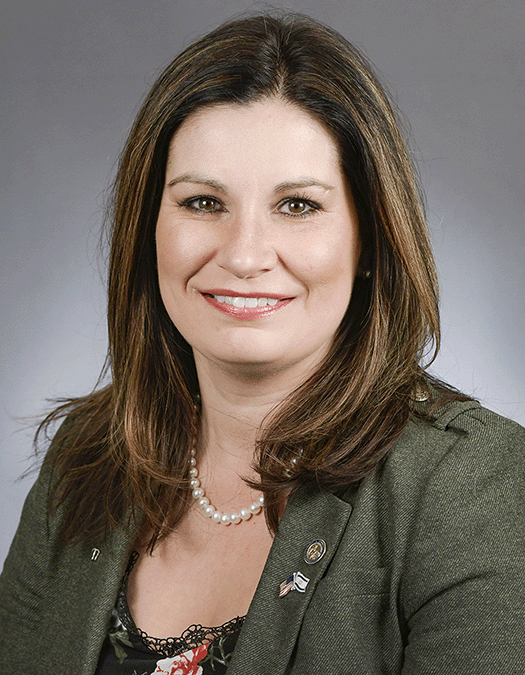
Rep. Mary Franson
Sponsored bills
Maddy summaryHF 1389 transfers specific state-owned land at the Cloquet Forestry Center in Carlton County to the University of Minnesota Board of Regents. It appropriates $1.3 million from the general fund to pay off existing state bonds financing improvements on this property, removing it from "state bond-financed property" status under Minnesota law. This debt payment enables the University of Minnesota to eventually return the land to the Fond du Lac Band of Lake Superior Chippewa, as stated in the bill's purpose. The bill directly affects the state, the University of Minnesota, and the Fond du Lac Band by facilitating a land transfer.
Maddy summaryHF 435 requires the Minnesota Commissioner of Corrections to house only biological female inmates at the Minnesota Correctional Facility-Shakopee. It amends statute 243.90 to establish the facility exclusively for biological females committed by courts. Existing inmates who are not biological females must be transferred to another facility within seven days of the bill's enactment. This requirement expires on January 1, 2026. The bill directly affects inmates housed at Shakopee and the commissioner's facility assignment decisions.
Maddy summaryHF 1411, the Bail Abatement Nonprofit Exclusion (BANE) Act, prohibits Minnesota nonprofits from registering to pay bail for individuals or to courts to satisfy bail conditions. The law directly affects nonprofits that might have intended to operate bail payment services. It adds a new provision to Minnesota law making such activity illegal under nonprofit registration rules. This bill does not change existing bail procedures but specifically prevents nonprofits from entering the bail payment industry.
Maddy summaryHF 436 establishes a property tax exclusion for Minnesotans aged 65 or older who are retired. It excludes all market value of qualifying primary residences (classified as 1a, 1b, or the home portion of an agricultural homestead) from taxable value for property owners meeting the age and retirement criteria. To qualify, applicants must submit a form by December 31 each year, and the exclusion applies until the property is sold, transferred, or no longer qualifies as a homestead. This exclusion replaces eligibility for other programs like senior tax credits or deferral programs. The policy takes effect for 2026 property taxes.
Maddy summaryHF 1262 establishes a new temporary license for food trucks to sell intoxicating liquor at community festivals, events, or private catering contracts. It directly affects food truck businesses operating within Minnesota municipalities, requiring them to obtain a license from local governments that specifies event conditions, mandates liability insurance, and limits sales to specific event durations. The bill requires licensees to notify local law enforcement before events and ensures licenses comply with state liquor laws and municipal fees. This change modifies Minnesota Statutes section 340A.404 to create this specific licensing pathway for food trucks.
Maddy summaryHF 416 amends Minnesota Statutes to lower the minimum age for applying for a permit to carry a pistol from 21 to 18 years old. The bill directly affects Minnesota residents aged 18 or older who meet other requirements, such as completing firearm safety training and passing background checks. Key provisions include updating section 624.714, subdivision 2, to reflect the new age eligibility while maintaining existing criteria for permit issuance. This change would allow 18- to 20-year-olds to apply for carry permits under the same conditions as older applicants.
Maddy summaryHF 577 appropriates $6 million in state bond funds to Lake of the Woods County for new law enforcement and government facilities. The funds will cover designing, building, and equipping these facilities, including expanded mental health and emergency operations spaces, while improving accessibility, energy efficiency, safety, and security. The state will issue bonds up to $6 million to cover this appropriation, following standard bond procedures under Minnesota law. This bill directly affects Lake of the Woods County government by providing capital funding for public safety infrastructure.
Maddy summaryHF 347 expands Minnesota's individual income tax deduction for military retirement pay. The bill adds three specific provisions allowing taxpayers to subtract military retirement income from taxable income: (1) certain military pensions under federal law, (2) federal employee retirement pensions multiplied by military service ratio, and (3) civil service retirement pensions multiplied by military service ratio. It also prohibits taxpayers claiming another specific credit (section 290.0677) from using this deduction. The change applies to tax years beginning after December 31, 2024, directly benefiting Minnesota residents receiving qualifying military retirement pay.
Maddy summaryHF 413 amends Minnesota Statutes to lower the age for license-free fishing from 90 to 65 years old for state residents. It directly affects Minnesotans aged 65 or older who wish to fish without purchasing a license. The bill changes Section 97A.451, subdivision 8 of Minnesota Statutes to state that residents 65 or older may fish without a license. This is a straightforward policy change modifying eligibility criteria for recreational fishing privileges. The amendment does not alter other fishing regulations or fees for younger residents.