

Maddy summaryHF 1029 requires Minnesota's health commissioner to add metachromatic leukodystrophy (MLD) testing to the official list of required medical tests for detecting heritable or congenital disorders. The bill mandates periodic updates to this test list to reflect medical advancements, new testing methods, and factors like test accuracy, treatability of conditions, and disorder severity. This directly affects healthcare providers and patients in Minnesota who rely on these screenings for early detection. The commissioner must follow specific criteria when revising the list, including input from an advisory committee, but revisions are exempt from standard rulemaking procedures.
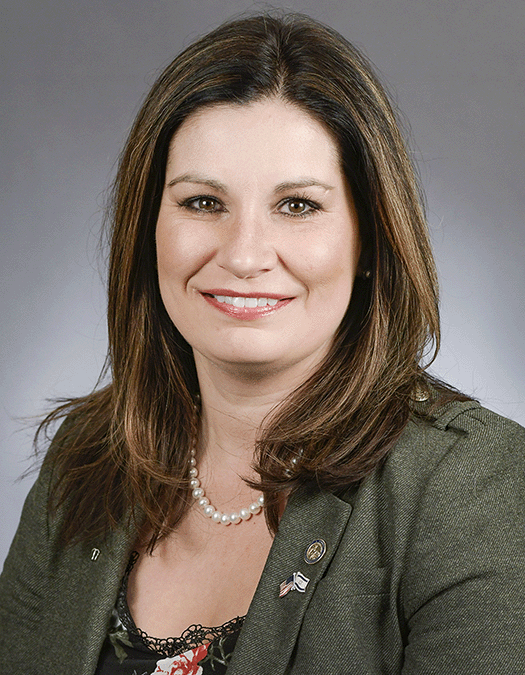
Rep. Mary Franson
Sponsored bills
Maddy summaryHF 2844 appropriates $102.99 million for the University of Minnesota's Higher Education Asset Preservation and Replacement (HEAPR) program, $102.99 million for Minnesota State Colleges and Universities' HEAPR program, $900,000 for library construction grants, and smaller sums for Minnesota State Academies (including student center and therapy pool predesign) and the Perpich Center for Arts Education. The bill authorizes spending bond proceeds and specific funds to acquire, improve, and better public land, buildings, and capital assets at state institutions, with strict requirements on project completion timelines and funding sources. It modifies existing programs like HEAPR and specifies that funds cannot replace routine operations or projects that could be financed through other means. This bill directly affects public universities, colleges, state schools, and cultural institutions by providing targeted capital improvement funding for facility upgrades.
Maddy summaryThis bill modifies Minnesota's criteria for when family caregivers (parents, spouses, or legal guardians) can receive payment for providing home nursing care under state home care programs. It adds a new hardship condition allowing payment if family caregivers are needed due to "labor conditions, special language needs, or intermittent hours of care" required to meet a recipient's medical needs. The bill maintains existing limits, including a maximum of 40-60 hours per week for family caregivers and requirements that licensed nurses must conduct safety assessments. It directly affects family members providing home care nursing services for eligible recipients under Minnesota's state plan or waiver programs.
Maddy summaryThis bill appropriates $11 million from the general fund to fund a new facility in Richfield for Minnesota Independence College and Community, a nonprofit organization. The funding will cover predesign, construction, furnishing, and equipping of a facility specifically designed to provide education and training services for individuals with autism spectrum disorder, along with administrative space for staff. The money is available until the project is completed or abandoned, as specified in Minnesota Statutes. The bill directly affects the nonprofit organization and individuals with autism spectrum disorder in the Richfield community who will use the facility's services.
Maddy summaryThis bill clarifies that chiropractors in Minnesota may provide telemedicine services as part of their practice. It also gives the State Board of Chiropractic Examiners authority to discipline chiropractors who fail to follow executive orders, such as public health directives. Additionally, it reorganizes the legal sections related to animal chiropractic care, which involves treating nonhuman animals for spinal issues without surgery or medication. These changes directly affect licensed chiropractors, the State Board, and practitioners offering animal chiropractic services.
Maddy summaryHF 2476 modifies Minnesota's restrictions on over-the-counter sales of products containing ephedrine or pseudoephedrine (commonly found in some allergy medications and cold remedies, but primarily regulated due to their use in methamphetamine production). The bill limits single sales to no more than 6 grams of these substances (by weight), requires sales to occur behind a counter with a licensed pharmacist, mandates ID checks showing date of birth, and requires written records of each sale to be kept for three years. It also prohibits sales to anyone under 18 and caps total purchases at 7.2 grams within 30 days. These changes directly affect pharmacies selling such products and customers purchasing them.
Maddy summaryHF 1100 requires Minnesota's human services commissioner to establish a $4.50 per prescription payment to eligible community pharmacies in rural or underserved areas. This payment, added to existing fees, must be paid by managed care plans, county health programs, and pharmacy benefit managers to qualifying pharmacies that serve medically underserved populations or share ownership with 12 or fewer Minnesota pharmacies. The bill appropriates funds for this program in fiscal years 2026 and 2027, with the payment ending if federal approval isn't obtained. It explicitly states this payment cannot replace or reduce other fees paid to pharmacies.
Maddy summaryHF 2468 appropriates $500,000 for fiscal year 2026 and $500,000 for fiscal year 2027 from the general fund to support mental health initiatives in Minnesota's construction industry. The funds, available until June 30, 2027, are designated for outreach, education, stigma reduction programs, and worksite strategies to prevent suicide. They can be used for grants to industry groups and developing resources targeting construction workers. This bill directly affects construction industry workers by funding concrete mental health support services through state-administered programs.
Maddy summaryMinnesota's legislature has passed a resolution requesting Congress to call a constitutional convention under Article V of the U.S. Constitution. The resolution asks for proposed amendments to impose budget rules on federal spending, reduce federal government authority over states, and limit terms for federal officials and members of Congress. This is a procedural step - Minnesota is formally petitioning Congress, not creating new laws. The resolution serves as Minnesota's ongoing application for such a convention, pending similar actions by two-thirds of states.
Maddy summaryHF 25 establishes a state grant program administered by Minnesota's Department of Health to fund nonprofit women's pregnancy centers and maternity homes. The program provides financial support for services like housing, medical care, parenting education, and mental health resources to help pregnant women and new mothers - particularly those facing homelessness or crisis - carry pregnancies to term and care for their children. Eligible organizations must be nonprofits offering free or low-cost services without promoting abortion, providing abortion care, or referring women to abortion providers. Grant funds cannot be used for abortion-related activities, and strict privacy rules require written consent before sharing personal information about clients. The bill appropriates state funds for this program while reducing other health-related appropriations.