

Maddy summaryThis bill creates a new 100% tax on money obtained through fraud by individuals or organizations, regardless of whether they have already paid fines or restitution. It applies to those convicted by a court, those identified by the state revenue commissioner as having committed fraud, and anyone paid to help facilitate such fraudulent activities. The revenue collected from this tax must be used exclusively to provide relief for state income or property taxes. The law takes effect retroactively for fraud cases determined after December 31, 2019.
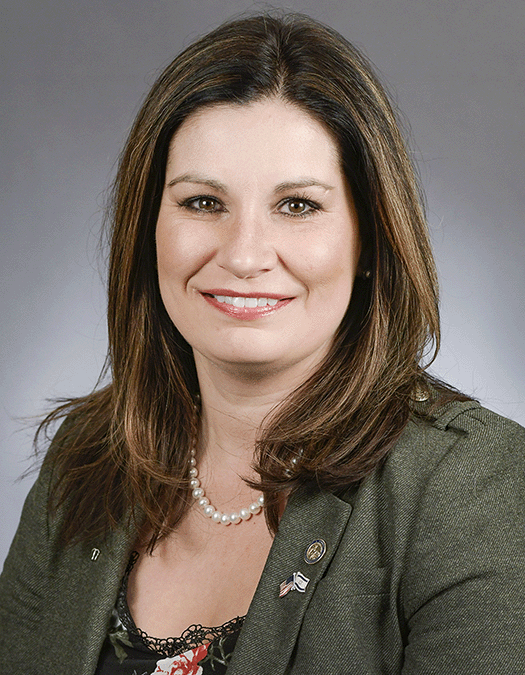
Rep. Mary Franson
Sponsored bills
Maddy summaryThis bill updates the wage calculation framework for staff working in family residential services in Minnesota, directly affecting service providers and employees in this sector. It establishes specific formulas for determining base wages for various staff roles, such as supervisors, nurses, and direct care workers, by tying their pay to median wages for comparable occupations. The legislation also introduces a temporary lower wage rate for asleep-overnight staff that applies until 2027 or federal approval, while other staff categories receive wage calculations based on weighted percentages of median wages for related job classifications.
Maddy summaryThis bill proposes a tax on plastic bottles containing less than three liters of beverage in Minnesota to raise funds for water infrastructure projects. The tax would be levied on distributors who sell these bottles to retailers, with the revenue collected in a dedicated state account managed by the Public Facilities Authority. Money in this account can only be used to finance specific water-related projects approved by the authority, and the tax is scheduled to begin on January 1, 2027, with provisions set to expire in 2031.
Maddy summaryHF 3513 defines key terms for autonomous vehicles in Minnesota Statutes, establishing a regulatory foundation for future rules. It adds definitions for terms like "automated driving system" (level 4/5 vehicles), "dynamic driving task," "minimal risk condition," and "on-demand autonomous vehicle network" to clarify operational standards. The bill does not impose new restrictions or requirements but creates the terminology needed for future legislation governing autonomous vehicle safety and operation. This procedural update prepares Minnesota’s legal framework for regulating self-driving technology as it develops.
Maddy summaryThis bill authorizes the state of Minnesota to use a lease-purchase agreement and the sale of certificates of participation to fund improvements or replacement of its MAXIS system. Under this plan, the state would lease the project from a vendor or financing source and pay for it in installments over a period of up to ten years. The legislation establishes specific rules for how the state must manage the funds, including requirements for insurance, liability, and financial reporting within a dedicated project fund. It also allows the state to transfer money from its general fund to cover expected costs before the financing proceeds are received.
Maddy summaryHF 5 modifies Minnesota's tax structure by repealing the retail delivery fee and establishing an "unlimited Social Security subtraction," allowing taxpayers to subtract all their Social Security benefits from state taxable income. It redirects transportation funding by creating a "transportation advancement account" and requires specific distribution percentages: 36% to metropolitan counties, 28% to county highway funds, 23% to larger cities, 34% to small cities, 15% to town roads, and 1% to food delivery support. The bill also mandates tax analysis and reporting requirements for transportation funding impacts and modifies several tax statutes, including those governing Social Security benefit subtractions. These changes directly affect Minnesota taxpayers, local governments, and transportation agencies, effective July 1, 2025.
Maddy summaryThis bill allocates $5,000,000 from the state's general fund to support the construction and equipping of a community center on the White Earth Reservation. The funding is designated for the White Earth Band of Ojibwe and will cover costs such as design, site preparation, construction, and furnishing. The new facility is intended to offer space for health, wellness, and community gatherings for both Tribal and non-Tribal residents. This one-time appropriation becomes effective immediately upon the bill's final passage.
Maddy summaryThis bill establishes a temporary sales tax holiday for the entire month of July 2026 to commemorate the 250th anniversary of the United States. It directly affects Minnesota retailers and consumers by exempting the sale of most tangible personal property from state sales tax during this period. The exemption applies to all retail sales from July 1 through July 31, 2026, but excludes alcohol, taxable cannabis products, and motor vehicles. The bill takes effect the day after it is finalized and signed into law.
Maddy summaryHF 12 restricts participation on female-designated sports teams in Minnesota K-12 schools to students identified as female at birth, based on specific medical criteria. It requires students in disputes about sex to provide a physician's statement confirming their sex using three factors: reproductive anatomy, natural testosterone levels, and chromosome analysis. The bill directly affects public and private schools offering girls' sports teams and students seeking to join them. It amends Minnesota education law to take effect July 1, 2025.
Maddy summaryHF 3127 modifies Minnesota's pass-through entity tax election process, allowing certain businesses (like partnerships and S corporations) to file a single tax return instead of requiring each owner to file individually. It specifies that qualifying entities must meet ownership thresholds (over 50% of qualifying owners) to elect this tax, and the election is irrevocable for the tax year. The bill clarifies that the tax amount equals each qualifying owner's income multiplied by Minnesota's highest individual tax rate, without allowing standard deductions. This directly affects pass-through business owners and entities filing under Minnesota Statutes 289A.08 and 290.06. The changes streamline tax filing for these entities while maintaining the tax calculation method.