

Maddy summaryHF 3133 modifies Minnesota's health professional education loan forgiveness program to explicitly include medical residents. The bill amends the statute to define "medical resident" as individuals training in family practice, internal medicine, obstetrics/gynecology, pediatrics, psychiatry, or emergency medicine. This change directly affects medical residents completing training in these specialties who wish to qualify for loan forgiveness. The key mechanism is adding medical residents to the list of eligible professionals under the program, expanding access to the existing loan forgiveness benefit.
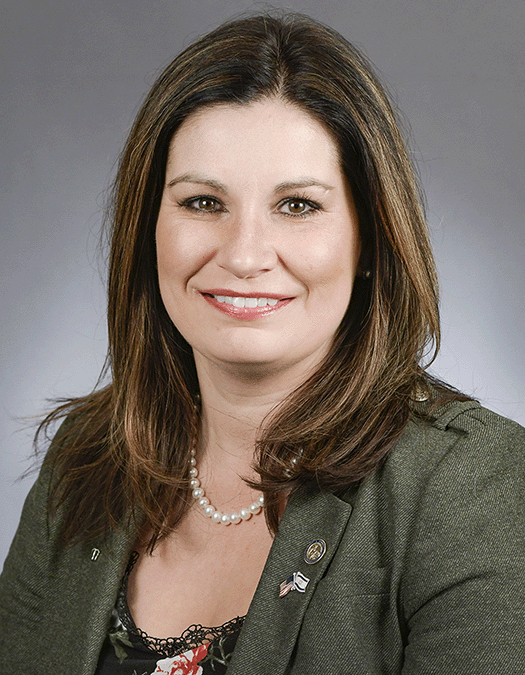
Rep. Mary Franson
Sponsored bills
Maddy summaryThis bill requires the creation of a centralized online portal and database for tracking certified payrolls on all state projects that must follow prevailing wage rules. Contractors working on these projects will need to submit detailed payroll information, including worker classifications, hours worked, and wage rates, which will be publicly accessible and searchable. The system will use electronic forms with digital signatures, and submitting through this portal will satisfy existing reporting requirements, while the state will allocate funding to cover the costs of developing and maintaining the system.
Maddy summaryThis bill removes the standard four-year statute of limitations for medical malpractice claims related to gender-affirming care received by minors in Minnesota. It defines gender-affirming care as medical or surgical interventions such as hormone therapy, puberty blockers, or gender reassignment surgery intended to affirm an individual's perceived gender identity that differs from their biological sex. The change allows patients or former patients to file lawsuits against healthcare providers for alleged errors or failures in such care without being restricted by the usual time limit. The amendment applies specifically to cases involving minor children and does not alter the statute of limitations for other types of medical malpractice claims.
Maddy summaryThis bill designates the Quality Learning Center in Hennepin County as a historic place under Minnesota state law. It achieves this by amending Minnesota Statutes section 138.664 to add a new subdivision specifically naming the facility. The change is administrative and does not alter the center's operations or funding, but it formally recognizes the building's historical significance within the state's historic preservation framework.
Maddy summaryThis bill establishes a new taxpayer refund account in Minnesota to hold undesignated money returned to the state through restitution, fraud recovery, overpayment recovery, administrative fines, or other reimbursements. State agencies must transfer these recovered funds to the commissioner of management and budget within 60 days of receipt, and the funds must be used exclusively for issuing refunds to individual taxpayers who filed Minnesota income tax returns. The commissioner will distribute the accumulated funds as direct payments to eligible taxpayers once the account balance exceeds $300 million, with refunds issued within 120 days after the legislative session ends. The bill also requires the commissioner to create rules for administering the account and determining the refund distribution formula, with provisions taking effect on July 1, 2026.
Maddy summaryThis bill restricts access to certain employee information at secure treatment facilities and correctional institutions in Minnesota to protect staff from potential harassment or violence. It prevents facility patients, clients, and inmates from viewing specific personnel data, including employees' education and work history, payroll details that could reveal home addresses or family locations, and disciplinary records for secure treatment facility staff. The law also requires anyone requesting this information to identify themselves and state their reason for the request. These changes amend existing Minnesota statutes to limit what personal data can be shared with individuals inside these facilities.
Maddy summaryThis bill renames the Perpich Center for Arts Education to the Perpich Quality Learning Center for Arts Education. It amends Minnesota Statutes section 129C.10 to update the official name of the organization's governing board. The legislation requires the state revisor to replace all instances of the old name with the new name throughout Minnesota statutes. This change directly affects the state agency responsible for arts education and its administrative structure.
Maddy summaryHF 2149, the Consumer Grocery Pricing Fairness Act, prohibits large grocery suppliers from offering different terms of sale (like price, discounts, or payment terms) to retailers purchasing the same volume of covered goods. It applies specifically to suppliers with over $6 billion in annual sales to retailers and dominant retailers with over $18 billion in annual sales across 20+ states. The law targets grocery items (excluding gasoline, prescription drugs, tobacco, and alcohol) and requires suppliers to offer identical per-unit terms to all comparable retailers. Violations could result in civil penalties, aiming to ensure fair pricing practices in Minnesota's grocery market.
Maddy summaryThis bill allows Minnesota's Department of Human Services to temporarily stop medical assistance payments to providers while investigating allegations of kickback fraud, without requiring prior notice or a hearing. It expands the state's definition of fraud to explicitly include illegal kickbacks and requires the department to update its rules to reflect this change. The legislation also mandates that providers receive written notice within five days of any payment suspension, explaining the general reasons while protecting ongoing investigation details, and outlines procedures for appealing the decision. Additionally, the bill authorizes the department to impose fines for incomplete documentation and requires forfeited payments to go to the state or managed care organizations when fraud is proven.
Maddy summaryThis bill allows senior hunters aged 65 and older to use motorized waterfowl boats in specific Minnesota wildlife management areas during the waterfowl hunting season. The permission is limited to areas south of U.S. Highway 10 and requires hunters to comply with existing regulations regarding waterfowl hunting. Additionally, the bill directs the state's natural resources commissioner to inform the federal Fish and Wildlife Service about this change and request similar allowances in federal waterfowl production areas.