

Maddy summarySB 767 creates a special fund-raising license plate for Michigan vehicles, with proceeds supporting the Golf Association of Michigan Foundation. The bill establishes a dedicated state fund to receive money from plate sales, which the state treasurer will manage and invest. Quarterly disbursements from this fund will provide resources for the foundation to create golf opportunities for youth, veterans, individuals with disabilities, and families facing financial barriers, including educational and career pathways in golf. The program is administered through the Secretary of State (for plate issuance) and the State Treasurer (for fund management), with no annual lapse of funds.
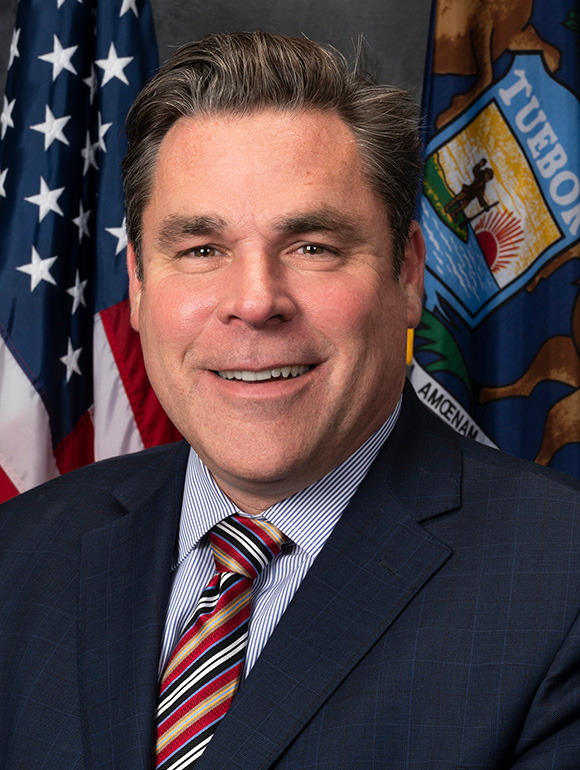
Sen. John Damoose
Sponsored bills
Maddy summarySB 158 prohibits the use of automated programs (bots) to purchase event tickets online in bulk. It directly affects consumers trying to buy tickets fairly and venues or ticket sellers using such bots to manipulate sales. The bill creates a new legal prohibition against these automated ticket-buying practices, making it illegal for businesses to deploy them. This policy change aims to prevent scalping and ensure equitable access to tickets for the general public.
Maddy summarySB 513 amends Michigan's liquor law by changing the legal definition of "brand" under Section 105 of the 1998 Liquor Code (MCL 436.1105) and adds a new Section 604. This directly affects liquor businesses, distributors, and regulators by clarifying how "brand" is legally defined in licensing and regulatory contexts. The bill does not create new taxes or restrictions but adjusts terminology to align with current industry practices. It passed unanimously in the legislature on December 2, 2025, with no opposing votes. (Note: The bill is procedural, focusing solely on statutory definition, not new policy.)
Maddy summarySB 95 (the "hospital price transparency act") prohibits hospitals from attempting to collect debts for services provided when they were not complying with state price transparency laws. It specifically bans hospitals from using debt collectors, suing patients, or reporting debts to credit bureaus for care received during non-compliance periods. The bill directly affects hospitals that fail to publicly list prices for services (like "chargemaster" rates) and patients who received care during those violations. Key provisions define "collection actions" and clarify that hospitals cannot pursue payment for non-compliant billing periods, offering patients remedies if hospitals attempt collection anyway.
Maddy summarySB 512 amends multiple sections of Michigan's liquor distribution laws (1998 PA 58), including provisions related to licensing, distribution channels, and retailer operations. It directly affects liquor distributors, retailers, and potentially consumers by modifying existing regulatory rules. The bill adds a new section (412) and updates specific sections (105, 303, 526, 607, 609b, 1025), though the context does not detail the exact policy changes. The bill passed the legislature on December 2, 2025, with 37 votes in favor.
Maddy summarySB 82 creates new legal protections to enhance the safety of judges, their families, and household members. The bill directly affects judges and their immediate household by limiting public access to personal information like home addresses and phone numbers. Key provisions require courts to implement measures that restrict the disclosure of such details and establish protocols for physical safety. This legislation aims to strengthen existing safeguards against potential threats by making personal information less accessible to the public.
Maddy summaryThis is a memorial resolution honoring Donald Koivisto, a former Michigan State Senator (1990-2002) and House Representative (1981-1986). The resolution expresses the legislature's tribute to his service, highlighting his dedication to the Upper Peninsula, farming community, and bipartisan collaboration. It was unanimously adopted by both chambers as a formal expression of respect for his legacy. The resolution has no policy impact - it solely commemorates his public service.
Maddy summarySB 733 reclassifies "child care microcenters" as a type of "family child care home" under Michigan's child care licensing law. This change directly affects small, home-based child care operations (microcenters) that serve a limited number of children, moving them from the "child care center" category to the "family child care home" category. The key mechanism is amending the legal definition in MCL 722.111 to explicitly include microcenters under family child care home regulations, which typically have different licensing requirements than larger centers. As a result, microcenter operators will now follow the same licensing rules as traditional home-based child care providers instead of facility-based centers.
Maddy summarySB 214 creates a Strategic Advisory Board under Michigan's existing Michigan Strategic Fund Act (1984 PA 270). The board, composed of voting members elected by appointed representatives from business, transit, economic development, housing/utilities, and education sectors, must develop strategic plans to guide the fund's work. It directly affects how the Michigan Strategic Fund operates by requiring formal strategic planning processes. The bill does not change funding levels but establishes a new governance structure to inform the fund's priorities.
Maddy summarySB 213 requires the Michigan Strategic Advisory Board to create a 10-year economic development plan for the state within one year of its appointment, with annual updates thereafter. The plan must include specific goals covering all regions (rural, suburban, urban), infrastructure needs, affordable housing, environmental protection, water resources, education access, and economic opportunities for all residents. It mandates measurable metrics for success, such as population growth and resident prosperity, and requires a "whole-government approach" to achieve these objectives. The bill directly affects the Strategic Advisory Board and Michigan Strategic Fund by establishing their planning obligations under the Michigan Strategic Fund Act.