

Maddy summarySB 805 establishes licensing requirements for standalone hyperbaric oxygen therapy clinics in Michigan. It mandates that these facilities obtain state licensure, appoint a qualified medical director and safety coordinator, comply with NFPA 99 safety standards, and meet FDA-approved treatment protocols. Clinics must display their license/permit and accreditation publicly, provide patients with clear information about treatment risks, FDA-approved uses, and insurance coverage limitations, and obtain written consent before treatment. The bill directly affects clinic operators, healthcare providers, and patients receiving hyperbaric oxygen therapy, ensuring standardized safety and transparency.
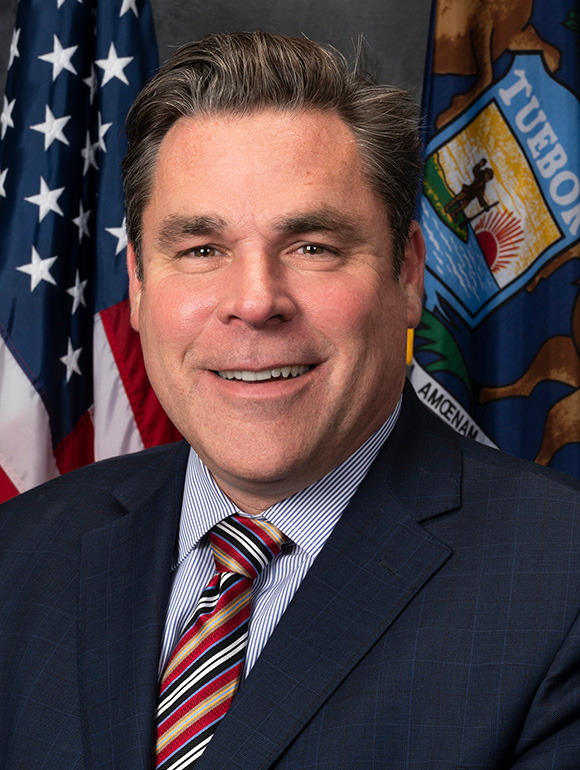
Sen. John Damoose
Sponsored bills
Maddy summaryThis resolution designates February 19, 2026, as "Conductive Education Day" to recognize a teaching method developed in Hungary that helps people with neuromotor disabilities - including cerebral palsy, stroke survivors, and multiple sclerosis patients - improve mobility and independence through neuroplasticity-based learning. It does not create new laws or allocate funding but formally acknowledges Conductive Education's potential to benefit nearly 9 million people in the U.S. and Canada. The resolution encourages broader support for this program without specifying any concrete policy changes. As a symbolic gesture, it directly affects awareness and advocacy for Conductive Education rather than individual beneficiaries.
Maddy summaryThis bill designates a specific segment of M-22 in Leelanau County as the "Company K Indian Veterans 1st Michigan Sharpshooters Civil War Memorial Highway." The designated portion begins at the intersection of M-22 and North Stallman Road and runs north to the intersection of M-22 and North Putnam Road. It amends Michigan's Memorial Highway Act to formally name this highway section in honor of the Civil War unit, with no changes to road infrastructure or policy.
Maddy summarySB 781 creates a special Upper Peninsula vehicle registration plate that drivers can choose instead of standard plates. Vehicle owners pay additional fees ($25 for new plates, $10 for renewals) that fund a dedicated grant program. The money supports Upper Peninsula projects focused on commerce, arts, and history through grants administered by the newly created Upper Peninsula Board. The bill establishes the Board (appointed by the governor) to manage grants and a Plate Commission to design the special plate, with funds disbursed annually starting September 2028.
Maddy summarySB 776 amends Michigan's Use Tax Act to update exemptions for watercraft trade-ins. It specifically clarifies that buyers can apply the agreed-upon value of a *documented* watercraft (one registered with the U.S. Coast Guard) as credit toward the purchase price of a new watercraft from a dealer. This change directly affects watercraft buyers, dealers, and the state’s tax collection process by allowing the trade-in value to reduce taxable purchases, provided the value is separately stated on the invoice. The bill does not change the $2,000 annual credit limit for watercraft trade-ins established in prior law.
Maddy summaryThis bill amends Michigan's sales tax law to maintain an existing exemption for watercraft trade-ins. It allows buyers to apply a credit for the agreed-upon value of a titled or documented watercraft (documented by the U.S. Coast Guard) when purchasing a new or used watercraft from a dealer, reducing the taxable sales price. The credit must be separately stated on the invoice and does not apply to leases or rentals. This directly affects watercraft dealers and customers trading in boats, as it lowers the sales tax owed on the new purchase.
Maddy summaryThis bill amends Michigan's sentencing guidelines (MCL 777.16w) to address cases involving minors exploited in prostitution. It specifically modifies how individuals aged 16 or younger are treated when found in a house of prostitution, shifting the focus from criminalization to victim support. The key change directs courts to prioritize rehabilitation and services for these minors rather than imposing standard criminal penalties. This policy change directly affects minors under 16 who are victims of exploitation, ensuring their cases are handled through a victim-centered approach.
Maddy summarySB 520 amends Michigan's penal code to increase penalties for certain prostitution-related offenses. It raises the maximum penalty for basic violations (under sections 462b-462d) from 10 years to 20 years in prison and from $10,000 to $20,000 in fines. The bill specifically targets individuals who violate these sections, including those operating or facilitating commercial sex, and updates penalties for more severe outcomes like bodily injury or serious harm. These changes apply to anyone convicted under the amended sections of the law. The bill does not alter the scope of prohibited conduct, only the severity of potential punishments.
Maddy summaryThis resolution designates January 2026 as Human Trafficking Prevention Month in Michigan. It formally recognizes the ongoing efforts of law enforcement, advocacy groups, and service providers working to combat human trafficking and support survivors, while emphasizing the importance of public awareness in identifying and preventing trafficking. The resolution does not create new laws or funding but serves as a symbolic acknowledgment to advance prevention awareness.
Maddy summaryThis Senate Resolution (SR 89) is a ceremonial recognition of January 25-31, 2026, as Catholic Schools Week in Michigan. It does not create new laws or policies but formally acknowledges the role of Catholic schools in the state. The resolution highlights that Catholic schools serve over 50,000 students across 207 schools, comply with public school safety standards, and contribute to community values and academic excellence. As a symbolic gesture, it has no binding effect on funding, regulations, or school operations.