

Maddy summaryHB 4361 requires Michigan electric utilities to establish worker transition programs for employees during restructuring events, such as ownership transfers of divisions or facilities. It mandates that new owners must first hire existing non-supervisory workers and maintain their wages and benefits for at least 30 months, with dispute resolution mechanisms for workplace concerns. The bill also directs the Public Service Commission to set service quality and reliability standards for utilities, including outage response and maintenance, and to review annual reports from utilities on compliance. These changes directly affect electric utility workers, employers, and the Public Service Commission.
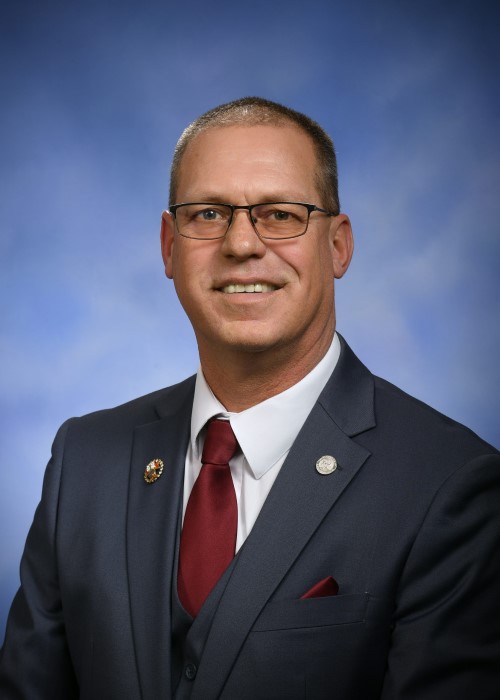
Rep. Greg Alexander
Sponsored bills
Maddy summaryHB 5489 would allow 17-year-olds to apply for medical first responder and emergency medical technician (EMT) licenses in Michigan, provided their application includes parental or guardian consent. It maintains an 18-year-old minimum for higher-level roles like paramedics, emergency medical services instructors, or EMT specialists. The bill amends Michigan's Public Health Code to establish these age requirements for EMS licensure, directly affecting young individuals seeking entry into emergency medical careers. This change requires the concurrent passage of HB 5488 to take effect.
Maddy summaryHB 5491 requires that pat-down searches of visitors and strip searches of prisoners in Michigan state correctional facilities be conducted by staff of the same biological sex as the person being searched. This directly affects visitors to prisons and incarcerated individuals. The bill defines "biological sex" as sex characteristics present at birth (including chromosomes, hormones, and genitalia), excluding gender identity or self-identification. Visitors may opt out of the same-sex requirement by signing a waiver, but strip searches of prisoners must always follow the same-sex rule.
Maddy summaryHB 5490 removes the existing list of prohibited nonnative species from Michigan's Natural Resources and Environmental Protection Act. The bill amends Section 41301 to eliminate specific prohibitions on species like giant salvinia, Asian longhorned beetles, and Eurasian ruffe, which previously required DNR oversight. This change directly affects individuals and businesses that previously had to comply with restrictions on these species. The key mechanism is deleting the defined prohibitions, reducing regulatory authority for the Department of Natural Resources regarding these specific nonnative species.
Maddy summaryHB 5493 regulates how state and local law enforcement agencies use automatic license plate reader (ALPR) systems. It prohibits most ALPR use except for specific purposes like checking for stolen vehicles, outstanding warrants, uninsured vehicles, or active criminal investigations. The bill requires agencies to delete captured plate data within 14 days (unless used as evidence or for ongoing investigations), adopt public policies on ALPR use, and submit quarterly usage reports. It directly affects police departments and other government entities that operate ALPR systems, limiting their data collection and retention practices.
Maddy summaryHB 5488 lowers the minimum age requirement for licensure as a medical first responder or emergency medical technician (EMT) in Michigan from 18 to 17 years old. It amends Section 20950 of the Public Health Code (MCL 333.20950), specifically changing the age requirement in subsection (2)(a) from "18 years of age or older" to allow 17-year-olds to apply. The bill does not alter other licensing requirements, such as education programs, passing exams administered by the National Registry of Emergency Medical Technicians, or military service pathways. This change directly affects 17-year-olds seeking these emergency medical services roles who previously could not obtain licensure until age 18.
Maddy summaryHB 5492, the "regulating automatic license plate readers act," sets rules for private entities operating automatic license plate reader (ALPR) systems, requiring them to preserve captured license plate data for 14 days when law enforcement or a criminal defendant requests it with a specific written statement. The bill prohibits using the data as evidence in court if disclosure would violate the act, mandates data destruction after 14 days if not used, and allows individuals to sue for violations and recover at least $1,000 in damages or actual damages plus legal fees. Vehicle owners' data is protected from public disclosure without consent, except under a court order or warrant, and cannot be accessed by law enforcement without a warrant or specific preservation request.
Maddy summaryHB 4980 amends Michigan's concealed pistol licensing law to allow applicants to file their license applications with *any* county clerk in the state where they reside, rather than requiring filing only in their county of residence. This change directly affects Michigan residents seeking concealed carry permits, simplifying the initial application process. The bill modifies Section 5b of the state's firearms licensing act (MCL 28.425b) to remove the residency county restriction, while maintaining all other requirements like fingerprinting, background checks, fees ($100), and training documentation. It does not alter eligibility criteria, fees, or processing timelines - only the location where applications must be submitted. The bill is pending in the Judiciary Committee as introduced on September 18, 2025.
Maddy summaryThis is a ceremonial resolution, not a law. It declares January 25-31, 2026, as "School Choice Week" in Michigan to recognize existing school choice options. The resolution acknowledges that many Michigan students attend public charter schools, private schools, or are homeschooled, but it creates no new policies or affects any specific groups through legal changes. It serves only as a symbolic observance.
Maddy summaryThis resolution declares January 18-24, 2026, as "Sanctity of Human Life Week" in Michigan. It encourages citizens to reflect on the value of human life, support women and families, and strengthen a "culture of life" through symbolic recognition. The bill does not create new laws, alter policies, or directly affect any specific group or program. It is a ceremonial declaration with no binding requirements or funding mechanisms.