

By Representative Farley-Bouvier of Pittsfield, a petition (accompanied by bill, House, No. 78) of Tricia Farley-Bouvier and others for legislation to establish the Massachusetts consumer data privacy act. Advanced Information Technology, the Internet and Cybersecurity.
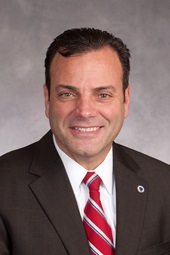
Rep. Paul McMurtry
Sponsored bills
By Representatives Lipper-Garabedian of Melrose and Vieira of Falmouth, a petition (accompanied by bill, House, No. 86) of Kate Lipper-Garabedian, David T. Vieira and others relative to regulation of location information derived from electronic devices. Advanced Information Technology, the Internet and Cybersecurity.
Maddy summaryThis bill requires Massachusetts to address air pollution in communities disproportionately affected by outdoor air pollution. It creates a technical advisory committee to identify pollution "hotspots" near highways, industrial areas, and transportation hubs, and mandates new air monitoring for pollutants like black carbon and ultrafine particles. By 2030, the state must reduce pollution levels in these hotspots by 50% compared to 2026 baselines, with a 75% reduction target by 2035. The bill also requires high-efficiency air filtration systems in specific buildings within 200 meters of pollution sources - including public housing, schools, colleges, and large commercial buildings - to improve indoor air quality for residents and workers.
Maddy summaryThis bill creates a Task Force to analyze electricity cost components affecting Massachusetts residential and commercial customers. The Task Force, chaired by the Attorney General and including utility representatives, will produce a report identifying all charges on electricity bills - such as distribution, transmission, and energy supply costs - along with historical and projected rate changes over 10 years. The report will compare Massachusetts rates to those in other New England states and key economic competitors. It will also examine how costs relate to greenhouse gas reduction goals and be subject to public comment before final submission to state leaders.
Maddy summaryHD 1371 creates a new six-member "Board of Hoisting Machinery Regulations" within Massachusetts' Department of Labor. The board, appointed by the governor, includes a safety inspector (chair), a public utility worker, a construction contractor, a safety trainer, an OSHA expert, and a union representative with five years' experience. This board will establish licensing rules for hoisting machinery operators, including training requirements, supervision protocols for apprentices, and procedures for license issuance, renewal, denial, or revocation based on safety violations. The bill directly affects apprentice and operator license holders and the safety training industry.
By Representative Biele of Boston, a petition (accompanied by bill, House, No. 326) of David Biele and others relative to pipefitting licensure. Consumer Protection and Professional Licensure.
By Representative Arciero of Westford, a petition (accompanied by bill, House, No. 317) of James Arciero, Colleen M. Garry and Paul McMurtry relative to professional licensure. Consumer Protection and Professional Licensure.
Maddy summaryThis bill establishes a licensing system for home care agencies in Massachusetts, requiring most agencies providing home care services to obtain a license from the Secretary of Health and Human Services. It directly affects home care agencies, workers, and consumers (individuals receiving home care), while excluding government agencies, house cleaning services, and existing programs like hospice or home health agencies. Key provisions include mandatory background checks for workers (criminal history, driving records, etc.), minimum standards for service plans and contracts, insurance requirements, and enforcement through fines for unlicensed operation. The law aims to improve safety and consistency in home care by creating standardized oversight, requiring agencies to follow state labor laws, and setting training requirements for staff.
Maddy summaryHD 2873 requires Massachusetts housing authorities using funds from chapter 150 of the 2024 acts to follow specific procurement rules when renovating or repairing public housing properties. For contracts under $10,000, authorities must use "sound business practices" and document vendor details; for larger contracts, they must use competitive bidding or request for proposals with public notice. The bill mandates including prevailing wage requirements, requiring bidders to submit eligibility certificates, and specifying evaluation criteria in writing. These rules apply directly to housing authorities managing properties funded by the designated capital allocation.
Maddy summaryThis bill exempts replacement public housing units from property taxes and special assessments, directly affecting housing authorities and private entities developing new public housing. It requires these entities to pay "payments in lieu of taxes" (PILOT) for the exempt portion, calculated using a formula based on the ratio of replacement unit square footage to total building square footage. The exemption applies only to the specific replacement units and associated common areas, with the PILOT amount determined by the same valuation method used for the housing authority's other properties in the city or town.