

Maddy summaryThe Combating Organized Retail Crime Act amends federal law to strengthen legal tools for addressing organized retail crime, including theft from stores, online, and supply chains. It establishes a new Organized Retail and Supply Chain Crime Coordination Center within the Department of Homeland Security to coordinate Federal, State, local, and tribal law enforcement efforts. The Center will share information, assist with investigations, track crime trends, and provide training to combat these crimes. The bill expands legal definitions to include organized retail crime as a specific category and requires annual reports on the Center's activities. The Center will operate for 7 years before sunset.
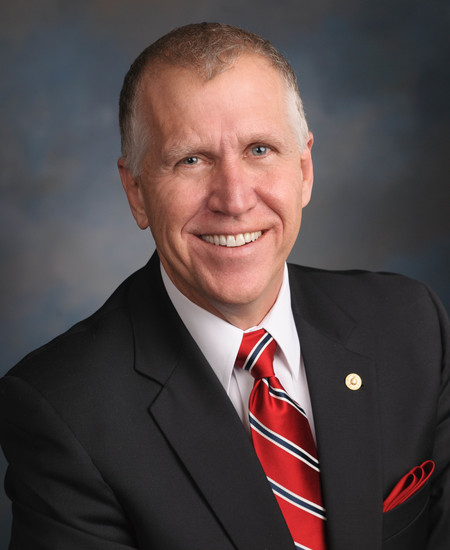
Sen. Thom Tillis
Sponsored bills
Proving Reserves Of Others’ Funds Act or the PROOF Act This bill requires digital exchanges to protect customer funds and provide proof of reserves. Specifically, digital exchanges must minimize (1) customer risk of asset loss, and (2) delays experienced by a customer when accessing assets. With some exceptions, a customer’s assets must be separated from any other assets and may not be used to margin, secure, or guarantee a trade or account of a person other than the customer. Further, digital exchanges and digital custodians must report on their proof of reserves through an attestation from an independent auditing firm or a disinterested third party. The Office of Domestic Finance in the Department of the Treasury must make these attestations publicly available. The bill also provides for the creation of an industry standard for the attestations. Violations are subject to civil penalties.
Maddy summaryS 1418 requires federal agencies to produce three reports analyzing data on threats to law enforcement officers and their well-being. The bill mandates a report on violent attacks (including ambushes) against officers, current training programs, and gaps in gear distribution; a report on adding a new category for non-criminal aggressive incidents against officers; and a report on mental health impacts and available support resources. These reports, due 270 days after enactment, will assess data collection systems, resource effectiveness, and disparities in reporting. The bill directly affects federal, state, and local law enforcement agencies by requiring them to contribute data and shape future safety policies. Its goal is to inform better resource allocation and training based on comprehensive data, not to mandate immediate changes.
Maddy summaryThis bill extends tax filing and payment deadlines for individuals and businesses affected by federally declared disasters, such as hurricanes or wildfires. It modifies the tax code to automatically treat disaster-related delays as extensions for both filing tax returns and making payments, preventing penalties during declared emergencies. Key provisions include amending IRS rules to apply these extensions to tax credit claims and collection notices issued after the bill's enactment. The law directly benefits taxpayers in disaster-impacted areas by providing relief during recovery periods.
Maddy summaryThis bill, the Helene Small Business Recovery Act, allows the President to waive certain federal assistance duplication rules for small businesses affected by major disasters declared in 2023 or 2024. It enables Governors to request waivers that prevent federal loans from being counted as duplicate assistance, ensuring businesses can access multiple aid programs without being blocked by existing rules. The waiver process requires the President to consider cost-effectiveness, equity, and FEMA recommendations within 45 days, and explicitly prohibits applying income limits to eligibility. This directly helps small businesses recovering from qualifying disasters by streamlining access to overlapping federal relief programs.
Maddy summaryThis bill extends Medicare payment incentives for healthcare providers using alternative payment models, directly affecting Medicare participating doctors and hospitals. It updates specific years in payment formulas from 2026 to 2027 and adjusts the 2027 incentive rate from 1.88% to 3.53%. The key mechanism modifies Medicare payment rules to maintain existing financial incentives through 2028, ensuring continuity for providers participating in these models. The changes are technical amendments to the Social Security Act's Medicare provisions.
Maddy summaryThe provided context does not include a substantive summary or bill text beyond the short title. Without details on the bill's specific provisions, mechanisms, or affected parties, a factual summary cannot be generated. The title "Interagency Patent Coordination and Improvement Act of 2025" suggests a focus on federal patent processes, but no concrete policy changes are described in the given text. For an accurate summary, the full bill language or official summary would be required.
Maddy summaryThis bill requires the Federal Trade Commission (FTC) to study how pharmacy benefit managers (PBMs) and other intermediaries affect prescription drug prices and competition. Specifically, the FTC must report within one year on whether PBMs charge different prices to pharmacies, steer patients toward pharmacies they own, use pharmacy data for profit, or design formularies to favor expensive drugs. The bill also mandates an interim report within six months and a separate study on sole-source drug manufacturers and enforcement challenges. It does not directly change drug prices or create new regulations, but instead seeks to gather data to inform potential future policy actions. The study focuses on transparency and competition in the pharmaceutical supply chain, with no immediate price-reducing mechanisms.
Maddy summaryThe NO FAKES Act of 2025 establishes legal rights for individuals to control how their voice and visual likeness is used in AI-generated digital replicas. It defines "digital replicas" as highly realistic computer-generated representations that are readily identifiable as an individual's voice or appearance, granting individuals (and their heirs) the right to authorize or prohibit such uses. The law creates liability for unauthorized use of digital replicas or distribution of products designed to create them without authorization, while providing safe harbors for online services that follow specific procedures for handling claims. It preempts state laws regarding voice and visual likeness rights in digital replicas (with limited exceptions) and establishes a 10-year post-mortem right that can be renewed for additional 5-year periods if there's active public use.
Maddy summaryThis bill amends federal rules governing physician self-referral to improve access for rural hospitals. It creates a new exemption for "covered rural hospitals" (defined as rural facilities meeting specific criteria) from certain referral restrictions, while clarifying they aren't required to meet additional criteria. It also removes a prohibition on expanding existing physician-owned hospitals, allowing such expansions to begin immediately upon enactment. The changes directly affect rural hospitals qualifying under the new definition and physician-owned hospitals seeking to expand. The bill modifies existing Social Security Act provisions without creating new programs or funding.