

Maddy summaryThe Paycheck Fairness Act aims to reduce gender-based pay disparities by strengthening protections against wage discrimination. It modifies the "bona fide factor" defense to require employers to prove pay differences are based on job-related factors rather than sex, prohibits reliance on salary history when making hiring decisions, and requires employers with 100+ employees to collect and report pay data disaggregated by sex, race, and ethnicity. The bill enhances penalties for violations, including compensatory and punitive damages, and strengthens non-retaliation protections for employees discussing wages. These changes directly affect employers, employees, and prospective employees, with particular focus on addressing pay gaps that disproportionately impact women and women of color. The act also creates a National Award for Pay Equity in the Workplace to recognize employers making progress in eliminating pay discrimination.
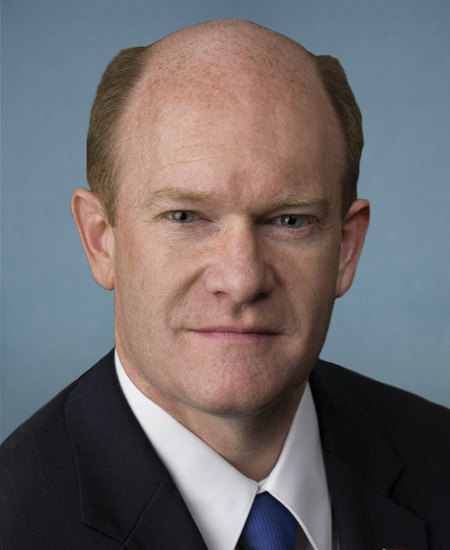
Sen. Christopher A. Coons
Sponsored bills
Maddy summaryThe Richard L. Trumka Protecting the Right to Organize Act of 2023 strengthens workers' rights to organize and bargain collectively by amending key labor laws. It clarifies that multiple employers can be held accountable for labor practices (joint employer definition), makes it harder for employers to misclassify workers as independent contractors, and prohibits employers from permanently replacing workers who strike. The bill requires employers to provide detailed voter lists for union elections, strengthens protections against anti-union discrimination, and increases penalties for unfair labor practices (up to $100,000 for repeat violations). It directly affects workers seeking union representation, employers who must comply with new requirements, and labor organizations conducting organizing campaigns. The bill aims to make it easier for workers to form unions and negotiate better wages and working conditions.
Maddy summaryS 2327, the Afghan Adjustment Act, creates a pathway to permanent residency for Afghans who directly supported U.S. missions in Afghanistan between October 1, 2001, and September 1, 2021. The bill allows eligible individuals already in the U.S. (or paroled into the U.S.) to adjust their status to lawful permanent residents without being subject to visa numerical limits. It establishes a new category of special immigrant visas for at-risk Afghan allies and their relatives, requiring a vetting process equivalent to refugee vetting. The bill prohibits application fees, provides benefits similar to those for refugees, and sets a deadline for applications with authorized funding for implementation.
Maddy summaryS 2299 prohibits the federal government from imposing or carrying out the death penalty for any violation of federal law after the bill's enactment date. It also requires that any person already sentenced to death for a federal offense before enactment be resentenced. The bill directly affects all individuals currently facing or convicted of federal crimes that carry the death penalty under current law. This legislation would eliminate the federal death penalty as a sentencing option and mandate new sentencing hearings for existing death row cases.
Maddy summaryThe Driving for Opportunity Act of 2023 (S 2313) provides federal grants to states that repeal laws allowing driver’s license suspensions for unpaid civil or criminal fines and fees (e.g., traffic tickets, child support). It directly affects millions of people - particularly in rural areas without public transit - who face license suspensions for non-driving-related debt, trapping them in poverty by blocking access to jobs and essential services. The bill’s key mechanism is funding states to reinstate licenses and vehicle registrations suspended for these reasons, with requirements to maximize eligibility, assist those in transportation-limited areas, and report on program outcomes. States must first repeal such suspension laws to qualify for grants, which cover costs of reinstatement and must be reported on annually. The law aims to reduce a widespread "poverty trap" while redirecting law enforcement resources from non-safety-related suspensions.
Maddy summaryS 928, the "Not Just a Number Act," requires the Department of Veterans Affairs (VA) to publish an annual report on veteran suicide rates starting 18 months after enactment. The report must include detailed data broken down by age, gender, and race/ethnicity, plus comparisons between veterans who used VA health services (like Vet Centers or mental health care) versus those who did not, and veterans engaged with VA benefits programs (such as education assistance, disability compensation, or housing loans). The bill also mandates a toolkit for state/local coroners to better identify and report veteran suicides, and a study on creating a dedicated VA suicide prevention office. These requirements aim to improve data collection, analysis, and reporting on veteran suicide trends to inform prevention strategies.
Maddy summaryS 2240, the United States-Israel International Development Cooperation Act of 2023, increases annual funding for US-Israel development projects from $2 million to $4 million (fiscal years 2024-2026) under the Foreign Assistance Act. It directly affects US-Israel cooperative development efforts in countries across Africa, Eastern Europe, and Latin America, focusing on sectors like water technology, agriculture, and education. The bill requires the USAID Administrator to submit a report within 180 days on expanding these projects, including multilateral cooperation with regional partners, and assessing resource needs. This legislation formalizes and scales up existing US-Israel development collaboration, as evidenced by their 2019 partnership agreement.
Maddy summaryThis bill establishes a federal compensation program for poultry farmers whose operations are restricted in "control areas" designated by the Animal and Plant Health Inspection Service (APHIS) due to animal health threats. It requires the Secretary of Agriculture to pay affected farmers an amount calculated as their average income from the five most recent flocks multiplied by the number of flocks they were prohibited from raising during the control period. Compensation is capped to avoid double payments - covering only the difference between the calculated amount and any existing state or other compensation received. Payments must be issued within 60 days of a farmer’s request, and farmers who already received compensation for destroyed animals under existing law are excluded.
Maddy summaryThis bill creates a new renewable fuel credit program under the Clean Air Act to help obligated entities (like refiners and importers) meet their renewable fuel requirements. It sets a fixed price of $0.20 per credit (adjusted for inflation), which can only be used for compliance in the year purchased and cannot be resold or used for other biofuel mandates. Revenue from credit sales is split equally: one-third funds advanced biofuels investments, one-third supports farmers' crop diversification, and one-third goes to the Habitat and Wildlife Restoration Fund. The fund directs money to restore grasslands, wetlands, and other habitats impacted by expanded corn and soy production since 2007, managed through a partnership with the National Fish and Wildlife Foundation.
Maddy summaryThe Nuclear Fuel Security Act of 2023 establishes programs to increase domestic production of nuclear fuel, specifically low-enriched uranium (LEU) and high-assay low-enriched uranium (HALEU), to support advanced nuclear reactor development. It requires the Department of Energy to acquire specific quantities of HALEU by 2026 (3 metric tons by 2024, 8 more by 2025, and 10 more by 2026) while prioritizing domestic production but allowing partnerships with U.S. allies when domestic options are insufficient. The legislation authorizes $3.5 billion for these programs, to be used through 2032, and includes provisions to ensure reasonable compensation for fuel supplied under these programs. The bill directly affects U.S. nuclear energy companies, advanced nuclear reactor developers, and the Department of Energy's operations.