

Maddy summaryThis bill amends over 30 sections of the Internal Revenue Code to replace gendered language like "husband and wife" with gender-neutral terms such as "married couple" or "spouses." It directly affects all married taxpayers by ensuring the tax code refers to married couples in inclusive language, regardless of gender. The key mechanism is updating specific tax code provisions to use neutral terminology throughout, including changing "his spouse" to "the individual's spouse" in numerous sections. This is a technical correction to modernize the language of the tax code, not a change to tax rates, deductions, or policy. The bill does not alter tax obligations or benefits for married couples.
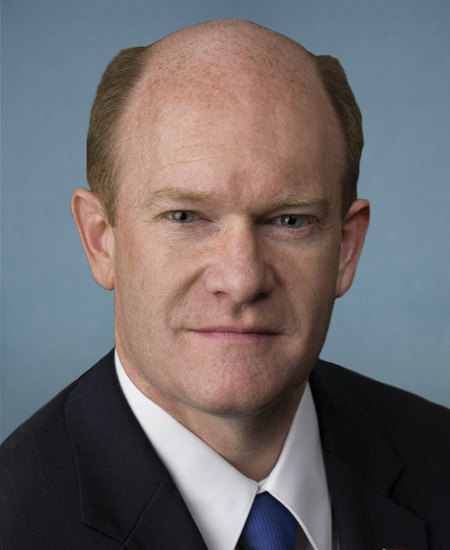
Sen. Christopher A. Coons
Sponsored bills
Maddy summarySRES 282 is a non-binding Senate resolution recognizing June 2023 as "LGBTQ Pride Month" to honor the contributions and resilience of lesbian, gay, bisexual, transgender, and queer individuals across the United States. It does not create new laws or policies but formally acknowledges historical challenges faced by the LGBTQ community, including discrimination, hate crimes (such as the Pulse and Club Q shootings), and barriers to equality in employment, healthcare, and housing. The resolution encourages all Americans to learn about the LGBTQ community's history of struggle and achievement during June 2023. Introduced by 44 bipartisan senators, it serves as a symbolic gesture of support without altering any legal rights or obligations.
Maddy summaryThis resolution (SRES 273) expresses the U.S. Senate’s support for strengthening economic ties between the United States, Canada, and countries in Latin America and the Caribbean through "nearshoring" - relocating supply chains from China to the Western Hemisphere. It highlights vulnerabilities in U.S. supply chains dependent on China (citing pandemic disruptions and China’s use of critical goods as political tools) and emphasizes nearshoring’s benefits, including reduced shipping costs, stronger democratic partnerships, and job creation. The resolution urges U.S. agencies like the State Department, USAID, and the Development Finance Corporation to support nearshoring initiatives by helping partner countries improve infrastructure, combat corruption, and meet labor/environmental standards. It directly affects U.S. foreign policy implementation and governments in Latin America/Caribbean seeking to attract supply chain investments.
Maddy summaryThe SHELLS Act establishes a new Office of Aquaculture within the Department of Agriculture to support sustainable aquaculture operations. This office will provide technical assistance to shellfish, algae, and land-based aquaculture farmers, coordinate with agencies like NOAA, and gather production data. It creates an advisory committee with 14 members representing producers, tribal organizations, coastal communities, and industry stakeholders to guide policy development. The bill authorizes $25 million annually (2024-2028) to advance aquaculture practices that enhance food security while limiting environmental harm.
Maddy summaryThis bill bans the provision and advertising of conversion therapy for compensation, targeting therapists, clinics, and anyone offering paid services claiming to change a person's sexual orientation or gender identity. It prohibits advertising that falsely claims such therapy is harmless, effective, or without risk, and makes it unlawful to profit from these practices. Enforcement is handled by the Federal Trade Commission and state attorneys general through civil actions. The law directly affects providers of paid conversion therapy while protecting LGBTQ+ individuals from potentially harmful and ineffective treatments.
Refund Equality Act of 2023 This bill permits legally married same sex couples to amend their tax returns to file as married filing jointly for returns outside of the statute of limitations.
Maddy summarySRES 260 is a symbolic Senate resolution recognizing Tunisia's pivotal role in the 2010-2011 Arab Spring and expressing support for its democratic progress following the uprising that ousted President Ben Ali. The resolution acknowledges Tunisia's early democratic reforms, including its 2014 constitution and free elections, while expressing deep concern over recent democratic backsliding under President Saied, including suspended parliament, weakened judicial independence, and political repression. It calls on Tunisia to release political prisoners, protect freedoms of assembly and press, and ensure a transparent 2024 presidential election. As a non-binding resolution, it does not alter U.S. policy but formally urges Tunisia to uphold democratic norms. This resolution directly addresses Tunisia's government and democratic trajectory, reflecting U.S. diplomatic engagement with the country's political developments.
Maddy summarySRES 263 is a symbolic Senate resolution commemorating June 19, 2023, as "Juneteenth National Independence Day" to recognize June 19, 1865 - the date Union troops announced the end of slavery in Texas. It honors the historical significance of this date, when news of emancipation reached enslaved people in the Southwestern U.S. after the Civil War. The resolution does not create new laws or policies but formally acknowledges this observance as part of U.S. history and heritage, supporting nationwide recognition of the event. It affects all Americans by affirming a shared historical moment in the nation's journey toward freedom.
Maddy summaryThis bill increases the annual funding cap for SBA 504 loans from $7.5 billion to $15 billion per fiscal year, directly affecting small businesses and local development companies seeking financing for major fixed assets like real estate. It modifies existing provisions in the Small Business Investment Act to replace the previous $7.5 billion funding limit with the new $15 billion cap for guaranteed loans under Section 503 and loans under Section 502(7)(C). The bill also includes a sunset provision, ending these changes on October 1, 2026, unless renewed by Congress.
Maddy summaryThe Equality Act (S 5) amends federal civil rights laws to explicitly prohibit discrimination based on sexual orientation and gender identity in public accommodations, employment, housing, credit, and jury service. It expands existing protections under the Civil Rights Act of 1964 by clarifying that discrimination based on sexual orientation or gender identity constitutes sex discrimination, as established by the Supreme Court's Bostock decision. The bill directly affects businesses, employers, housing providers, financial institutions, and government services that receive federal funding, requiring them to provide equal access and treatment regardless of sexual orientation or gender identity. It includes specific provisions addressing discrimination in foster care and adoption, where LGBTQ individuals often face barriers, and clarifies definitions of terms like "gender identity" and "sexual orientation" for consistent application. The law creates a uniform national standard for nondiscrimination where many states lack such protections, aiming to eliminate barriers to full participation in society for LGBTQ individuals.