

Maddy summaryThe Pensions for All Act requires most private sector employers and self-employed individuals to either provide a retirement plan comparable to the Federal Employees Retirement System (FERS) or enroll in FERS. It establishes reduced contribution requirements for smaller employers (with revenue under $100 million) and lower-income self-employed individuals (with income under $125,000), with specific calculation methods based on business size and income. The bill imposes a $10-per-day penalty for failure to provide an adequate retirement plan, with inflation adjustments after 2026, and creates tax credits for eligible retirement contributions through the Internal Revenue Code. The law specifically applies to non-federal workers, as federal employees are already covered by FERS.
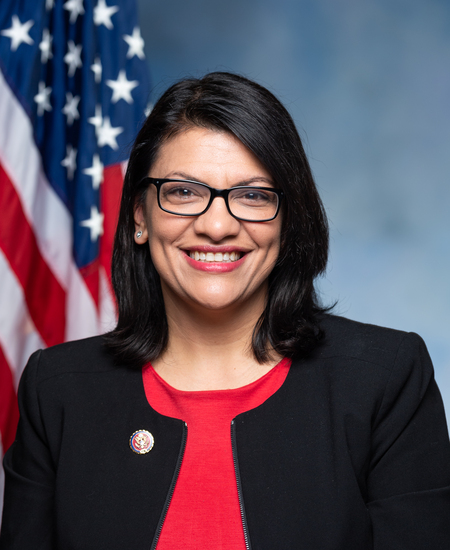
Rep. Rashida Tlaib
Sponsored bills
Maddy summaryThis bill establishes a 12-member National Council on African American History and Culture within the National Endowment for the Humanities (NEH). The Council, appointed by the President with Senate approval, will include experts in African American history and culture who are not federal employees, with balanced representation (6 Democrats, 6 Republicans) and attention to diversity. Its duties include evaluating NEH programs related to African American history, preparing annual reports, and making recommendations to improve preservation and celebration efforts. The Council will operate for 10 years, with members serving five-year terms and receiving partial compensation for their service.
Maddy summaryHR 7566 establishes a federal pilot program to provide competitive grants for job guarantee programs in high-unemployment areas. Eligible entities (like states, tribes, or rural communities with unemployment at least 150% of the national rate) must offer jobs to all adults (18+) residing in their area, with wages meeting or exceeding prevailing rates, health insurance comparable to federal benefits, and paid family/sick leave. The program requires supportive services (childcare, training), prohibits displacing existing workers, and mandates annual audits. It runs for up to 3 years in 15 pilot sites, with evaluations tracking impacts on employment, poverty, and environmental outcomes.
Maddy summaryThe SCAM Act requires online platforms that display paid advertisements (like social media sites) to verify advertiser identities, implement scam detection systems, and remove fraudulent ads within 24 hours of confirmation. It directly affects platforms that accept payment for ads, targeting scams such as fake giveaways, romance scams, and AI impersonations that cost consumers $195 billion in 2024 (per FTC data). Key mechanisms include mandatory identity checks for advertisers, active monitoring systems, and a 72-hour investigation window for reported scams. The law aims to reduce fraud by shifting responsibility to platforms, with enforcement by the FTC and state attorneys general.
Maddy summaryHR 7492, the Michigan-Canada Partnership Act, prohibits federal officials - including the President - from interfering with the opening or operation of the Gordie Howe International Bridge and its associated port of entry without congressional approval or a request from the Governor of Michigan. The bill requires federal agencies to take all necessary actions to ensure the bridge opens and operates continuously, preventing delays or obstruction. It directly affects federal agencies responsible for border operations and Michigan, which has a vested interest in the bridge's timely completion as a critical trade link with Canada. The law allows Michigan or local governments to sue to enforce these requirements if federal action impedes the bridge's operation.
Maddy summaryHRES 1058 is a non-binding House resolution recognizing the federal government’s duty to develop a Transgender Bill of Rights. It calls for specific policy changes, including amending civil rights laws to explicitly prohibit discrimination based on gender identity in employment, housing, and public accommodations; protecting access to gender-affirming medical care; and streamlining legal recognition of gender identity on federal documents like passports and voter registration. The resolution also proposes expanding protections for transgender and nonbinary individuals in healthcare, education, immigration, and correctional facilities, while emphasizing community-led policy development. As a resolution, it does not create new law but sets a framework for future legislative action.
Maddy summaryHR 7513, the GSIB Act of 2026, requires the largest global systemically important bank holding companies (GSIBs) to submit detailed annual reports to the Federal Reserve Board. These reports must cover specific disclosures including the bank's size and complexity, branch locations, enforcement actions (including labor and safety violations), trading desk activities, executive compensation comparisons, climate risk strategies, environmental justice impacts, and diversity policies. The bill mandates public availability of these reports on the Federal Reserve's website, increasing transparency around banking practices. This affects only the most significant banks deemed systemically important by regulators, not all financial institutions.
Maddy summaryHR 7500, the Responsible Firearms Marketing Act, directs the Federal Trade Commission (FTC) to study whether firearm advertising or marketing practices are unfair or deceptive, particularly those targeting minors, implying illegal use, or promoting semiautomatic assault weapons. After a two-year study, the FTC must report to Congress and then create enforceable regulations within 18 months to ban such practices. The law specifically prohibits manufacturers, dealers, and importers from using ads that appeal to people under 18, suggest illegal activity, or market assault weapons. Violations would be enforced under existing FTC authority, treating them as unfair or deceptive acts under current law. This bill directly affects firearm industry marketing practices but does not regulate gun sales or ownership.
Maddy summaryThe Firearm Safety Act of 2025 removes an existing exemption that prevents the Consumer Product Safety Commission from regulating firearms as consumer products. By amending the Consumer Product Safety Act, the bill allows the commission to apply its standard safety rules to guns, similar to how it regulates other household items. This change directly affects manufacturers and sellers of firearms by potentially subjecting them to federal safety standards and testing requirements. The legislation does not alter existing gun laws or create new bans, but rather changes the regulatory framework under which firearm safety is overseen.
Maddy summaryHRES 1056 is a non-binding House resolution calling for the U.S. to formally end the Monroe Doctrine as official policy and develop a "New Good Neighbor" approach to relations with Latin American and Caribbean nations. It proposes specific policy shifts, including ending unilateral sanctions (like the Cuba embargo), reforming international financial institutions to support equitable development, and ending U.S. interference in regional judicial processes. The resolution directly affects U.S. foreign policy toward 34 countries in the region and aims to reshape diplomatic, economic, and security cooperation. As a resolution, it does not create new law but urges the State Department and Congress to adopt these changes.