

Resilient Federal Forests Act This bill modifies and sets forth provisions regarding forest management activities on National Forest System, public, and tribal lands. The bill provides for, among other things the Departments of Agriculture (USDA) and Interior to conduct fireshed management projects in fireshed management areas, certain categorical exclusions for various purposes, the balancing of the short- and long-term effects of forest management activities while considering injunctive relief, USDA and Interior to establish their own discretionary arbitration pilot programs as an alternative dispute resolution process for forest management activities, increasing the maximum term for a stewardship end result contract to 20 years, demonstration projects to support the development and commercialization of biochar on Indian forest lands or rangelands and in nearby communities by providing reliable supplies of feedstock from federal lands, the decommissioning of certain Forest Service Roads within designated high fire-prone areas, repealing of the Eastside Screens requirements on National Forest System lands, making the Northwest Forest Plan Survey and Manage Mitigation Measure Standards and Guidelines inapplicable to any National Forest System lands or public lands, development of a protection plan for giant sequoia trees on National Forest System lands and public lands, and permanent rights of access to the Oregon and California Railroad grant lands and the Coos Bay Wagon Road grant lands for private landowners issued reciprocal road rights-of-way.
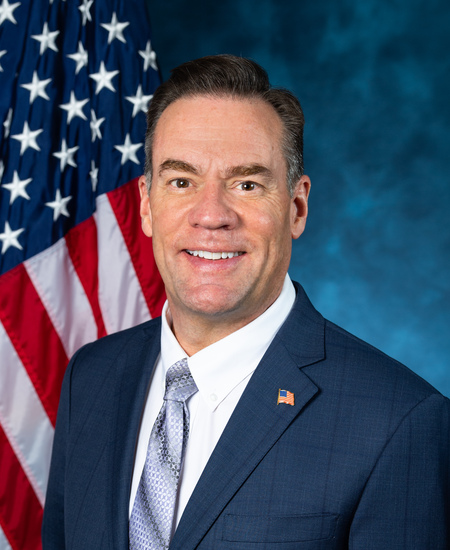
Rep. Russ Fulcher
Sponsored bills
This resolution impeaches Secretary of Homeland Security Alejandro Nicholas Mayorkas for high crimes and misdemeanors related to his actions regarding border security and immigration.
American Energy First Act This bill addresses the onshore and offshore production of traditional (e.g., oil and gas) and alternative (e.g., solar and wind) energy resources and establishes requirements for distributing revenues generated from energy production, including revenues to states and territories for conservation efforts. For example, the bill limits the President's authority to (1) withdraw areas of the Outer Continental Shelf (OCS) from oil and gas leasing, and (2) declare new marine national monuments. In addition, the Department of the Interior must obtain congressional approval before declaring a moratorium on issuing leases on federal lands or waters for oil, gas, or coal. Further, the bill requires Interior to defer to state regulations, guidance, and permit requirements for all activities regarding hydraulic fracturing (i.e., fracking) relating to oil, gas, or geothermal production activities on federal land. Interior may delegate decisions about issuing oil and gas drill permits on federal land to states. Interior must also establish certain federal land as geothermal, solar, and wind energy leasing priority areas. The bill also allows Interior to conduct certain lease sales, such as offshore wind lease sales on the OCS in the U.S. Exclusive Economic Zone adjacent to U.S. territories, and establishes requirements for distributing revenues from such leases to the Treasury, the Coral Reef Conservation Fund established by this bill, and U.S. territories.
Alexander Lofgren Veterans in Parks (VIP) Act This bill makes the America the Beautiful-National Parks and Federal Recreational Lands Pass available, without charge, to members of the Armed Forces, veterans, and Gold Star Families. The pass covers the entrance fee and standard amenity recreation fee for all federal recreational lands and waters.
School Milk Nutrition Act of 20 21 This bill revises requirements for milk provided by the National School Lunch Program of the Department of Agriculture. The bill permits schools participating in the program to offer students low-fat flavored milk.
This resolution denounces socialism and opposes the implementation of socialist policies in the United States.
This bill provides supplemental FY2021 appropriations to the National Guard for its response to the events at the U.S. Capitol on January 6, 2021. The bill designates the funding as emergency spending, which is exempt from discretionary spending limits.
National Strategic and Critical Minerals Production Act of 2021 This bill sets forth environmental review requirements for the mine permitting process and limits the review to 30 months. Under the bill, projects that provide minerals vital to job creation, energy infrastructure, coastal resilience and restoration, economic competitiveness, and national security must be considered to be infrastructure projects as described in Executive Order 13807, titled Establishing Discipline and Accountability in the Environmental Review and Permitting Process for Infrastructure Projects and dated August 15, 2017.This order directed agencies to ensure that the environmental review and permitting process for infrastructure is coordinated, predictable, and transparent. The Bureau of Land Management (BLM)or the Forest Service must appoint a project lead for the mine permitting process to coordinate with other agencies to ensure that the agencies minimize delays, set and adhere to timelines for completion of the permitting process, set clear permitting goals, and track progress against goals. The project lead must also determine the amount of financial assurance required for reclamation of a mineral exploration or mining site. The bill considers the requirements of the National Environmental Policy Act of 1969to be satisfied if the BLM or the Forest Service determines that the agency issuing the permit will address specified factors, such as environmental impacts of the permit or alternatives to issuance of the permit. Additionally, the bill exempts projects on National Forest System land from regulations that prohibit timber tree cutting and road construction in areas without roads.
Making Obligations Right by Enlarging Payments In Lieu of Taxes Act or the MORE PILT Act This bill directs the Department of the Interior to develop a modeling tool that calculates the approximate market value of land covered by the payments in lieu of taxes (PILT) program and the approximate amount of local tax revenue the land would generate if privately owned. The PILT program compensates local governments for tax revenue lost due to tax-exempt federal lands within their boundaries. Interior must annually report on the value of land covered by the PILT program, the tax revenue the land would generate if privately owned, and how PILT payments could more accurately reflect that tax revenue.
Aluminum Pricing Examination Act or the APEX Act This bill extends the jurisdiction of the Commodity Futures Trading Commission (CFTC) to include the markets for aluminum premiums. Specifically, the CFTC has jurisdiction over (1) the process and manner in which reference prices for such premiums are set or reported, and (2) whether the mechanism for setting such reference prices is fair and transparent. Additionally, the CFTC must consult with the Department of Justice regarding relevant information, including allegations of anticompetitive conduct.