

Maximum Pressure Act This bill expands sanctions and economic penalties on Iran. It also restricts the President from unilaterally lifting or waiving the sanctions or penalties and increases congressional oversight of them. Specifically, the bill requires the President to impose visa- and asset-blocking sanctions. Additionally, it modifies existing sanctions, including by (1) providing statutory authority for executive orders imposing sanctions; (2) applying sanctions to additional sectors of Iran's economy; and (3) broadening sanctionable conduct to cover, for example, assisting Iran with the acquisition of ballistic missiles and the complicity of Iranian officials in human rights violations in specified countries. The bill also requires reporting on licenses that authorize activities subject to sanctions. The bill prohibits U.S. representatives at the International Monetary Fund from voting to allow Iran's access to special drawing rights (a currency support tool) and places restrictions on financial transactions with Iran. The restrictions include requiring domestic financial institutions to implement special measures with respect to foreign financial institutions that conduct significant transactions connected to the Instrument in Support of Trade Exchanges (a European mechanism that bypasses U.S. sanctions when carrying out trade with Iran). The Department of State must maintain the Islamic Revolutionary Guard Corps' designation as a terrorist organization and must designate Ansharallah (or Houthis), which operates in Syria, as a foreign terrorist organization. The bill also requires reports on U.S. sanctions concerning Iran, the status of Iran's nuclear weapons program, and other matters.
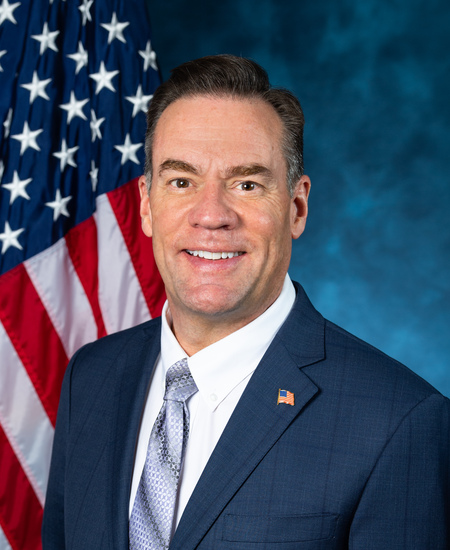
Rep. Russ Fulcher
Sponsored bills
Child Interstate Abortion Notification Act This bill creates new federal crimes related to transporting a minor across state lines for an abortion. Specifically, the bill makes it a crime to knowingly transport a minor across a state line to obtain an abortion without satisfying the requirements of a parental involvement law in the minor's resident state. A parental involvement law requires parental consent or notification, or judicial authorization, for a minor to obtain an abortion. The bill prohibits an individual who has committed incest with a minor from knowingly transporting the minor across a state line to receive an abortion. Finally, the bill makes it a crime for a physician to knowingly perform or induce an abortion on an out-of-state minor without first notifying the minor's parent.
Prohibiting IRS Financial Surveillance Act This bill prohibits the Department of the Treasury from requiring a financial institution to report the transfers into and out of a financial account. This prohibition does not apply to laws or regulations in effect on October 1, 2021.
This bill requires the Internal Revenue Service (IRS) to report to Congress on projections of the estimated tax gap (i.e., the difference between tax liabilities owed to the IRS and those liabilities that the IRS actually collects). The IRS may use artificial intelligence and related data analysis tools to calculate a tax gap projection. The bill also requires the Joint Committee on Taxation to issue periodic reports to the congressional tax committees on the tax gap projection. The bill restricts IRS funding to FY2021 levels for audits and enforcement until it publishes an updated tax gap projection. Funding is also restricted for certain purposes, including (1) targeting U.S. citizens who exercise their First Amendment rights, (2) targeting a group for regulatory scrutiny based on its ideological beliefs, and (3) auditing individual taxpayers with an adjusted gross income of less than $400,000. The bill directs the IRS to establish a fellowship program to recruit private sector tax experts to join the IRS to create and participate in the audit task force. The purposes of the tax force include performing audit case selection, educating IRS employees on emerging issues, auditing selected taxpayers, addressing offshore tax evasion, and identifying, mentoring, and training IRS junior employees with respect to audits.
This resolution calls for the immediate resignation of President Biden.
Puppies Assisting Wounded Servicemembers for Veterans Therapy Act or the PAWS for Veterans Therapy Act This bill implements a program and a policy related to service dog therapy for veterans. Specifically, the bill requires the Department of Veterans Affairs (VA) to implement a five-year pilot program to provide canine training to eligible veterans diagnosed with post-traumatic stress disorder as an element of a complementary and integrative health program. Eligible veterans are those who are enrolled in the VA health care system and have been recommended for participation by a qualified mental health care provider or clinical team. The VA must seek to enter agreements containing specified elements with accredited nongovernmental entities that have demonstrated ability to provide canine training. Veterans who participate in the program are authorized to adopt the dog they assisted in training if their health provider determines it is in the best interest of the veteran. The VA must establish processes to document and track the progress of participating veterans with respect to health benefits and improvements. The Government Accountability Office must brief Congress and submit a report on the program. The bill also authorizes the VA to provide service dogs to veterans with mental illnesses, regardless of whether they have a mobility impairment.
This bill requires the Department of Defense (DOD) to report daily on the efforts to evacuate U.S. citizens and legal permanent residents from Afghanistan until the President certifies to Congress that all such individuals who sought evacuation have been evacuated. Until such certification is submitted, DOD may not use FY2021 funds for activity which would have the effect of reducing the total number of service members deployed to Afghanistan, except in specified circumstances.
This bill requires the Inspector General of the Department of Defense to conduct a full investigation into the withdrawal of the U.S. Armed Forces from Afghanistan. The investigation must analyze (1) the extent to which, and reasons why, U.S. Humvees, helicopters, artillery, and drones ended up in the Taliban's possession; (2) the extent to which Afghan forces in possession of U.S. equipment entered Iran with such equipment; and (3) the effectiveness of the evacuation of U.S. and allied personnel.
Treating Tribes and Counties as Good Neighbors Act This bill revises the Good Neighbor Authority program to modify the treatment of revenue from timber sale contracts under good neighbor agreements with the Department of Agriculture (USDA) and the Department of the Interior. (The Good Neighbor Authority permits USDA and Interior to enter into cooperative agreements or contracts with states, counties, and Indian tribes to perform forest, rangeland, and watershed restoration services on federal land managed by the Forest Service or the Bureau of Land Management.) Specifically, the bill (1) requires Indian tribes and counties to retain revenue generated from timber sales under a good neighbor agreement; and (2) allows states, counties, and Indian tribes to use such revenue for authorized restoration projects on nonfederal lands under a good neighbor agreement. (Under current law, only a state is permitted to retain the revenues, and the revenues must be used for restoration projects on federal land.)
Forest Improvements through Research and Emergency Stewardship for Healthy Ecosystem Development and Sustainability Act or the FIRESHEDS Act This bill directs the Department of Agriculture (USDA), with respect to National Forest System lands, and the Department of the Interior, with respect to public lands, no later than 90 days after receiving a request from a state, to enter into an agreement with such state to jointly designate one or more fireshed management areas within such state, and conduct fireshed management projects in such fireshed management areas. Not later than 90 days after entering into an agreement, the USDA or Interior, as appropriate, and such state shall jointly conduct a stewardship and fireshed assessment. The USDA and Interior shall carry out fireshed management projects in accordance with the timeline and project size limitations included in the stewardship and fireshed assessment. Fireshed management projects shall be categorically excluded from the preparation of an environmental assessment or an environmental impact statement and exempt from the special administrative review process. The bill makes permanent the authority for a state to use revenue from timber sales under a good neighbor agreement for forest, rangeland, and watershed restoration services.