

Restoring Brand USA Act This bill requires the Department of the Treasury to make $250 million available (out of unobligated balances remaining from certain fees collected by Treasury) for the Corporation for Travel Promotion, also known as Brand USA.
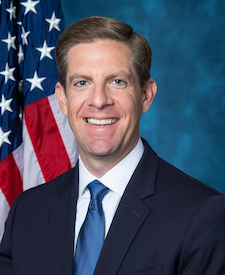
Rep. Mike Levin
Sponsored bills
IDEA Full Funding Act This bill provides permanent, mandatory funding for the grant program that assists states and outlying areas in providing special education and related services to children with disabilities.
National Wildland Fire Risk Reduction Program Act This bill directs the President to establish a National Wildland Fire Risk Reduction Program to achieve major measurable reductions in the losses of life and property from wildland fires. This program shall coordinate federal efforts to improve the assessment of fire environments and the understanding and prediction of wildland fires, associated smoke, and their impacts; develop and encourage the adoption of science-based and cost-effective measures to prevent and mitigate wildland fire and associated smoke impacts; and improve the understanding and mitigation of the impacts of climate change and variability on wildland fire risk, frequency, and severity and inform the other goals described here. Not later than 90 days after enactment of this bill, the Office of Science and Technology Policy shall establish an Interagency Coordinating Committee on Wildland Fire Risk Reduction to oversee the planning, management, and coordination of the program. The committee shall submit a strategic plan for the program to Congress. The Government Accountability Office shall submit a report to Congress on the progress and performance of the program. Further, the bill sets forth the responsibilities of the National Institute of Standards and Technology, National Science Foundation, National Oceanic and Atmospheric Administration, Federal Emergency Management Agency, National Aeronautics and Space Administration, Environmental Protection Agency, and Department of Energy with respect to the program.
Honoring Our Promises through Expedition for Afghan SIVs Act of 2021 or the HOPE for Afghan SIVs Act of 2021 This bill authorizes the Department of State and the Department of Homeland Security (DHS) to postpone the medical exam requirement for qualifying citizens or nationals of Afghanistan seeking entry into the United States as special immigrants. Specifically, this bill applies to an existing program that provides special immigrant status to an individual (or the spouse or child of such an individual) who (1) faithfully performed sensitive and trusted duties for the U.S. government or the International Security Assistance Force in Afghanistan on or after October 7, 2001, and (2) has experienced or is experiencing an ongoing serious threat due to the performance of those duties. Under this bill, the State Department and DHS may jointly issue a blanket waiver of any requirement for such individuals to undergo a medical exam before admission into the United States. DHS shall ensure, to the greatest extent practicable, that individuals admitted under such a waiver undergo medical exams no later than 30 days after admission into the United States. Such an individual shall be admitted as a conditional permanent resident. DHS shall remove the conditions once the individual receives and passes a medical examination.
Temporary Family Visitation Act This bill establishes a new nonimmigrant visa classification for an alien temporarily entering the United States to visit a relative who is a U.S. citizen or lawful permanent resident. The maximum period of stay for a family visitor visa shall be 90 days. An alien seeking such a visa must have health insurance for the duration of the stay. An alien who holds such a visa may not change to another nonimmigrant visa classification except in certain limited instances. If an alien has been approved for a family-based immigrant visa and is waiting for one to become available, the alien may obtain a family visitor visa if the alien meets the eligibility requirements.
Untraceable Firearms Act of 2021 This bill establishes a federal statutory framework to regulate the manufacture, sale, offer to sell, transfer, purchase, and receipt of ghost guns (i.e., guns without serial numbers). Additionally, the bill revises the federal statutory framework regulating the manufacture, possession, sale, import, shipment, delivery, receipt, and transfer of undetectable firearms. Among the revisions, the bill defines undetectable firearm as a firearm without a major component wholly made of detectable material.
Raise the Age Act This bill establishes new restrictions on the sale or transfer of certain semiautomatic firearms to individuals under 21 years of age. Specifically, this bill makes it unlawful for a licensed gun dealer, importer, manufacturer, or collector to sell or deliver a semiautomatic center-fire rifle that has (or has the capacity to accept) an ammunition feeding device with a capacity of more than five rounds to an individual who the licensee knows or has reasonable cause to believe is under age 21. The prohibition does not apply if the individual under age 21 is a full-time law enforcement officer or active-duty member of the Armed Forces. The bill also requires the Federal Bureau of Investigation to report on the operation of its public access line, including a description of information sharing protocols and recommendations for improving such protocols.
Commission to Study the Stigmatization, Criminalization, and Ongoing Exclusion and Inequity for LGBTQ Servicemembers and Veterans Act This bill establishes the Commission to Study the Stigmatization, Criminalization, and Ongoing Exclusion and Inequity for LGBTQ Servicemembers and Veterans. The Commission must identify and compile information about the history of military policy regarding homosexuality from 1778 onward, including regarding lesbian, gay, bisexual, transgender, and queer (LGBTQ) sexual orientation and gender identity. The Commission must hold public hearings, gather public testimony, examine lasting and disparate impacts of the discriminatory policies on the physical and mental well-being of members of the Armed Forces, and make recommendations on appropriate remedies.
Pets Belong With Families Act This bill prohibits public housing agencies from imposing breed restrictions on pets owned by residents of public housing units. The bill continues to allow public housing agencies to prohibit ownership of dangerous animals in public housing, but prohibits classification as dangerous by breed and requires that any such classification be based on specific behaviors or actions of the animal.
Help Ensure Lower Patient Copays Act or the HELP Copays Act This bill requires health insurance plans to apply certain payments made by, or on behalf of, a plan enrollee toward a plan's cost-sharing requirements. Specifically, plans must apply third-party payments, financial assistance, discounts, product vouchers, and other reductions in out-of-pocket expenses toward the requirements.