

Maddy summaryHR 2820, the California Clean Coast Act of 2025, prohibits new oil and gas leasing and related activities in federal waters off California's coast starting from its enactment date. This directly affects oil and gas companies seeking to develop new offshore resources in California’s outer Continental Shelf areas. The bill preserves existing leases issued before the law’s effective date but bans all future preleasing, leasing, and related activities in those waters. It represents a permanent federal policy change for California’s coastal offshore regions, with no impact on current leaseholders.
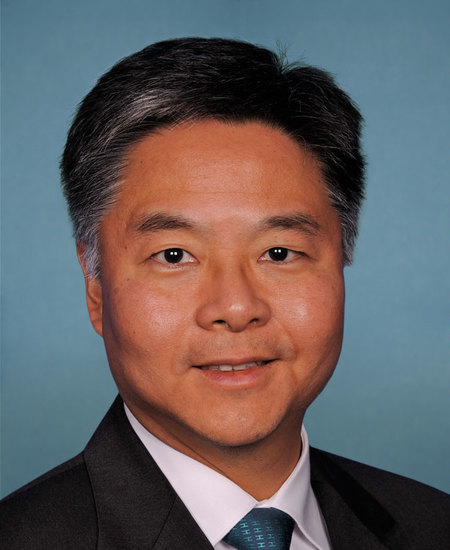
Rep. Ted Lieu
Sponsored bills
Maddy summaryHR 2849, the West Coast Ocean Protection Act of 2025, prohibits federal oil and gas exploration, development, and production on the outer Continental Shelf off the coasts of California, Oregon, and Washington. It directly affects oil and gas companies seeking leases in four specific planning areas: Washington/Oregon, Northern California, Central California, and Southern California. The bill amends existing law to block the Secretary from issuing any leases or authorizations for these activities in those designated zones. This creates a permanent ban on offshore drilling in these regions, replacing previous federal leasing plans.
Maddy summaryHR 2848, the Stop Arctic Ocean Drilling Act of 2025, prohibits the federal government from issuing new oil and gas leases in Arctic federal waters. It amends the Outer Continental Shelf Lands Act to ban the Secretary of the Interior from authorizing exploration, development, or production of oil, natural gas, or minerals in designated Arctic areas, overriding all other federal laws. The bill defines "Arctic" using the 1984 Arctic Research Act, focusing on federal waters off Alaska. This directly affects federal leasing decisions and prevents new drilling permits in the region.
Maddy summaryH.J. Res. 91 terminates the national emergency declared by the President on April 2, 2025, under Executive Order 14257. The resolution ends this emergency status by invoking Section 202 of the National Emergencies Act (50 U.S.C. 1622). This action would halt the use of emergency powers associated with the declaration, such as special authorities or funding mechanisms. The bill directly affects federal agencies and the executive branch by removing the legal basis for operating under the emergency framework.
Maddy summaryHRES 317 is a non-binding resolution urging the U.S. government to lead global efforts to halt and reverse the nuclear arms race. It calls on the President to pursue negotiations with nuclear-armed states to reduce arsenals, end the U.S. policy allowing first use of nuclear weapons, eliminate immediate launch readiness, stop developing new weapons, and support communities affected by nuclear programs. The resolution emphasizes diplomatic action over military modernization to reduce nuclear risks and prevent catastrophic conflict.
Maddy summaryThe GOSAFE Act prohibits the sale, manufacture, transfer, and possession of gas-operated semi-automatic firearms and large capacity ammunition feeding devices (those holding more than 10 rounds). It defines gas-operated firearms as those that use gas from fired cartridges to cycle the action, requiring the Attorney General to publish a list of prohibited firearms within 180 days. The bill establishes a process for manufacturers to seek approval for new firearm designs before selling to civilians and creates a "Firearm Safety Trust Fund" to cover related costs. Certain firearms are exempt, including single-shot, muzzle-loading, and firearms with permanently fixed magazines holding 10 or fewer rounds. Violations could result in fines up to $5,000 or up to 12 months in prison.
Maddy summaryHR 2767, the BRAIN Act, aims to advance brain tumor research and improve patient care by requiring the NIH to create a public database of tumor samples collected with federal funding. It authorizes $50 million annually for a Glioblastoma Therapeutics Network to accelerate treatment development and $10 million for cellular immunotherapy research (including CAR-T therapies) targeting brain tumors. The bill also mandates a national awareness campaign to increase understanding of cancer clinical trials and biomarker testing, plus $5 million yearly for pilot programs studying survivor care coordination and follow-up services. Additionally, it directs the FDA to issue guidance ensuring brain tumor patients can access clinical trials. These provisions directly affect patients, researchers, and healthcare providers focused on brain tumors and rare cancers.
Maddy summaryThe American Family Act (HR 2763) establishes a new refundable child tax credit that provides monthly payments to eligible families with children. It would pay $300 per month for each child under age 6 and $360 per month (120% of $300) for each child age 6 or older, with income limits of $150,000 for joint filers and $112,500 for other filers. The bill creates a "period of presumptive eligibility" to determine eligibility for monthly payments, allowing families to receive advance payments based on information from previous tax returns. This would directly affect millions of families with children who meet the income requirements, providing more consistent financial support throughout the year rather than an annual tax credit.
Maddy summaryHR 2799, the Closing the Bump Stock Loophole Act of 2025, prohibits the sale, possession, and modification of devices that increase the firing rate of semi-automatic firearms to mimic machine guns (commonly called "bump stocks"). It specifically bans manual, power-driven, or electronic devices designed to speed up firing, as well as modified firearms that achieve this effect. Owners of pre-existing modified firearms must register them within 120 days of the law's enactment, with exemptions for government entities and firearms already lawfully modified and registered before the bill passes. The bill does not restrict standard semi-automatic firearms or require registration of unmodified guns.
Maddy summaryHR 2787, the Warrant for Metadata Act, requires law enforcement to obtain a warrant before accessing metadata (like email sender/recipient information or phone call details) from electronic communication providers, regardless of how long the data has been stored. This applies to government entities seeking metadata for subscribers or customers, excluding the actual content of communications. The bill amends existing law to replace the previous exception for data stored over 180 days with a uniform warrant requirement, using standard judicial procedures. It directly affects law enforcement agencies and service providers when accessing non-content user data. The change applies prospectively, with prior disclosures unaffected but subsequent requests for expanded access now requiring a warrant.