

Maddy summaryThis bill allows federal employees who are furloughed or working without pay during a government shutdown (defined as a funding lapse of at least two weeks) to withdraw up to $30,000 from their Thrift Savings Plan (TSP) retirement savings without the usual 10% early withdrawal penalty. The $30,000 limit adjusts annually for inflation and applies per shutdown period. It also ensures missed TSP loan payments during a shutdown are not treated as taxable distributions, and employees can later contribute back up to the withdrawn amount without penalty. The bill directly affects federal workers facing financial hardship due to funding lapses, providing immediate relief through modified TSP rules.
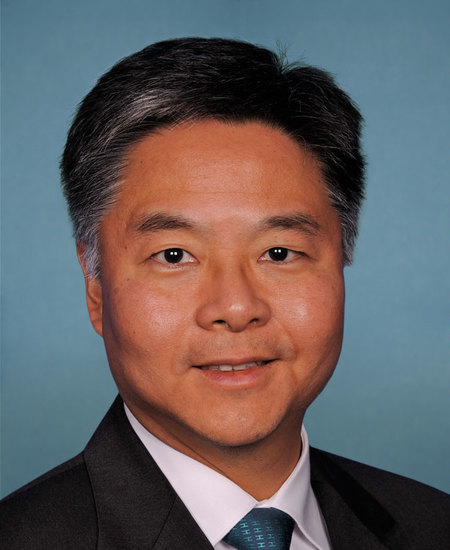
Rep. Ted Lieu
Sponsored bills
Maddy summaryThis bill adds Medicare coverage for multi-cancer early detection screening tests (blood or biological tests analyzing cell-free DNA) starting January 1, 2028. It directly affects Medicare beneficiaries aged 68 and older (starting in 2028, with the age limit increasing by 1 year annually), requiring tests to be FDA-cleared and deemed reasonable/necessary by the Secretary for early cancer detection across multiple organ sites. Payment will initially match current stool DNA test rates before 2031, then shift to a lower rate or new payment system after 2031, with limits preventing more than one test per year. The bill explicitly states it does not alter coverage for existing cancer screenings like breast, colorectal, or prostate cancer tests.
Maddy summaryHR 5653, the Trust Through Transparency Act of 2025, requires U.S. Customs and Border Protection (CBP) and U.S. Immigration and Customs Enforcement (ICE) officers, as well as deputized personnel, to wear body cameras during all public immigration enforcement actions like stops, arrests, or checkpoints. Footage must be kept for six months unless it involves use of force, an arrest, a complaint, or a voluntary request for longer retention (up to three years) by officers, the public, or families. The bill mandates annual reports to Congress detailing enforcement actions, compliance issues, disciplinary actions taken, and public access to these reports (with privacy redactions permitted). It also creates an independent panel to advise on body camera policies, aiming to increase accountability in immigration enforcement.
Maddy summaryHRES 774 is a non-binding resolution that expresses congressional support for recognizing October 2025 as Filipino American History Month. It celebrates the historical contributions of Filipino Americans to U.S. society, including their roles in military service (such as World War II veterans), healthcare, labor movements, and cultural achievements. The resolution does not create new laws or benefits but urges the public to observe the month through educational programs and activities that highlight Filipino American history and culture. It directly affirms the heritage of the Filipino American community - approximately 4.6 million people - who are the third-largest Asian American group in the U.S. and have made significant contributions across multiple fields.
Maddy summaryHRES 781 is a symbolic resolution designating October 1, 2025, as "National Animal Rescue Day" to raise public awareness about animal adoption and spaying/neutering. It does not create new laws or allocate funds but encourages nationwide events like adoption drives and educational campaigns to support shelters and reduce pet overpopulation. The resolution directly aims to benefit animal shelters, rescue organizations, and potential adopters by promoting the importance of adopting pets and responsible pet ownership. As a non-binding gesture, it focuses on awareness rather than policy change.
Maddy summaryThis bill requires NASA and NOAA to establish civilian space cooperation with Taiwan within 90 days of enactment, focusing on satellite programs, weather technology, and personnel exchanges. It mandates that these efforts comply with the Taiwan Relations Act and U.S. export rules while protecting U.S. intellectual property and economic interests. The agencies must submit annual reports to Congress detailing cooperation activities, challenges, and progress for five years after enactment. The bill directly affects U.S. space agencies and Taiwan’s space agency, facilitating non-military space collaboration. It does not alter existing U.S. policy toward Taiwan but creates a formal mechanism for expanded technical engagement.
Maddy summaryThis bill prevents federal agencies from terminating employees during a government shutdown caused by a lapse in discretionary funding. It prohibits removals of civil service employees at any agency affected by a funding gap, and if an employee is wrongfully removed, they can return to their job with back pay once funding resumes. The law directly protects all federal employees covered by the civil service system during shutdowns. It applies automatically to any funding lapse, requiring automatic reinstatement without needing separate legal action.
Maddy summaryThis bill restores National Institutes of Health (NIH) grants and awards suspended or terminated between January 20, 2025, and its enactment date (unless fraud or mismanagement is found). It requires NIH to immediately reinstate eligible funding, process payment requests within 30 days, and extend grant terms by one year for reinstated awards. The bill directly affects NIH grant recipients (like researchers and institutions) and NIH officials responsible for award management. It focuses on concrete procedural changes to funding access, not on policy content or scientific substance.
Maddy summaryHR 5545, "Katie Meyer’s Law," requires colleges and universities receiving certain federal funds to provide students facing alleged violations of campus conduct codes with the option of having an adviser during disciplinary proceedings. Institutions must adopt policies allowing students to choose an outside adviser or request an independent adviser from the school, who must be trained on campus procedures and can participate in hearings as an advocate. The law also mandates that advisers may receive bi-weekly updates with student permission and ensures students are informed of their adviser options in written notifications. This directly affects students in disciplinary cases at participating higher education institutions across the U.S.
Maddy summaryHJRES 126 is a joint resolution directing the removal of U.S. Armed Forces from military operations against specific targets without congressional authorization. It requires the President to end hostilities involving: (1) foreign terrorist organizations designated after February 20, 2025; (2) countries where those groups operate; or (3) non-state groups trafficking illegal drugs, unless Congress explicitly authorizes such actions through a war declaration or specific law. The bill cites recent military strikes on vessels as examples of unauthorized hostilities and emphasizes that drug trafficking alone does not justify military force under the War Powers Resolution. This resolution applies to all current and future operations targeting these groups without prior congressional approval.