

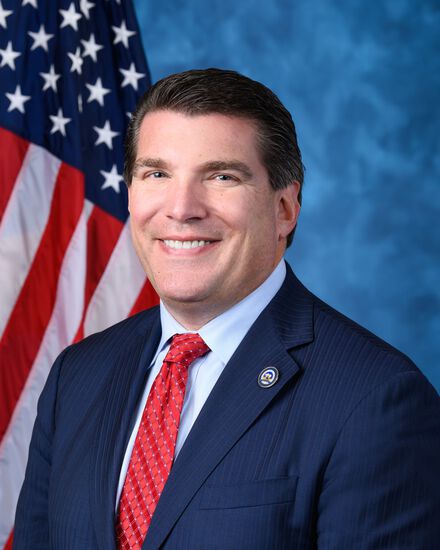
Photo of Jay Obernolte
R United States House · District 23 · California On the 2026 ballot

Rep. Jay Obernolte

Compare
Total votes
2,837
all sessions
Attendance
99%
33 missed
Near the chamber average
With party
91%
of cast votes
Near the chamber average
Bipartisan score
5%
crosses aisle rarely
Near the chamber average
Sponsored
827
bills & resolutions
Near the chamber average
Committees
7
assignments
827 bills and resolutions

Sponsored bills

Total
827
Primary
68
Co-sponsor
759
This page
827
matching current filters
Co-sponsor HR 4758
Passed · Indiana House · Co-sponsor
Accelerating Kids’ Access to Care Act

Maddy summaryThis bill modifies Medicaid and CHIP rules to let eligible out-of-state healthcare providers enroll without extra state screening. It applies to providers already in Medicare or their home state program, with low fraud risk, serving children under 21 with complex medical conditions. Providers would receive 5 years of enrollment under this streamlined process, eliminating state-level barriers. The change directly affects children seeking specialized care across state lines and the providers who serve them.

Passed Sep 18, 2024 1 co-sponsor
Co-sponsor HR 9625
In committee · Indiana House · Co-sponsor
JUDGES Act of 2024

Maddy summaryThe JUDGES Act of 2024 authorizes new federal district court judgeships across multiple states to address rising case backlogs in the federal judiciary. It specifies new permanent judgeships for districts including California (multiple districts), Florida, Texas, Delaware, Indiana, Iowa, New Jersey, and New York, with implementation phased through 2035, and creates temporary judgeships for Oklahoma districts with specific vacancy rules. The bill authorizes funding for these positions and requires reports on judicial caseloads and detention space needs, while mandating public access to the Judicial Conference's judgeship recommendations. The bill directly affects federal district courts in the specified locations by increasing judicial staffing to handle growing case volumes.

In committee Sep 17, 2024 1 co-sponsor
Co-sponsor HR 9611
In committee · Indiana House · Co-sponsor
Small Business Disaster Damage Fairness Act of 2024

Maddy summaryHR 9611, the Small Business Disaster Damage Fairness Act of 2024, increases the collateral requirement threshold for small business disaster loans under the Small Business Act from $14,000 to $50,000 and removes the "major" disaster requirement, meaning more small businesses affected by any disaster (not just major ones) will qualify for loans without needing to provide collateral. The bill directly affects small businesses seeking SBA disaster loans by reducing their collateral burden. It requires the Government Accountability Office (GAO) to report on loan default rates and the impact of these collateral changes within three years of enactment, covering loans from September 2020 through two years after the bill's passage. This focuses on concrete changes to loan eligibility and accountability, not on predicted outcomes.

In committee Sep 16, 2024 1 co-sponsor
Co-sponsor HR 9535
In committee · Indiana House · Co-sponsor
To designate the facility of the United States Postal Service located at 130 South Patterson Avenue in Santa Barbara, California, as the "Brigadier General Frederick R. Lopez Post Office Building".

Maddy summaryThis bill designates the U.S. Postal Service facility at 130 South Patterson Avenue in Santa Barbara, California, as the "Brigadier General Frederick R. Lopez Post Office Building." It updates all official U.S. government references to the building to reflect this new name, with no policy changes or funding impacts.

In committee Sep 11, 2024 1 co-sponsor
Primary HR 9497
In committee · Indiana House · Lead sponsor
AI Advancement and Reliability Act of 2024

Maddy summaryHR 9497, the AI Advancement and Reliability Act of 2024, creates a new Center for AI Advancement and Reliability within the Commerce Department to advance U.S. leadership in AI safety and reliability. The Center will conduct research, develop voluntary standards, and collaborate with federal agencies, industry, and researchers to address AI reliability, security, and safety risks - such as system flaws and adversarial attacks - through testing and benchmarking. It prohibits new regulatory authority or mandatory data sharing from private entities, requires annual reports to Congress, and is funded at $10 million for fiscal year 2025 with a six-year sunset provision. This bill directly affects federal agencies (like NIST and the National Science Foundation), research institutions, and private sector partners working on AI systems, without imposing new compliance requirements.

In committee Sep 11, 2024 0 co-sponsors
Co-sponsor HR 5077
In committee · Indiana House · Co-sponsor
CREATE AI Act of 2023

Maddy summaryThe CREATE AI Act of 2023 establishes a National Artificial Intelligence Research Resource (NAIRR) to improve access to AI research tools, computational resources, data, and educational materials for researchers and students across the United States. The NAIRR will provide computational resources, curated datasets, educational tools, and access to AI testbeds, with special emphasis on supporting groups historically underrepresented in STEM fields. Governed by a Steering Subcommittee chaired by the Director of the Office of Science and Technology Policy and managed by a Program Management Office within the National Science Foundation, the NAIRR includes specific requirements for ethical AI development, privacy protections, and security measures. The resource will be accessible to researchers at U.S. institutions of higher education, nonprofits, government agencies, and certain businesses, with priority given to projects addressing privacy, ethics, civil rights, and AI safety.

In committee Sep 11, 2024 1 co-sponsor
Co-sponsor HR 9475
In committee · Indiana House · Co-sponsor
AI Grand Challenges Act of 2024

Maddy summaryThe AI Grand Challenges Act of 2024 creates a National Science Foundation program to award cash prizes for solving specific artificial intelligence challenges in critical U.S. priority areas like health, national security, energy, and cancer research. It requires the NSF to establish competitions with clear problem statements and success metrics, including a mandatory cancer-focused competition offering at least $10 million in prizes within one year of enactment. Eligible participants must be U.S. entities or U.S. citizens/permanent residents, and winners receive minimum $1 million prizes per competition. The NSF must publish competition details online, report annually to Congress on program outcomes, and ensure public accessibility of all challenges.

In committee Sep 6, 2024 1 co-sponsor
Co-sponsor HR 9308
In committee · Indiana House · Co-sponsor
No Frankenrail Act of 2024

Maddy summaryHR 9308, the "No Frankenrail Act of 2024," prohibits federal funding for California's high-speed rail project unless at least one mile of rail is completed. It directly affects the California High-Speed Rail Authority and the Federal Railroad Administration, which manage the project that has received over $2.5 billion in federal funds since 2009. The bill blocks new federal funds for this "covered project" (defined as any high-speed rail project receiving funds before 2014) until the Secretary of Transportation certifies at least one mile of rail is built. This action stems from the project's significant cost overruns ($33 billion projected to $128 billion) and lack of completed infrastructure since its 2009 start. The bill does not terminate existing funding but halts future disbursements until the completion milestone is met.

In committee Aug 7, 2024 1 co-sponsor
Co-sponsor HJRES 199
In committee · Indiana House · Co-sponsor
Providing for congressional disapproval under chapter 8 of title 5, United States Code, of the rule submitted by the National Highway Traffic Safety Administration relating to "Corporate Average Fuel Economy Standards for Passenger Cars and Light Trucks for Model Years 2027 and Beyond and Fuel Efficiency Standards for Heavy-Duty Pickup Trucks and Vans for Model Years 2030 and Beyond".

Maddy summaryThis resolution aims to block a rule issued by the National Highway Traffic Safety Administration (NHTSA) that sets new fuel efficiency standards for passenger cars, light trucks (starting in 2027), and heavy-duty pickup trucks/vans (starting in 2030). If passed, it would prevent this specific rule from taking effect by disapproving it under a congressional review process. The rule directly affects vehicle manufacturers by requiring them to meet these updated fuel economy targets for future model years. This is a procedural resolution, not a new law, focused solely on halting the implementation of the existing NHTSA rule.

In committee Aug 2, 2024 1 co-sponsor
Co-sponsor HR 6213
In committee · Indiana House · Co-sponsor
National Quantum Initiative Reauthorization Act

Maddy summaryThe National Quantum Initiative Reauthorization Act (HR 6213) reauthorizes and expands federal efforts to advance quantum information science, engineering, and technology in the United States. It establishes new programs including National Quantum Centers, Quantum Testbeds, and a Quantum Reskilling and Workforce Coordination Hub to develop domestic talent and infrastructure. The bill creates an International Quantum Cooperation Strategy to build partnerships with allies while restricting collaboration with "foreign countries of concern" as defined in the legislation. It provides funding for research, workforce development, and commercialization of quantum technologies across government agencies, universities, and industry. The act aims to strengthen U.S. leadership in quantum technology through coordinated federal investment and international collaboration.

In committee Jul 25, 2024 1 co-sponsor
Showing 351 to 360 of 827 bills
Previous 1 … 35 36 37 … 83 Next