

Maddy summaryH.J. Res. 80 would declare the Equal Rights Amendment (ERA) part of the U.S. Constitution, asserting it has been ratified by 38 states (three-fourths of the states) despite the original 1972 deadline. If passed, this resolution would formally establish the ERA as a constitutional amendment, requiring all federal and state laws to align with its gender equality protections. The bill does not create new laws but confirms the ERA's status as part of the Constitution, affecting how laws are interpreted and enforced. It is a procedural step to resolve the legal dispute over the ERA's validity after decades of debate.
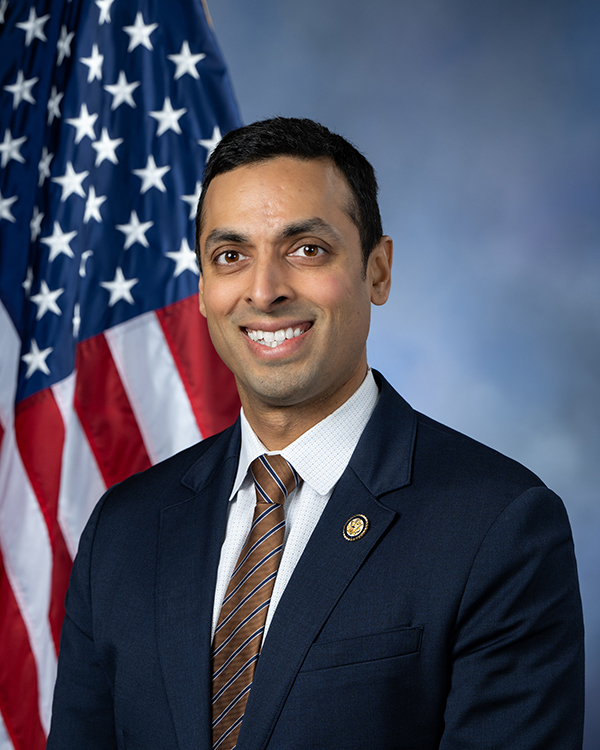
Rep. Suhas Subramanyam
Sponsored bills
Maddy summaryHR 2311, the Pakistan Democracy Act, imposes U.S. sanctions on Pakistani military and government officials who undermine democracy or wrongfully detain political figures. Specifically, it requires sanctions within 180 days on General Asim Munir (Pakistan’s Army Chief) and identifies individuals involved in the persecution of Imran Khan or other political detainees, barring them from U.S. entry via visa inadmissibility. The bill mandates the President to certify to Congress for waivers, requiring proof that military rule has ended and political detainees are freed. It defines key terms like "knowingly" and "foreign person" to clarify eligibility for sanctions. The law directly affects targeted Pakistani officials and their immediate family members, with no mention of broader economic or diplomatic measures.
Maddy summaryHR 2207, the Saving DOE’s Workforce Act, prohibits the Department of Energy from implementing layoffs or involuntary separations of employees until after Congress enacts full fiscal year 2026 funding. It specifically protects federal workers in competitive service positions, career roles in excepted service, and senior executive leadership roles. The bill allows separations only for documented misconduct, inefficiency, or delinquency following standard disciplinary procedures, without affecting existing personnel authority.
Maddy summaryThe Air America Act of 2025 authorizes one-time payments of $40,000 to individuals who worked for Air America or its affiliated companies for at least five years during 1950-1976, or to their surviving spouses, children, or dependents. Additional payments of $8,000 per full year beyond five years are allowed. The program is capped at $60 million total funding, with claims required within two years of final regulations. Payments are a single lump sum with no ongoing benefits, and the bill explicitly states it does not create new entitlements beyond this one-time award.
Maddy summaryThis bill prohibits the National Science Foundation (NSF) from implementing layoffs or involuntary employee separations until after full-year funding for fiscal year 2026 is secured. It directly affects NSF employees in competitive service, excepted service, and the Senior Executive Service by blocking workforce reductions. The key provision creates a temporary moratorium on layoffs, with exceptions only for separations due to misconduct, inefficiency, or delinquency. This applies until Congress enacts the full FY2026 budget, adding a specific timeline to existing federal personnel rules.
Maddy summaryHR 2210, the Saving NASA’s Workforce Act, prohibits NASA from initiating or implementing reductions in force or involuntary separations of most employees until after full-year funding for fiscal year 2026 is enacted. It specifically protects employees in competitive service, excepted service, and the Senior Executive Service from being laid off, except for cause related to misconduct, inefficiency, or delinquency. The bill applies to all standard personnel actions under federal law and does not affect existing authority for disciplinary separations. This moratorium directly affects NASA’s workforce by preventing layoffs during the current funding cycle.
Maddy summaryHR 2209, the Saving NIST’s Workforce Act, prohibits the National Institute of Standards and Technology (NIST) from implementing layoffs or involuntary employee separations (except for misconduct, inefficiency, or delinquency) until after full-year funding for NIST’s fiscal year 2026 budget is enacted. The bill directly affects all NIST employees in the competitive service, excepted service, and senior executive roles by blocking workforce reductions during this period. Key provisions require NIST to maintain current staffing levels through the end of FY2026, unless Congress passes a full-year appropriations bill for that year. This is a procedural measure focused on preserving NIST’s current workforce structure, not creating new programs or altering funding levels.
Maddy summaryThe Saving NOAA’s Workforce Act (HR 2211) prohibits the National Oceanic and Atmospheric Administration (NOAA) from initiating layoffs or involuntary separations of most employees until after full-year funding for fiscal year 2026 is approved. It specifically blocks reductions in force or involuntary separations for competitive service, excepted service career employees, and Senior Executive Service members, except for cause (like misconduct or inefficiency). This bill directly affects NOAA’s workforce by preserving current employment status through the 2026 budget cycle.
Maddy summaryThis bill designates the U.S. Postal Service facility at 409 South Hicks Street in Lawrenceville, Virginia, as the "James Solomon Russell Post Office." It changes the official name of the building for all federal references, including laws, maps, and documents. The bill has no policy or funding impact - it is purely a ceremonial naming action. No individuals or groups are directly affected beyond the standard administrative update to the facility's name.
Maddy summaryHR 2131 requires the Secretary of Homeland Security to reimburse state and local governments for providing security services, personnel, equipment, and facilities used in presidential protection efforts. This applies to resources utilized for functions under specific sections of federal law, directly affecting state and local agencies that support presidential security. The bill authorizes reimbursement on a reimbursable basis and allows retroactive payments for eligible costs incurred from July 12, 2024, through the bill's effective date. It creates a formal process for compensating jurisdictions that contribute to security operations without altering existing security protocols. The measure focuses solely on financial reimbursement for resource use, not on changing security standards or responsibilities.