

Maddy summaryHRES 216 is a resolution condemning the leadership of the House Republican Conference for allowing a social media post that falsely questioned the immigration status and patriotism of Congressman Adriano Espaillat (Chairman of the Congressional Hispanic Caucus). The resolution specifically names House Speaker Mike Johnson, Majority Leader Steve Scalise, Majority Whip Tom Emmer, and other top Republican leaders as responsible for the post. It characterizes the post as xenophobic and inappropriate, stating such rhetoric violates the standards of conduct expected of members of Congress.
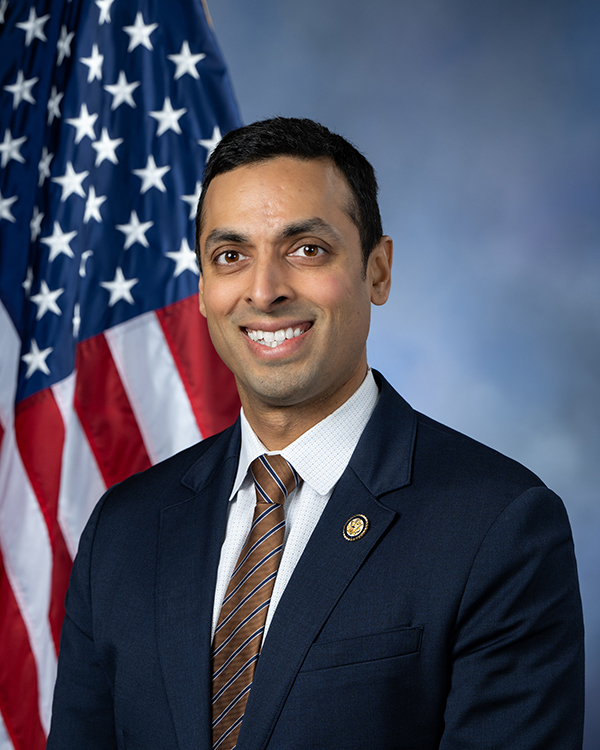
Rep. Suhas Subramanyam
Sponsored bills
Metastatic Breast Cancer Access to Care Act This bill expedites payment of Social Security Disability Insurance (SSDI) benefits and eligibility for Medicare coverage for those with metastatic breast cancer (i.e., breast cancer that has spread to other sites in the body). Specifically, the bill eliminates the 5-month waiting period for SSDI benefits and the subsequent 24-month waiting period for Medicare coverage for individuals with metastatic breast cancer. Under current law, individuals generally must wait 5 months after the onset of disability to begin receiving SSDI benefits and an additional 24 months to become eligible for Medicare.
Maddy summaryThis bill requires the Transportation Security Administration (TSA) to transition its workforce from a special personnel management system to the standard federal personnel system under Title 5 of the U.S. Code by December 31, 2025. It protects TSA employees by ensuring no reduction in pay, benefits, or retirement rights during the transition, while preserving collective bargaining rights for screening agents. The legislation also mandates consultation with labor unions during the process and requires several reports on workforce issues including recruitment, harassment policies, and workplace safety.
Maddy summaryThis bill adjusts probationary periods for certain federal employees who were involuntarily separated between January 20, 2025, and January 20, 2029. It allows eligible employees (those separated while on probation in an Executive agency) to count their prior service time toward a new probationary period when rehired into a similar position with their former agency. Specifically, the new probation period equals the original required duration minus the time already served in their previous federal role. The law expires on January 20, 2029, and applies only to appointments matching the employee’s prior position.
Maddy summaryHR 1973, the "No Pay for Congress During Default or Shutdown Act," would withhold pay from members of Congress during periods when the U.S. government reaches the public debt limit or experiences a shutdown. Specifically, for each 24-hour period the debt limit is reached or a shutdown occurs during the 119th Congress (2025-2027), members' pay would be reduced daily and placed into an escrow account. The withheld funds would be released to members on the last day of the 119th Congress, with no effect after the November 2026 general election. This bill directly affects current House and Senate members serving in the 119th Congress during these fiscal crises.
Maddy summaryThe Feed Our Families Act of 2025 ensures SNAP (Supplemental Nutrition Assistance Program) benefits continue for 90 days during the first government funding lapse in a fiscal year. It appropriates emergency funds from the Treasury to cover SNAP operations for the initial 90 days of a lapse in discretionary appropriations for the program. These funds are held in reserve and can only be used to maintain SNAP program services during that period. The bill directly affects millions of low-income households relying on SNAP benefits by preventing immediate disruptions during early government shutdowns.
Maddy summaryHR 1939, the U.S. Engagement in Sudanese Peace Act, requires the U.S. government to develop a comprehensive strategy supporting peace in Sudan, including sanctions on individuals responsible for atrocities and restrictions on arms sales to entities supporting the Rapid Support Forces (RSF) and Sudanese Armed Forces (SAF). The bill mandates reports on international crimes, violations of humanitarian aid access, and U.S. weapons used in Sudan, while directing the U.S. to advocate for unimpeded humanitarian access and support for Sudanese women and youth in peace processes. It establishes a Special Envoy for Sudan with a 5-year term and requires the President to impose sanctions on foreign persons who commit or enable genocide, war crimes, or crimes against humanity in Sudan. The legislation prohibits the sale of major defense equipment to countries supporting the RSF or SAF, with limited waiver authority, directly affecting U.S. foreign policy implementation and humanitarian efforts in Sudan.
Maddy summaryThis bill prohibits the Federal Communications Commission (FCC) from taking action against broadcasters - such as revoking licenses - based on the viewpoints they broadcast or the content they disseminate. It also bans the FCC from imposing viewpoint-related conditions when reviewing transactions like license transfers. The law explicitly preserves the FCC’s authority to act against illegal content (such as incitement, hate speech, or threats under existing federal law) but prevents political pressure from influencing regulatory decisions. It directly affects broadcasters and the FCC’s enforcement practices under the Communications Act of 1934.
Protecting Americans’ Social Security Data Act This bill prohibits political appointees and special government employees from accessing Social Security data systems that contain personally identifiable information about Social Security beneficiaries. Specifically, political appointees and special government employees may not access systems maintained by the Social Security Administration (SSA) that issue or record Social Security account numbers, that are used to determine eligibility for or to pay Social Security benefits, or that otherwise contain personally identifiable information about individuals receiving or applying for benefits. The bill also establishes a civil right of action for an individual whose information was negligently accessed or disclosed in violation of these provisions. The individual may bring suit against the United States if the violator was a U.S. employee or officer, or against the violator if they were not a U.S. employee or officer. Such a claim must be brought within two years of the affected individual’s discovery of the violation. Upon a finding of liability, defendants are liable for specified monetary damages. If an individual is criminally charged or subject to proposed disciplinary or adverse action by a federal or state agency for having accessed or disclosed information in violation of these provisions, SSA must notify the individual whose information was accessed or disclosed of the violation as soon as practicable. Finally, the bill requires the SSA Office of the Inspector General to investigate and report to Congress on any unauthorized access to or disclosure of information in a beneficiary data system.
Maddy summaryThis bill strengthens the Voting Rights Act of 1965 by clarifying how to prove voting discrimination and expanding requirements for preclearance of voting changes. It establishes new standards for determining when voting practices dilute minority voting strength or deny/abridge voting rights, requiring plaintiffs to show specific conditions for vote dilution claims and including factors like historical discrimination and racial polarization in court analyses. The bill modifies the criteria for determining which states and political subdivisions must seek preclearance for voting changes, and adds new transparency requirements for jurisdictions to publicly disclose changes to voting qualifications, polling locations, and election districts. It directly affects states and local governments that implement voting policies, particularly those with a history of voting rights violations or that make changes to voting qualifications, procedures, or district boundaries. The bill aims to prevent discriminatory voting practices by providing clearer standards for courts and requiring greater transparency in voting rule changes.