The act requires a court to sentence a defendant convicted of second degree assault by strangulation in an enhanced range as a crime of violence subject to mandatory incarceration if the defendant has previously been convicted of second degree assault by strangulation. A previous conviction must be set forth in the complaint, indictment, or information for the present act.(Note: This summary applies to this bill as enacted.)
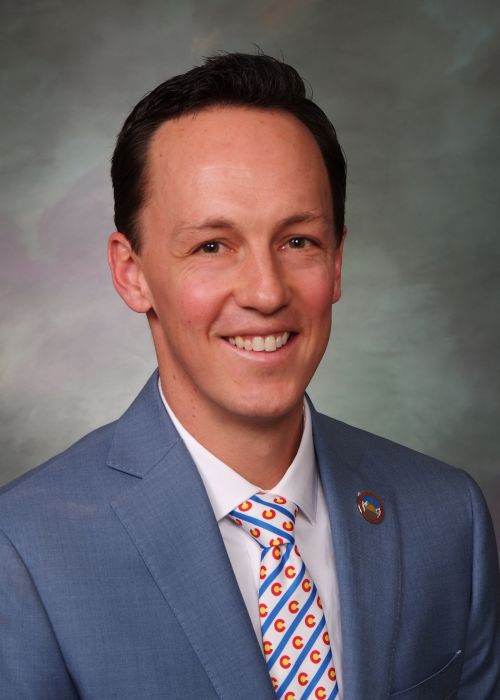
Sen. Dylan Roberts
Sponsored bills
The act creates the 'Transit Investment Area Act' to facilitate the financing of transit and rail station infrastructure. Specifically, the act:Allows a local government and a transit agency to jointly undertake a transit investment project. To finance the project, the local government may apply to the Colorado economic development commission (commission) to designate a transit investment area and an approved financing entity;Authorizes the approved financing entity, which may be a newly created transit investment authority, a county revitalization authority, a metropolitan district, or an urban renewal authority, to receive state sales tax increment revenue. This revenue consists of the state sales tax collected in the designated area above a base amount, plus an additional 20% to account for out-of-area deliveries.Permits the financing entity to issue bonds and use the state sales tax increment revenue to finance eligible improvements related to the transit project;Prohibits the financing entity from using the state sales tax increment revenue to acquire property through eminent domain;Requires projects to comply with specified hiring, apprenticeship, and workforce standards;Caps the commission's approval authority at no more than 3 transit investment projects in any calendar year and no more than 6 in total and caps the total state sales tax increment revenue dedicated to all projects at $75 million per fiscal year; andAuthorizes the commission to revoke project approval if substantial work does not commence within 5 years and requires financing entities to submit annual reports and independent financial audits. The act requires the Colorado office of economic development, in consultation with the department of local affairs and the department of transportation, to publish a transit and housing investment zone map on or before October 30, 2026. The act creates the Colorado affordable housing in transit and housing investment zones tax credit (tax credit). The tax credit is administered in the same manner as the Colorado affordable housing in transit-oriented communities income tax credit; except that the tax credit is awarded in connection with housing projects in transit and housing zones. The act authorizes the Colorado Housing and Finance Authority to allocate up to $8,333,333 in tax credits each calendar year beginning in the 2027 calendar year through the 2033 calendar year. For the 2026-27 state fiscal year, the act appropriates $213,349 to the office of the governor for use by economic development programs.(Note: This summary applies to this bill as enacted.)
The act increases the penalties for improperly passing a vehicle in a no-passing zone and clarifies that no-passing zones are indicated by a solid yellow line or line pavement markings. The act requires the Colorado department of transportation to prioritize installing signage on roadways with increased incidents of crashes resulting from illegal overtaking on the left. The act increases the points assessed for multiple speeding violations within a one-year, 2-year, or 5-year period for driving 20 miles per hour or more in excess of the reasonable and prudent speed or driving in excess of a 75 miles per hour speed limit and requires drivers driving a vehicle 100 miles per hour or greater be assessed 4 additional points. The act requires that drivers who have multiple speeding violations within a one-year, 2-year, or 5-year period receive a summons and complaint upon committing their violation instead of a penalty assessment notice. The act increases the fine for violating regulations regarding transporting hazardous materials by motor vehicle to $500 and increases the fine range for a second or subsequent violation to $500 to $1,000. The act appropriates $30,943 to the Colorado department of revenue from the Colorado DRIVES vehicle services account.(Note: This summary applies to this bill as enacted.)
The act requires the division of parks and wildlife (division) in the department of natural resources to expand the division's capacity for outdoor recreation coordination, planning, and management and take a leading role in state-level coordination, strategic planning, and implementation of Colorado's outdoors strategy. The division is directed to, among other things, engage with relevant partners, stakeholders, tribal governments, and agencies to coordinate and incorporate wildlife, conservation, recreation, and climate-resilience considerations across agency planning and decision-making processes. In addition, the division is required to support, in consultation with relevant entities, the planning, development, and maintenance of outdoor recreation infrastructure to enhance outdoor recreation opportunities while protecting private property rights, wildlife, and natural resources. The division is directed to coordinate and consult with local governments to identify potential impacts to services and infrastructure associated with outdoor recreation use. The act also requires the division to create, and update at least annually, integrated regional outdoor recreation and conservation planning reports to inform division awareness and operational decision-making. In 2027 and 2028, the division is required to include an update on the outdoor recreation coordination, planning, and management efforts required by the act during its 'SMART Act' hearing. For the 2026-27 state fiscal year, the act appropriates $436,025 to the department of natural resources from the parks and outdoor recreation cash fund to be used for state park operations.(Note: This summary applies to this bill as enacted.)
The act directs the division of brand inspection (division) in the department of agriculture and the state board of stock inspection commissioners in the department of agriculture to receive reports of lost or stolen livestock. On or before December 31, 2026, the division shall implement procedures that:Facilitate efficient coordination with law enforcement, including procedures to ensure that reports of stolen livestock are provided to relevant law enforcement within 24 hours after the division receives a report of stolen livestock; andEnsure that the public is notified of lost or stolen livestock. The procedures implemented by the division may vary by geographic region depending on the needs of the region.(Note: This summary applies to this bill as enacted.)
Current law requires a local government or a tribal government desiring to receive funding from the statewide affordable housing fund to have filed with the division of housing of the department of local affairs (division) a commitment specifying how, within a 3-year cycle, affordable housing units within the local or tribal government's territorial boundaries will be increased by 3% each year over the baseline number of affordable housing units (baseline number). The baseline number resets every 3 years for the next cycle. To be eligible for funding from the statewide affordable housing fund, a local or tribal government is required to file a commitment with the division and achieve the 3% increase over the baseline number each year during the 3-year cycle. The act changes the requirements for the 3-year cycle beginning on January 1, 2027, and each 3-year cycle thereafter. A local government desiring to receive funding from the statewide affordable housing fund is no longer required to increase affordable housing units by 3% above the baseline each year, but is instead required to meet the target increase number of affordable housing units (target increase number). The target increase number equals the average annual number of permits for new housing units or functional equivalents of permits for new housing units that have been issued over the past 3 years within the jurisdiction of the local government, multiplied by the number of years of the upcoming 3-year cycle to which the local government is committing, multiplied by:0.10 if the average annual job growth rate in the county in which the local government is located is significantly lower than the statewide median annual job growth rate over the past 3 years, as determined by the division;0.15 if the average annual job growth rate in the county in which the local government is located is close to the statewide median annual job growth rate over the past 3 years, as determined by the division; or0.20 if the average annual job growth rate in the county in which the local government is located is significantly higher than the statewide median annual job growth rate over the past 3 years, as determined by the division. The act requires the division to establish specific numerical ranges for the job growth rate thresholds. The act permits a local government that desires to be eligible for funding from the statewide affordable housing fund but is unable to achieve the 3% annual increase in affordable housing units for the 3-year cycle beginning on January 1, 2024, to file a good faith effort waiver with the division. To be eligible, the local government must have achieved at least 65% of the targeted annual increase. The division may, in its discretion, grant a good faith effort waiver to a local government that filed for a waiver on or after June 15, 2026, but before November 1, 2026, and complied with other requirements of the act. The act permits a government that desires to be eligible for funding from the statewide affordable housing fund but is unable to meet the target increase number in affordable housing units for the 3-year cycle beginning on January 1, 2027, to file an adjustment waiver with the division. The adjustment waiver must be supported by verifiable data and propose a revised annual increase of at least one unit per year. The division may, in its discretion, grant an adjustment waiver to a government that filed for a waiver and complied with other requirements of the act. To determine whether a local government has achieved the target increase number for the 3-year cycle beginning on January 1, 2027, and for each 3-year cycle thereafter, an affordable housing unit that satisfies the following criteria counts for one affordable housing unit plus the following corresponding additional unit amount:Unless local governments have a written agreement otherwise, a unit developed with money from multiple local governments may be counted by each local government as a percentage of one unit proportional to the percentage of funding it provided;A unit that is developed on land donated by the local government qualifies for an additional 0.10 of a unit. The 0.10 of a unit qualifies for the local government that donated the land.An affordable housing unit that is developed with money provided by multiple local governments qualifies for an additional 0.10 of a unit for each local government that provided money;A unit that is developed to be for-sale housing and that meets certain affordability requirements qualifies for an additional 0.20 of a unit; andA unit that is restricted to be rented or sold to a household with an annual income of at or below 40% of the area median income, including a supportive housing unit, qualifies for an additional 0.20 of a unit. If affordable housing is developed and qualifies for a property tax exemption, thereby reducing property tax revenue to the county in which the affordable housing is located, and the county did not provide any money to develop the affordable housing, the division may, in its discretion, allow each such affordable housing unit to count as up to 1.15 affordable housing units for the county at the time of vertical construction. Beginning in 2027, to be eligible for direct funding, or for affordable housing projects within a tribal government's territorial boundaries to be eligible for funding, tribal governments are required to implement a system to expedite the development approval process for affordable housing projects and required to submit evidence of such satisfaction to the division.(Note: This summary applies to this bill as enacted.)

The act creates the pesticide product disposal and container recycling enterprise (enterprise) in the department of agriculture (department). The board of directors of the enterprise (board) consists of the members of the state agricultural commission. The enterprise is tasked with developing and administering a program for the disposal of pesticide products not identified as exempt from the program by the board (eligible pesticide products) and with coordinating the recycling of pesticide product containers (program). Along with providing these business services, the program must:Organize eligible pesticide product disposal events for commercial applicators and private applicators across the state;Provide outreach and education to commercial applicators and private applicators on proper and safe disposal of eligible pesticide products and the recycling of their containers and the services provided by the program; andProvide certain business services to an applicant that registers an eligible pesticide product with the commissioner of agriculture for sale or distribution in the state (applicant). The enterprise operates as a government-owned business imposing:A pesticide product disposal fee for each eligible pesticide product that is disposed of through the program; andA pesticide registration product disposal fee on each applicant, which fee must be no more than $50 per eligible pesticide product. The fees are credited to the pesticide product disposal and container recycling enterprise cash fund (fund) for use by the enterprise to carry out the program. Money credited to the fund is continuously appropriated to the enterprise for the purposes set forth in the act. Commencing in 2028, the enterprise must annually report to the legislative committees with jurisdiction over agricultural matters the following information for the previous 12 months: the amount of fees collected, the total revenue generated by the fees, the location and times of disposal events held, a summary of the amount and types of products disposed of, and a description of education and outreach activities conducted. $19,875 is appropriated from the legal services cash fund to the department of law to provide legal services for the department in implementing the act. The appropriation is from revenue received from the department that is continuously appropriated to the department from the fund.(Note: This summary applies to this bill as enacted.)

The act requires a person seeking certification or recertification from the peace officers standards and training board to undergo training on various missing person alerts active within the state. The department of public safety is required to create a missing person alert training program for persons seeking certification or recertification of their peace officer status. The act requires an institution of higher education (institution) to either conduct a preliminary wellness assessment for no longer than 6 hours or immediately contact a law enforcement agency if a student is reported missing. If the student is not found within the 6-hour period, or if there is evidence of a credible risk to the student's safety, the institution shall notify the institution's police department or the nearest law enforcement agency with jurisdiction over the student's current local address on file with the institution or the student's permanent address on file with the institution if the institution does not have its own police department. An institution is required to adopt and publish a preliminary wellness assessment policy. The preliminary wellness assessment must consist of at least the following steps: A digital contact attempt, a residential verification, and an academic and social inquiry. An institution that conducts a preliminary wellness assessment is immune from civil liability if the institution acted in good faith. An institution is required to maintain contemporaneous written documentation regarding the steps the institution took to complete the preliminary wellness assessment. The records are subject to certain disclosure requirements.(Note: This summary applies to this bill as enacted.)
The act requires a minor who is under 18 years old to have written permission of the minor's parent or legal guardian to obtain an instruction permit to drive a motorcycle. The act does not apply to emancipated minors.(Note: This summary applies to this bill as enacted.)
The act adds kidney function screening services as mandated preventive health-care services for which insurance policies or contracts in the state must provide total-cost coverage. Coverage for kidney function screening services will be implemented for all large employer health benefit policies or contracts issued or renewed in this state on or after January 1, 2027, and coverage will be implemented for all individual and small group health benefit plans issued or renewed in this state on or after January 1, 2028, as long as the state is not required to defray the cost of the coverage of the kidney function screening services. The act permits the exclusion of the 'State Employees Group Benefits Act' from this mandate and exempts certain high deductible plans from having to provide total-cost coverage for such services.(Note: This summary applies to this bill as enacted.)