The microgrids for community resilience grant program (grant program) in the division of local government in the department of local affairs provides grants for cooperative electric associations and municipally owned utilities to purchase microgrid resources for eligible rural communities located within their service territories. Under current law, the grant program is set to repeal on September 1, 2026. The act continues the grant program indefinitely by removing the repeal date.(Note: This summary applies to this bill as enacted.)
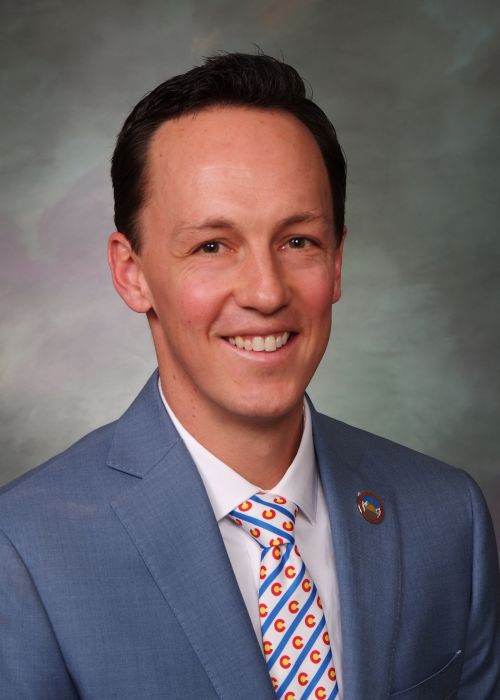
Sen. Dylan Roberts
Sponsored bills
The act requires each covered social media platform (covered platform) to impose a fee on each add-on transaction that occurs on the covered platform. The act creates the youth mental health services access enterprise in the behavioral health administration (BHA) to use the fee revenue to operate and fund programs that provide youth mental health services. The youth mental health services access enterprise constitutes an enterprise for purposes of section 20 of article X of the state constitution. The act defines a 'covered platform' as a sole proprietorship, a partnership, a limited liability company, a corporation, an association, or another legal entity, or an affiliate thereof, that:Conducts business in this state;Generates revenue directly from add-on transactions conducted in an online gaming service, product, or feature;Generates a majority of its annual revenue from online gaming services, products, or features;Publishes one or more online gaming services, products, or features that are reasonably likely to be accessed by a youth;Collects users' personal data or has users' personal data collected on its behalf; andDetermines the purposes and means of the processing of users' personal data. The act defines an 'add-on transaction' as a transaction through which a player or participant in a video game accessed via an online gaming service, product, or feature acquires:An item or ability that provides the player or participant an advantage over other players or participants of the video game; orA feature that alters or enhances the video game as accessed by the online gaming service, product, or feature. The act creates the youth mental health services access enterprise fund, consisting of money credited to the fund as fee revenue, any money received from the issuance of revenue bonds, and any other money that the general assembly may appropriate or transfer to the youth mental health services access enterprise fund. Money in the youth mental health services access enterprise fund is continuously appropriated to the youth mental health services access enterprise. After deducting its administrative expenses, the youth mental health services access enterprise is required to allocate the remaining fee revenue credited to the fund as follows:40% to operate and fund the youth mental health peer navigator grant program, which program is created in the act;35% to operate and fund the crisis resolution team program, which program is created in the act; and25%, beginning January 1, 2028, to operate the existing youth mental health services program. The initial amount of the fee is 5% of the amount of the add-on transaction. On and after October 1, 2027, the youth mental health services access enterprise may adjust the amount of the fee. The act creates the youth mental health peer navigator grant program to award grants to entities that recruit and train young adults to provide prevention services, peer support, and system navigation to youth in schools or community-based settings. The act creates the crisis resolution team program to provide community-based de-escalation and stabilization services to youth who are experiencing high-acuity behavioral health crises and to their caregivers. Under current law, the BHA operates the youth mental health services program to facilitate access to mental health services, including substance use disorder services, for youth in response to mental health needs identified in an initial mental health screening through the program's web-based portal. The youth mental health services program reimburses providers for up to 3 mental health sessions with a youth. The act directs the youth mental health services access enterprise, rather than the BHA, to operate and fund the youth mental health services program beginning January 1, 2028. The act also allows the youth mental health services access enterprise to reimburse a provider for up to 6 mental health sessions with a youth. The act creates the youth programming and protections enterprise to:Award grants through the existing out-of-school time program grant program; andSupport the department of education's enforcement of educational rights on behalf of children. The youth programming and protections enterprise constitutes an enterprise for purposes of section 20 of article X of the state constitution. The act creates the youth programming and protections enterprise fund. In each state fiscal year, after the state treasurer has credited $8 million to the youth mental health services access enterprise fund, the state treasurer must credit any other money received as fees to the youth programming and protections enterprise fund. Under current law, the department of education administers the out-of-school time program grant program and the state board of education awards grants from the program, subject to available appropriations. The act directs the department of education to consult with the youth programming and protections enterprise in administering the out-of-school time program grant program, and the act directs the youth programming and protections enterprise to award grants from the program in consultation with the state board of education. The act also requires the out-of-school time program grant program to provide programming and services that support the mental health and well-being of children and youth. The act requires a covered platform to ensure that the purchase price for an online gaming service, product, or feature that is reasonably likely to be accessed by a minor to be listed in United States dollars at the point of sale. For the 2026-27 state fiscal year, the act appropriates:$294,984 to the department of revenue from the general fund;$26,500 to the department of law from reappropriated funds;$145,750 to the department of law from the youth mental services access enterprise fund created in the act; and$79,500 to the department of law from the youth programming and protections enterprise fund created in the act.(Note: This summary applies to this bill as enacted.)

Beginning June 1, 2027, a person convicted for the first time of certain offenses related to driving while under the influence of drugs or alcohol is required to hold an interlock-restricted license for a consecutive period of nine months following reinstatement of the person's driver's license prior to being eligible to obtain any other driver's license, except in limited circumstances. If a person's driving privileges have been revoked for one year or more because of a refusal related to certain offenses related to driving while under the influence of drugs or alcohol, current law authorizes the person to apply for early reinstatement with an interlock-restricted license after the driving privilege has been revoked for 2 months. Beginning June 1, 2027, the 2-month waiting period is repealed. Under current law, a financial assistance program (assistance program) is available to assist people who apply for an interlock-restricted license and are unable to pay the full cost of an approved ignition interlock device. The act restricts eligibility for the program to those who satisfy certain income criteria. A certified ignition interlock manufacturer (manufacturer) must provide a person who is eligible for the assistance program certain discounts on installation of, lease charges for, and removal of an interlock device. The manufacturer must provide certain information regarding the assistance program at the time the interlock device installation appointment is scheduled and when a person executes an interlock device lease or service agreement. The act appropriates $15,225 to the department of revenue to implement the act.(Note: This summary applies to this bill as enacted.)

The act creates a jury selection working group (working group) in the judicial department to identify best practices and make recommendations for statutory or rule changes to improve jury selection. The act details the working group's membership and duties, and requires the working group to submit a final report of the working group's recommendations to the judiciary committees of the house of representatives and the senate and to each supreme court justice. If recommendations for rule changes are made, the Colorado supreme court shall respond to the recommendations and post the response on its website for public access.(Note: This summary applies to this bill as enacted.)
The act extends for an additional 10 years the availability of the state income tax credit allowed to a taxpayer who makes a qualifying monetary contribution to promote child care in the state equal to 50% of the total value of the contribution, not to exceed $100,000, through income tax years commencing prior to January 1, 2038.(Note: This summary applies to this bill as enacted.)
The act makes the following changes to the 'Labor Peace Act':Specifies that employees' right to bargain collectively includes the right to bargain collectively concerning any mandatory subject of bargaining;Eliminates the requirement for a second election to negotiate a union security agreement clause in the collective bargaining process;Declares that it is not an unfair labor practice for an employer to refuse to agree to a lawful proposal made by the exclusive representative of the employees, or for the exclusive representative of the employees to refuse to agree to a lawful proposal made by the employer, concerning a mandatory subject of bargaining if the refusing party has bargained in good faith with the other party; andRequires employers and employees, through their exclusive representative, to bargain in good faith.(Note: This summary applies to this bill as enacted.)
The act clarifies the conduct by which a person can commit criminally negligent homicide to include proximately causing the death of another person while operating or driving a motor vehicle with criminal negligence. The act repeals the class 1 misdemeanor traffic offense of a person being the proximate cause of death to another person while driving a motor vehicle, while clarifying it can be charged as a class 5 felony elsewhere in statute.(Note: This summary applies to this bill as enacted.)
The act:Increases the statewide base per pupil funding for the 2026-27 budget year by $208.60 to account for inflation;Sets a new statewide base per pupil funding amount for the 2026-27 budget year at $8,900.40; andSets the total program funding for the 2026-27 budget year at $10,178,856,871. Under current law, there are 2 total program formulas that are used to determine a school district's total program, commonly referred to as the old formula and the new formula. A school district's funded pupil count is a figure that is used as a part of determining a school district's total program. Under the new formula, for the 2026-27 budget year and each budget year thereafter, a school district's funded pupil count is calculated by determining the greater of the school district's pupil enrollment for the applicable budget year or the average of the district's pupil enrollment for the applicable budget year and the immediately preceding 2 budget years. However, the act requires that when specified conditions are met, a school district's funded pupil count is the school district's online pupil enrollment for the budget year, plus the school district's supplemental kindergarten enrollment for the budget year, plus the school district's extended high school pupil enrollment for the budget year, plus the greater of:The school district's pupil enrollment for the budget year;An amount equal to 50% of the school district's pupil enrollment for the budget year, plus an amount equal to 30% of the school district's pupil enrollment for the preceding budget year, plus an amount equal to 20% of the school district's pupil enrollment for the budget year that is 2 years preceding the budget year; orAn amount equal to 97% of the school district's pupil enrollment for the preceding budget year. A school district's cost of living factor is a figure that is used as a part of determining a school district's total program. Under the old formula and the new formula, the act requires the cost of living factor that was used for the 2025-26 budget year to apply in the 2026-27 budget year. Under current law, for the 2026-27 budget year, a district's total program is the greater of:The district's total program amount for the 2024-25 budget year; orThe amount calculated for the 2025-26 budget year under the old formula plus an amount equal to 30% of the difference between the amounts calculated between the old formula and the new formula. The act clarifies that for the 2026-27 budget year, if the calculation under the new formula is less than the calculation under the old formula, then that district's total program for the 2025-26 budget year is the greater of:The district's total program amount for the 2024-25 budget year under the old formula; orThe amount calculated for the 2026-27 budget year under the old formula. The act permits a school transformation grant recipient that is implementing a priority improvement or turnaround plan to use the grant award to plan for and implement rigorous redesign strategies. The act changes the provisions that determine the amounts of total program that school districts and the state charter school institute distribute to their charter schools. Related to the changes of these provisions, the act repeals at-risk supplemental aid for charter schools. The act exempts from a future repeal the general assembly's legislative declaration that using state education fund money for maintaining a website that explains major categories in the chart of accounts for local education providers is a permissible use of state education fund money. The act repeals the scheduled repeal of, resulting in a continuation of, a statute that authorizes contingency reserve fund payments to be used for rural or small rural school districts if an unusual financial burden would be caused by the withholding of local property taxes due to a delay in filing the audit report due to extraordinary problems that could not have been reasonably foreseen or prevented by the rural or small rural school district. The act adds an assistant superintendent, a vice principal, and an assistant principal to the list of eligible school employees who may receive a salary without a reduction in public employees' retirement association (PERA) benefits if the service retiree meets specified conditions. The act permits a local education provider to request that the department of education approve the local education provider's use of pencil and paper to complete any or every portion of a state assessment for grades 3 or 4 and requires that the local education provider be responsible for costs owed to the vendor that are associated with the administration of the assessment using pencil and paper. The act authorizes the state board of education to adopt rules that are necessary to determine the district of residence of a child with a disability for a circumstance that is not described under law. The act repeals the requirement that $500,000 be distributed to administrative units that enroll children with disabilities and instead requires that $1 million be distributed to fund reimbursements for administrative units that pay tuition or education expenses that ensure a free appropriate public education for a student in out-of-home placement who has an individualized education program. The act requires the department of education to engage stakeholders concerning public placements in facility schools and on the issue of whether to make recommendations concerning such placements to the state board of education regarding rules or to the general assembly regarding statutes. Under current law, each participating school food authority that satisfies certain requirements is eligible to receive a local food purchasing grant and an amount to increase wages or stipends for individuals employed to prepare and serve school meals. The act clarifies that a charter school that operates under a participating school food authority is eligible for the awards. The act:Prohibits a board of cooperative services (BOCES) from acting as a statewide authorizer of programs or schools; andLimits a BOCES to operating a school or program outside the geographic boundaries of its school district members, unless specified conditions are satisfied. The act permits a local education provider to offer one or more part-time programs for homeschool students if specified conditions are satisfied. The act requires an authorizer contracting with an education management provider to maintain appropriate independence from, and oversight of, the education management provider. The act prohibits a school district from creating a contract school that is a full-time complete educational program offered exclusively by a private entity pursuant to a contract with the public entity. The act appropriates:$3,755,558 to the department of education from the state education fund for the state share of districts' total program;$313,395 to the department of education from the state education fund for management and administration for information technology services and for use by school district operations for administration related to public school finance; and$3,385,203 to the department of education from the state education fund for school district operations for costs associated with holding charter schools harmless for changes in the distribution of total program funding. The act adjusts the 2026-27 long bill by decreasing:$8,502,195 from the appropriation from the state education fund to the department of education for the state share of districts' total program funding; and$3,504,995 from the appropriation from the state education fund to the department of education for use by school district operations for at-risk supplemental aid.(Note: This summary applies to this bill as enacted.)
The act makes changes to the dispute resolution process between health insurance carriers (carriers) and out-of-network health-care providers (providers) by requiring a carrier to provide, with each payment made to a provider, a remittance advice that: Identifies when the associated health benefit plan is regulated by the state and when the payment is made pursuant to services received from an out-of-network provider or at an out-of-network facility; andProvides the carrier's median in-network reimbursement rate for out-of-network claims.(Note: This summary applies to this bill as enacted.)
Beginning on January 1, 2027, the act authorizes an optional collision prevention fee (fee), which is collected at the time of registration of a passenger motor vehicle, light-weight truck, motorcycle, or recreational vehicle (motor vehicle). An individual may decline to pay the fee when registering a motor vehicle, and nonpayment of the fee does not affect the individual's ability to register the motor vehicle. In connection with imposing the fee, the statewide bridge and tunnel enterprise (enterprise) within the department of transportation (department) is required to collaborate with:The department of revenue and county clerks to develop language to notify individuals about the fee, including explicit language regarding the ability to decline to pay the fee and the fact that nonpayment of the fee will not affect an individual's ability to register a motor vehicle; andThe department of revenue, the department, county clerks, the division of parks and wildlife, and other impacted stakeholders to conduct a public outreach campaign to educate the public about the fee and what benefits the fee will provide. The enterprise is required to initiate the public outreach campaign as soon as practicable and must develop and deliver customer-facing educational materials to county clerks on or before December 1, 2026.The fee amount is set at $5 and, beginning in state fiscal year 2028-29, the enterprise is allowed to adjust this fee amount upward for inflation. 75% of the revenue from the fee is credited to the newly created collision prevention fund (fund), which is continuously appropriated to the enterprise for use in the following ways:To fund wildlife safe passage projects, defined as one or more projects that reduce wildlife-vehicle collisions and improve habitat connectivity by providing wildlife road crossings;To provide matching money as required by federal grant programs relating to wildlife safe passage projects; To expend for administrative and personnel expenses related to those purposes; andTo promote the fee and fund to maximize participation in the optional fee, in collaboration with the department of revenue, impacted stakeholders, and interested organizations.In determining which wildlife safe passage projects the enterprise will undertake, the enterprise is required to:Consult with the division of parks and wildlife (division) and the Colorado wildlife and transportation alliance;Consult with the tribal government if the project is on or adjacent to tribal land;Consult with relevant local governments with jurisdiction over the area of the proposed project and any relevant local organizations engaging in work to reduce vehicle collisions;Consider studies concerning the prioritization of wildlife within the state;Consider whether the wildlife safe passage project is related to a bridge or tunnel project undertaken by the enterprise; andIn consultation with the division, consider opportunities for landowner agreements or additional conservation efforts that may be necessary to ensure the continued functionality of infrastructure associated with a proposed wildlife safe passage project. 25% of the revenue from the fee is credited to the wildlife cash fund and continuously appropriated to the division to provide services related to wildlife connectivity and wildlife crossing-related conservation efforts. The act also modifies the process for the keep Colorado wild pass fee, which is an existing optional fee paid at the time an individual registers a motor vehicle, to align with the process for the collision prevention fee by removing the presumption that an individual who declines to pay the keep Colorado wild pass fee is presumed to decline to pay that fee in subsequent years with respect to registration of the same motor vehicle. With this change, an individual must affirmatively opt out of the payment of both the keep Colorado wild pass fee and the collision prevention fee each year that the individual registers the motor vehicle. For the 2026-27 state fiscal year:$53,516 is appropriated from the DRIVES cash fund to the department of revenue for use by the division of motor vehicles; Of funds appropriated from the parks and outdoor recreation cash fund to the department of natural resources for use by the division, $778 is reappropriated to the department of revenue for use by the division of motor vehicles; and$19,940 is appropriated from the legal services cash fund, from revenue received from the department from the collision prevention fund, to the department of law to provide legal services for the department.(Note: This summary applies to this bill as enacted.)