

The act enacts the "Colorado Vending of Digital Assets Act", which requires an owner or operator of a virtual currency kiosk to: Provide certain disclosures to customers of the virtual currency kiosk; Provide each customer with an electronic receipt detailing the customer's virtual currency transaction; and Fully refund a customer's first virtual currency transaction if the virtual currency transaction is to a virtual currency wallet or exchange located outside of the United States and, within 60 days after the virtual currency transaction, the customer contacts the owner or operator of the virtual currency kiosk and a government or law enforcement entity regarding the fraudulent nature of the transaction and submits proof of the fraud. The act establishes a daily transaction limit of $2,000 for a new customer and $10,500 for an existing customer of a virtual currency kiosk. The act defines "virtual currency" as a type of digital unit that is used as a medium of exchange or a form of digitally stored value or that is incorporated into payment system technology. "Virtual currency kiosk" is defined as an electronic terminal acting as a mechanical agent of the owner or operator to enable the owner or operator to facilitate the exchange of virtual currency for other virtual currency or fiat currency. "New customer" is defined as a customer who has been a customer of a virtual currency kiosk for less than 7 days. (Note: This summary applies to this bill as enacted.)
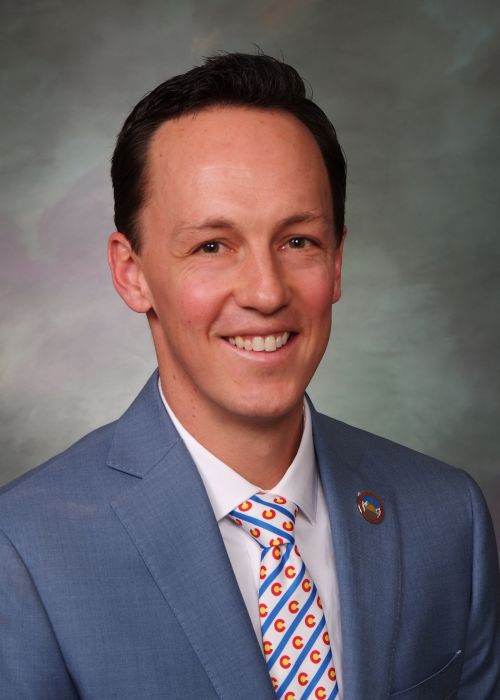
Sen. Dylan Roberts
Sponsored bills
The act continues the just transition advisory committee (advisory committee) until September 1, 2030. Prior to its repeal, the department of regulatory agencies will conduct a sunset review of the advisory committee. The act requires the just transition office in the department of labor and employment (office) to consult with the advisory committee on issues related to the impact of facility closures and job layoffs in coal-related industries in a manner that best ensures continued economic stability and prosperity for impacted workers and communities during and after the transition away from coal as an economic driver. The office is also directed to develop and implement plans to maximize the economic stability and prosperity of coal workers and communities. When the general assembly created the advisory committee in 2019, the advisory committee was required to develop a draft just transition plan (plan) before July 1, 2020. The act repeals obsolete references to the development of the plan and requires the director of the office to update the plan as needed. The act increases the number of coal transition workers appointed to the advisory committee from 3 to 5 and requires that at least one advisory committee member works at a coal mine and at least one member works at an electric utility. (Note: This summary applies to this bill as enacted.)
The act requires the following regarding the application for a license to practice medicine in Colorado (application) and the questionnaire accompanying the form for a license renewal (questionnaire): The Colorado medical board (board) must consider the recommendations of the Federation of State Medical Boards and the requirements of the federal "Americans with Disabilities Act of 1990" when developing the application questions; The application and questionnaire must not require the disclosure of personal medical or health information that is not relevant to the applicant's ability to provide safe, competent, and ethical patient care at the time of application; The application and questionnaire must not include questions seeking information about past health-related conditions that do not impact an applicant's ability to practice safe, competent, and ethical patient care at the time of application; and The board shall include information in the application about the board's peer health assistance program, the applicant's ability to self-refer to the peer health assistance program at any time, and the applicant's ability to self-refer in lieu of disclosure to the board. The act clarifies that an individual subject to the licensing requirements of the "Colorado Medical Practice Act" is not required to disclose a physical illness, physical condition, behavioral health disorder, mental health disorder, or substance use disorder that no longer impacts the individual's ability to practice the applicable health-care profession or occupation with reasonable skill and safety to patients or clients. Current law requires that if a health-care professional has a physical illness, physical condition, or behavioral or mental health disorder that renders the person unable to practice the applicable health-care profession or occupation with reasonable skill and safety to patients or clients, the licensee, registrant, or certificate holder shall notify the regulator that regulates the person's profession or occupation of the physical illness, physical condition, or behavioral or mental health disorder. The act requires that a health-care professional must additionally provide notice of a substance use disorder and specifies that the health-care professional is required only to provide notice of a current physical illness, physical condition, behavioral health disorder, mental health disorder, or substance use disorder. (Note: This summary applies to this bill as enacted.)
The "Identity Theft and Financial Deterrence Act" was set to repeal September 1, 2025. The act implements the department of regulatory agencies' recommendations to: Continue the "Identity Theft and Financial Fraud Deterrence Act" until September 1, 2036; Repeal the identity theft and financial fraud board; and Repeal the current cash fund funding structure; allow appropriation of money from the general fund to the department of public safety (department); and allow the department to accept gifts, grants, and donations to staff the Colorado investigators unit. For the 2025-26 state fiscal year, the act appropriates $653,345 from the identity theft and financial fraud fund to the department for use by the Colorado bureau of investigation and decreases appropriations made to the department for use by the Colorado bureau of investigation from the identity theft and financial fraud fund by $653,345. Money appropriated to the department to staff the Colorado investigators unit is subject to available appropriations. (Note: This summary applies to this bill as enacted.)
The act codifies the federal "Indian Child Welfare Act of 1978" into state law as the "Colorado Indian Child Welfare Act" (CO-ICWA) and provides additional protections for Indian children and children known or determined to be Indian children under state law. (Note: This summary applies to this bill as enacted.)
Section 1 of the act amends the state public financing cash fund (fund) statute in 2 ways. First, the act removes the limit on the amounts included in the issuance or incurrence of certain financial obligations by the state that the state treasurer credits to the fund. Second, the act modifies the fund so that bond counsel approval is no longer needed before money in the fund is used to reimburse the state treasurer for certain verifiable costs. Section 2 allows the state treasurer to use a security token offering for state capital financing and adopt rules as necessary to do so. Section 3 creates a new special purpose authority: The building urgent infrastructure and leveraging dollars authority (authority). The authority's primary purpose is to finance infrastructure projects that are ready for construction or commencement. As used in this context, an infrastructure project includes the development, construction, repair, improvement, operation, maintenance, decommissioning, or ownership of: A transportation infrastructure project, an infrastructure project in a transit-oriented community, a county courthouse facility, a transportation facility; utility infrastructure; renewable energy infrastructure; recycling infrastructure; energy efficiency infrastructure; an education facility; water infrastructure; information technology capital construction; affordable and accessible housing infrastructure; or digital, social, or other infrastructure related to economic development. The powers of the authority are vested in a 13-member board with the following membership: The state treasurer or the state treasurer's designee; The state architect or the state architect's designee; The chair of the capital development committee of the general assembly or any successor committee; A member of the capital development committee of the general assembly or any successor committee who is the longest serving member on the committee and who is a member of the major political party other than the party of the chair of the committee; A representative of a statewide organization representing counties, appointed by the governor; A representative of a statewide organization representing municipalities, appointed by the governor; The executive director of the Colorado education and cultural facilities authority or their designee; A representative of a statewide organization of general and specialty commercial construction contractors, appointed by the governor; A representative of a statewide employee organization representing building and construction trade workers, appointed by the president of the senate; An individual representing service employees, appointed by the state treasurer; An individual with a background in finance who has experience with pension fund management, appointed by the state treasurer; and An individual with a background in commercial lending representing an institution insured by the federal deposit insurance corporation, appointed by the state treasurer. The state treasurer or the state treasurer's designee serves as the chair of the board and is required to call the first meeting of the board no later than January 1, 2026. Among other powers, the authority may: Make and execute agreements, contracts, and other instruments as necessary to achieve the authority's purposes, including contracting with the officers, personnel, and consultants of the state treasurer to achieve its purposes; Charge to and collect from state agencies and persons fees and charges in connection with the authority's loans or other services; Issue and sell building urgent infrastructure and leveraging dollars bonds, payable solely from the building urgent infrastructure and leveraging dollars bonding fund created within the authority; Invest and deposit money; Finance or participate in the financing of eligible projects or any interest in such a project; except for projects that are within the statutory authority of the Colorado housing and finance authority; and Facilitate the funding of infrastructure projects. The infrastructure and long-term development assistance program (program) is created in the authority to allow the authority to provide financing for eligible projects. The act requires the authority to develop policies and procedures necessary to implement the program. At a minimum, the policies and procedures must specify application criteria, an application process, and a selection process for the authority to determine which eligible projects it will finance or assist in financing through the program. The authority must pay for such financing out of the eligible project revolving fund created in the authority. The act also requires that the authority allow the Colorado educational and cultural facilities authority a right of first refusal for the financing of eligible projects. (Note: This summary applies to this bill as enacted.)
The act clarifies that, under current law, the department of public health and environment may use up to 10% of appropriated money to administer and manage project grants concerning public water systems and wastewater treatment works in small communities. (Note: This summary applies to this bill as enacted.)
The act creates 2 income tax subtractions for income tax years commencing on or after January 1, 2027, but before January 1, 2038. The first subtraction is for an amount equal to state capital gains that are realized by a taxpayer, who is the owner of a qualified business, during the taxable year for the conversion by an increment of at least 20% ownership to a qualified employee-owned business. The taxpayers that are eligible for this subtraction are the same taxpayers that would be eligible for the tax credit for conversion costs for employee business ownership. The total amount of capital gains that a taxpayer may subtract is set by and may be annually adjusted by the Colorado office of economic development (office), and is required to be posted on the office's website. The second subtraction is allowed to worker-owned cooperatives in an amount equal to the worker-owned cooperative's federal taxable income for the tax year not to exceed $1 million. The act also makes changes to the tax credit for conversion or expansion costs for employee business ownership (credit), which has been available through income tax year 2026. The act extends the credit through income tax years commencing in 2031. The act also specifies that the aggregate amount of credits that can be claimed for each income tax year commencing on or after January 1, 2026, but before January 1, 2032, is $3 million. The act also increases the percentage of conversion or expansion costs that are eligible to be claimed for the credit from 50% to 75% beginning in tax year 2026 while maintaining the existing dollar caps for the different methods of conversion. Additionally, the act revises several definitions to expand eligibility for the credit and allows for qualified support entities, which are businesses or nonprofit organizations that provide services to businesses that qualify under the credit so that those businesses can convert or expand to employee ownership, to be eligible to receive the credit for up to 75% of the costs incurred for providing such support, not to exceed $167,000, including for staff salaries and benefits, marketing and outreach, and consulting and technical assistance. Support costs exclude any costs that are considered conversion or expansion costs that can be claimed in the credit for employee business ownership. (Note: This summary applies to this bill as enacted.)
The act authorizes a county, special district, or school district to negotiate property tax relief with a taxpayer that establishes or expands a "qualified communication services facility", which is a facility or other real or personal property used in the provision of fixed broadband or mobile broadband internet access service, if the facility will serve an unserved or underserved area of the county, special district, or school district. The act sets limits and standards for the tax relief. The act also amends the legislative declaration for the statute establishing a sales tax refund for rural broadband service providers by: Stating that requirements to pay sales and use tax on federal-funded and state-funded broadband deployment reduce the efficacy and impact of the federal and state deployment grant money; Noting that wireless telecommunications technologies rely on forms of broadband infrastructure like fiber and landline networks and are, therefore, interconnected to broadband; and Including a tax preference performance statement for the sales tax refund indicating that a purpose of the sales tax refund is to incentivize private sector investment in broadband infrastructure.(Note: This summary applies to this bill as enacted.)
Under the federal 340B drug pricing program (340B program), a covered entity, including certain hospitals, programs, and federally qualified health centers (covered entity), that serves patients with low income receives discounted outpatient drugs (340B drugs) from manufacturers that participate in the federal medicaid and medicare programs. Unless the receipt of 340B drugs is prohibited by the federal department of health and human services, the act prohibits a manufacturer, third-party logistics provider, or repackager in this state, or an agent, contractor, or affiliate of those entities, including an entity that collects or processes health information, from directly or indirectly denying, restricting, prohibiting, discriminating against, or otherwise limiting the acquisition of a 340B drug by, or delivery of a 340B drug to, a covered entity, a pharmacy contracted with a covered entity, or a location otherwise authorized by a covered entity to receive and dispense 340B drugs. The act also prohibits a manufacturer from directly or indirectly requiring a covered entity, a pharmacy contracted with a covered entity, or any other location authorized to receive 340B drugs by a covered entity to submit any health information, claims or utilization data, or other specified data that does not relate to a claim submitted to certain federal health care programs, unless the data is voluntarily furnished or required to be furnished under federal law. The act defines "340B savings" as the difference between the aggregated market rate costs and the aggregated acquisition costs for 340 B drugs. Certain hospital covered entities are prohibited from using 340B savings for certain purposes. A violation of the prohibitions in the act is an unfair or deceptive trade practice under the "Colorado Consumer Protection Act" (protection act), and the violator is subject to the enforcement provisions and penalties contained in the protection act. In addition, a person regulated by the state board of pharmacy (pharmacy board) that violates the provisions of the protection act may be subject to discipline by the pharmacy board against the person's license, certification, or registration, as well as other penalties. The act requires certain hospital covered entities to annually report to the department of health care policy and financing certain information concerning 340B savings and costs relating to providing charity care. (Note: This summary applies to this bill as enacted.)