

The act establishes and modifies requirements related to the practice of veterinary medicine by a veterinary professional associate (VPA). In November 2024, voters in Colorado approved Proposition 129, which established the role of VPAs and permits VPAs, starting on January 1, 2026, to practice veterinary medicine under certain circumstances. The act specifies how an individual can register as a VPA in Colorado and clarifies the circumstances under which a VPA can practice veterinary medicine. The act clarifies that a VPA is only permitted to practice veterinary medicine under the supervision of a licensed veterinarian. A licensed veterinarian shall supervise no more than 3 VPAs who are practicing veterinary medicine at any one time. The act requires a licensed veterinarian and a VPA to enter into a mutual supervisory agreement before the licensed veterinarian and the VPA begin working together. The supervising licensed veterinarian may delegate the practice of veterinary medicine to the VPA if: The aspects of the practice are within the training, experience, and competency of the VPA; The practice of veterinary medicine delegated to the VPA is permitted under requirements of state law and board of veterinary medicine (board) rules; and The supervising licensed veterinarian and VPA are located at the same veterinary premises while practicing veterinary medicine, unless the VPA meets certain indirect supervision requirements. The act instructs the board to adopt rules regarding the practice of veterinary medicine by VPAs, including rules that: Require a VPA to practice veterinary medicine under an appropriate level of supervision by a licensed veterinarian; Determine clinical benchmarks that a VPA must meet in order to practice veterinary medicine under indirect supervision by a licensed veterinarian; Approve a nationally recognized VPA credentialing organization that requires a VPA to complete a university-approved VPA program that is approved by the board or a university-approved VPA program that is accredited by the nationally recognized credentialing organization, pass a VPA examination, and complete continuing education requirements; Provide guidance to supervising licensed veterinarians in their delegation of tasks to and supervision of VPAs; Determine a scope of practice for VPAs; Establish a registration fee for the registration of VPAs; and Determine continuing education requirements for VPAs. The board may also adopt rules establishing an equivalent registration pathway for a veterinary technician specialist to register as a VPA, which pathway considers the veterinary technician specialist's experience, education, and training as a substitute for the education requirements needed to register as a VPA and requires the veterinarian technician specialist to pass the same national credentialing exam as a VPA. The act requires a VPA to identify themself as a VPA to a client before practicing veterinary medicine on a patient. The act requires a licensed veterinarian to comply with certain restrictions when prescribing opioids and benzodiazepines. (Note: This summary applies to this bill as enacted.)
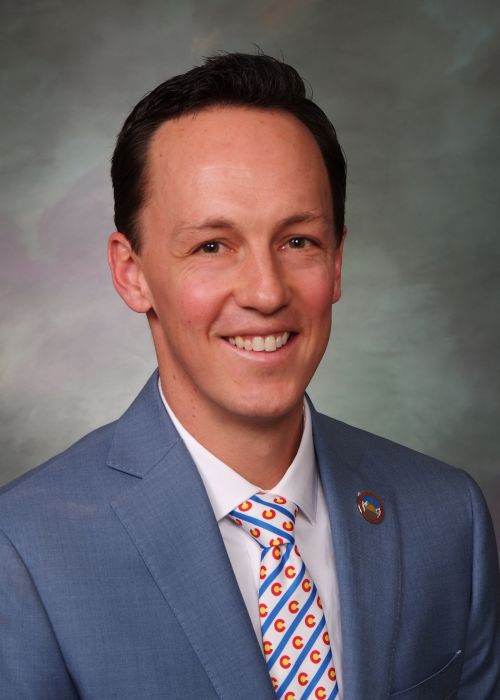
Sen. Dylan Roberts
Sponsored bills
Current law limits to 10 years the time a school district can lease district property not needed for its purposes. The act allows a school district to lease district property for any term of years for purposes of a solar field, energy storage system, or affordable housing. If a board of education of a school district leases or rents property for the purposes of an affordable housing project, the board of education shall develop a policy that defines affordable housing for the project. (Note: This summary applies to this bill as enacted.)
For state fiscal year 2025-26, the act appropriates $5,000,000 from the species conservation trust fund in the state treasury for various wildlife conservation programs directed at conserving candidate native species that have been listed as threatened or endangered under state or federal law or are species that are likely to become candidate species, as determined by the United States fish and wildlife service, as follows: $2,480,000 for the upper Colorado river endangered fish recovery program; $20,000 for selenium management, research, monitoring, evaluation, and control; $1,250,000 for native terrestrial wildlife conservation; and $1,250,000 for native aquatic wildlife conservation.(Note: This summary applies to this bill as enacted.)
The act implements the recommendations of the department of regulatory agencies (DORA) in its sunset review and report concerning the regulation of outfitters and guides by the division of professions and occupations (division) within DORA. Specifically, the act: Continues the regulation of outfitters and guides for 9 years, until 2034; Allows the director of the division to take disciplinary action against an owner of an outfitter entity regardless of the owner's ownership share percentage; Credits one-half of the money that is collected as fines to the general fund rather than to the division; Exempts motor carriers and third-party booking agencies from regulation under the outfitters act; Adds provisions prohibiting an individual from working as a guide or receiving or renewing a registration as an outfitter if the individual has a license or registration suspended or revoked by the division of parks and wildlife or by an agency of any member state of the "Wildlife Violator Compact" for a violation of a law concerning wildlife; and Repeals certain language concerning the punishment for a person that engages or offers or attempts to engage in activities as an outfitter without an active registration.(Note: This summary applies to this bill as enacted.)
The act establishes a sales and use tax exemption for contractors and subcontractors that purchase, store, use, or consume construction and building materials for use in the building, erection, alteration, or repair of structures owned and used by a regional transportation authority (authority) to house authority employees or contractors. The act authorizes an authority or an authority's board to build, erect, alter, or repair such structures for the purpose of housing employees or contractors of an authority. (Note: This summary applies to this bill as enacted.)
The act removes the term "homosexuality" from the definition of sexual conduct in the sexually explicit materials harmful to children part of the "Colorado Criminal Code". (Note: This summary applies to this bill as enacted.)
The act creates the strategic outdoor recreation management and infrastructure cash fund (infrastructure cash fund), requires a specified percentage of lottery fund money to be distributed to the infrastructure cash fund in state fiscal years when available lottery fund money exceeds $20 million, and continuously appropriates the money in the cash fund to the division of parks and wildlife for specified outdoor recreation and management purposes. The act also creates the outdoor recreation economic development cash fund (development cash fund); requires a specified amount and, in state fiscal years when available lottery fund money exceeds $20 million, an additional specified percentage, of lottery fund money to be distributed to the development cash fund; subject to annual appropriation, allows the outdoor recreation industry office to spend money from the development fund; and requires the following transfers to be made to the development cash fund on June 30, 2025: $176,830 from the damage prevention fund; $83,839 from the dispute resolution fund; $6,784 from the youthful offender system surcharge fund; $118,741 from the professional development center cash fund; $21,278 from the immunization fund; $83,354 from the family support services fund; $5,348 from the department of military and veterans affairs fund; $9,648 from the publications fund; $85,901 from the tax lien certification fund; $4,413 from the wholesale and distributing subcontractor license fund; $5,963 from the moving outreach fund; and $121,389 from the disabled parking education and enforcement fund. Law in effect before the passage of the act distributed, to the extent available, the first $3 million of the lottery fund to the outdoor equity fund, the next $3 million to the public school capital construction assistance fund, and any remaining money as follows: 25% to the wildlife cash fund; 25% to the parks and outdoor recreation cash fund; and 50% to the public school capital construction assistance fund. For the 2024-25 state fiscal year and each state fiscal year thereafter, the act redistributes, to the extent available, the first $4 million of the lottery fund to the outdoor equity fund, the next $3 million to the public school capital construction assistance fund, the next $750,000 to the development cash fund, and any remaining money as follows: If the total amount of lottery fund money available is $20 million or less: 50% to the public school capital construction assistance fund; 20% to the parks and outdoor recreation cash fund; 20% to the wildlife cash fund; and 10% to the outdoor equity fund; or If the total amount of lottery fund money available is more than $20 million: 50% to the public school capital construction assistance fund; 15% to the parks and outdoor recreation cash fund; 15% to the wildlife cash fund; 10% to the outdoor equity fund; 5% to the development cash fund; and 5% to the infrastructure cash fund. For state fiscal year 2025-26, the act appropriates $723,488 from the development cash fund to the office of economic development for use by the outdoor recreation industry office. If not fully expended in state fiscal year 2025-26, the appropriation remains available for expenditure for state fiscal years 2026-27 and 2027-28. (Note: This summary applies to this bill as enacted.)
The act creates the work-based learning consortium pilot program (pilot program) in the department of higher education (department). The purpose of the 3-year pilot program is to: Demonstrate the value of work-based learning in postsecondary curricula by studying the impact of industry-sponsored projects on course objectives and learning outcomes; Promote the adoption of work-based learning in higher education by working with faculty at institutions of higher education (institutions) that participate in the pilot program (participating institutions) to embed project-based learning opportunities into credit-bearing programs; Provide broader access to collegiate work-based learning for students; Measure the impact of work-based learning on participating students; and Learn how institutions can increase the value of postsecondary education through career exposure and preparedness. Pending the receipt of sufficient funds, the department shall convene a consortium (consortium) of representatives from participating institutions, the commission on higher education (commission), the department of labor and employment, the department of education, and a subject matter expert with experience implementing work-based learning. The consortium shall: Work with each participating institution's faculty to embed industry-sponsored projects in course curriculum that meet the work-based learning quality standards; Work with the department to determine the impact of industry-sponsored projects; Work with a third-party platform to connect faculty from participating institutions to employers for the purpose of developing high-quality, project-based learning opportunities for classroom instruction; Advise the commission on strategies to improve student access to high-quality, work-based learning opportunities for students based on participating faculty members' experience embedding industry-sponsored projects into curriculum; Develop best practices for institutions to expand access to work-based learning in the classroom through industry-sponsored projects; and Develop findings and recommendations. Subject to available appropriations, at the end of the pilot program, the act requires the consortium to complete and submit a report to the education committees of the house of representatives and the senate, or their successor committees. The report must include: A description of the consortium's findings and recommendations; Details on the consortium's impacts on participating institutions and the effects of creating additional work-based learning activities on students, faculty, and employers; and Recommendations for statutory changes, financial resources, department policy changes, and policy changes in institutions that are necessary to improve successful work-based learning opportunities for students in institutions. The department may seek, accept, and expend gifts, grants, or donations from private or public sources for the pilot program. The department shall transmit all gifts, grants, or donations to the state treasurer, who shall credit the money to the higher education work-based learning consortium fund (fund). If, by June 30, 2028, the money in the fund has never reached or exceeded $2 million dollars, the state treasurer shall return each grantor's or donor's gift, grant, or donation. On or before November 1, 2026, the commission shall recommend a list of terms used by institutions related to work-based learning to the Colorado workforce development council for inclusion in the talent development glossary (glossary). The purpose of the list of terms is to: Augment the glossary so that collegiate work-based learning activities are accurately reflected in statewide efforts to promote work-based learning; and Demonstrate to institutions relevant opportunities to participate in statewide efforts to promote work-based learning. On or before July 1, 2026, the commission shall work with institutions, the Colorado workforce development council, the department of education, the consortium, nonprofit organizations, industry associations, and businesses to develop recommendations on how to best embed work-based learning opportunities into current degree pathways. On or before December 31, 2026, the department shall work with institutions to identify which work-based learning activities are measurable and how to best report work-based learning activities. Institutions that are eligible for the work-study program may use work-study program money to cover the costs of work-based learning credits for students who are required to complete credit-bearing work-based learning requirements to graduate from an institution. The office of economic development (office) administers the universal high school scholarship program (program). The act allows the office to spend unexpended or unencumbered money appropriated in the 2023-24 state fiscal year through the 2025-26 state fiscal year without further appropriation. The act requires that expenditures for the administrative costs of the program not exceed $1.5 million. The act extends the date for the state treasurer to transfer all unexpended and unencumbered money in the universal high school scholarship cash fund from December 30, 2026, to June 30, 2027. (Note: This summary applies to this bill as enacted.)
Current law does not allow a voice court reporter to administer an oath or affirmation. The act adds voice reporters to the list of professionals who may administer an oath or affirmation. (Note: This summary applies to this bill as enacted.)
The act updates the ongoing schedule of annual fees imposed on retail food establishments, which fees are imposed to cover the cost of required health and safety inspections under current law. (Note: This summary applies to this bill as enacted.)